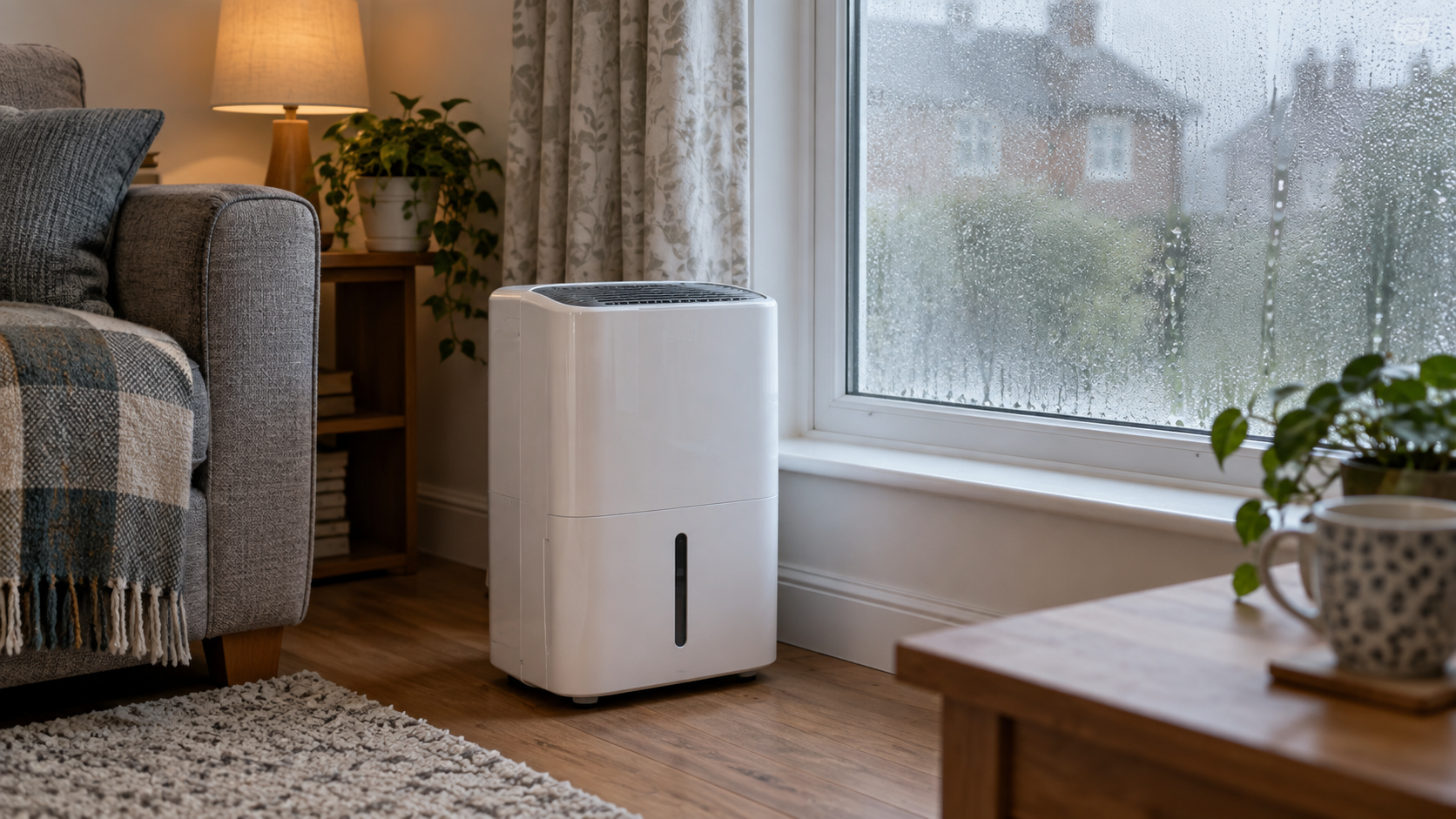
Dehumidifiers are the single most misunderstood appliance in the British home. Every autumn, thousands of households buy one in a panic when black mould appears on a bedroom wall, choose the wrong type, run it in the wrong place, and conclude the thing does not work. It almost always does work — it was simply the wrong machine, in the wrong room, on the wrong setting.
This guide explains how dehumidifiers actually behave in UK homes: why the headline litres-per-day figure on the box is close to meaningless, why compressor and desiccant models suit completely different houses, what running one really costs at current energy prices, and how to match a machine to your property rather than to a marketing claim.
The 60-second answer
If you want the short version: most UK households should buy a compressor dehumidifier rated 12–20 litres per day, with a humidistat and a laundry mode, for £120–£250. That covers condensation on windows, damp bedrooms, drying washing indoors and general winter humidity in a typical two- to four-bedroom home.
Buy a desiccant model instead if you need to dry an unheated garage, conservatory, caravan, boat or a cold hallway — anywhere that regularly drops below about 15°C. Avoid the tiny £30–£50 "mini" Peltier units entirely unless your only problem is a single damp wardrobe.
And ignore any dehumidifier sold purely on its litre rating. That number is measured in laboratory conditions no British home ever experiences, and comparing two machines on it alone will mislead you more often than it helps.
Do you actually need a dehumidifier?
A dehumidifier removes water vapour from the air. That makes it brilliant at one specific job — reducing condensation damp — and completely useless at two others.
British housing stock produces three distinct kinds of damp, and telling them apart before you spend anything is the most valuable five minutes in this guide.
Condensation damp
Warm, moist air meets a cold surface, the moisture drops out as liquid water, and mould follows within weeks. The signs are water pooling on window frames in the morning, black spotted mould in the corners of rooms and behind furniture on external walls, musty smells in wardrobes, and steamed-up windows after showers or cooking. Roughly four in five damp complaints in UK homes are condensation. This is exactly what a dehumidifier fixes.
Penetrating damp
Water getting in from outside — a cracked render, a blocked gutter, a failed window seal, a slipped roof tile. The tell is a damp patch that is worse after heavy rain, often with a defined edge, and usually on one wall rather than throughout the room. A dehumidifier will dry the air around it and slow the mould, but the water keeps coming. Fix the fabric of the building first.
Rising damp
Groundwater drawn up through masonry where a damp-proof course has failed or been bridged. It shows as a tide mark up to around a metre from the floor, sometimes with salt deposits. Genuine rising damp is far rarer than the damp-proofing industry suggests, but again, a dehumidifier treats the symptom and not the cause.
If your damp is worst in winter, appears on cold surfaces, and improves when you open a window, it is condensation and a dehumidifier is the right purchase. For a fuller diagnosis, our guide to whether a dehumidifier will stop condensation and mould walks through each case.
The three types of dehumidifier
There are only three technologies on the UK market, and the difference between them matters far more than the difference between two brands.
Compressor (refrigerant)
A compressor model works like a fridge in reverse. It draws air over a cold coil, the moisture condenses out into a tank, and slightly warmed, drier air comes out the other side. These are the mainstream choice: efficient, cheap to run, and quiet enough for living spaces.
Their weakness is temperature. Compressor efficiency falls away below roughly 15°C and collapses below about 10°C, because there is less moisture in cold air to condense and the coil can frost over. Better models include automatic defrost cycles, which help but cost you extraction time.
Desiccant
A desiccant model passes air over a rotating wheel coated in a moisture-absorbing material, then uses a small heater to drive the collected water off into the tank. Because it does not rely on condensation, performance barely changes when the room is cold — a desiccant unit works nearly as well at 5°C as at 20°C.
That makes them the correct answer for garages, conservatories, unheated spare rooms, static caravans, boats and holiday homes left empty over winter. They also warm the room by a couple of degrees as a side effect, which some people love and others find stuffy. The trade-off is electricity: a desiccant typically draws 300–650W continuously against roughly 150–350W for a comparable compressor. Our compressor vs desiccant comparison covers the decision in detail.
Peltier (thermoelectric "mini" units)
The £30–£50 units sold in their thousands each autumn use a thermoelectric plate rather than a compressor. They are near-silent and tiny, and they extract perhaps 250–750ml a day in ideal conditions — against 12,000ml for a mid-range compressor.
For a single wardrobe, a small bathroom cupboard or a caravan locker, that is genuinely useful. For a bedroom with streaming windows, it is money thrown away. Most one-star reviews of "dehumidifiers that don't work" are Peltier units bought for a job three sizes too big.
| Type | Best for | Works below 15°C? | Typical power draw | Typical price |
|---|---|---|---|---|
| Compressor | Heated homes, bedrooms, laundry drying | Poorly | 150–350W | £110–£280 |
| Desiccant | Garages, conservatories, caravans, cold rooms | Yes, barely affected | 300–650W | £150–£280 |
| Peltier mini | Wardrobes, cupboards, small lockers | Barely works at all | 25–75W | £25–£60 |
Why the litres-per-day figure misleads almost everyone
Every dehumidifier is sold on a headline number: 12L, 16L, 20L, 25L. Buyers reasonably assume this is how much water the machine pulls out of their home in a day. It is not.
That figure is an extraction rate measured in a test chamber, and the conditions used are warmer and far more humid than any occupied British house. Two standards are in circulation. The older one tests at 30°C and 80% relative humidity; the newer, more realistic one tests at 27°C and 60% RH. A machine advertised as "20L" under the first standard might be a 12L machine under the second — the same appliance, two different numbers, both technically honest.
A typical UK bedroom in February sits somewhere around 16–18°C and 65–75% RH. In those conditions, a nominal 20L compressor unit will realistically collect something like 5–9 litres a day, and a nominal 12L unit perhaps 3–5 litres. That is not a fault. It is the gap between the laboratory and your house.
Two practical consequences follow. First, never compare two dehumidifiers on litre rating unless both quote the same test standard — check the small print. Second, do not panic if your tank is not filling: in a house that is drying out successfully, collection should fall week by week.
What size dehumidifier do you need?
Sizing is about the volume of air, the amount of moisture being produced and how cold the space runs — not about floor area alone. Use the table below as a starting point, then size up one step if you dry washing indoors, have more than three occupants, or the property is poorly insulated.
| Property | Nominal rating | Notes |
|---|---|---|
| Single room, flat, studio | 10–12L | Plenty if it stays in one room |
| 1–2 bed house or flat | 12L | The most common sensible buy |
| 3 bed house | 12–20L | 20L if you move it between floors |
| 4+ bed or persistently damp house | 20–25L | Consider two smaller units instead |
| Unheated garage or conservatory | Desiccant, 7–10L | Litre rating matters less than cold performance |
| Wardrobe, cupboard, caravan locker | Peltier mini | Only for tiny enclosed volumes |
One counter-intuitive point: a larger unit is not more expensive to run in a given room. Because it reaches the target humidity faster and then idles, a 20L machine often uses less electricity over a day than a 12L one straining continuously. Oversizing costs you money at the till, not at the meter. Our dedicated guide on what size dehumidifier you need goes further into room-by-room sizing.
Budget bands: what your money buys
Under £80 — mini and entry units
Almost exclusively Peltier machines plus a handful of very small compressors. Fine for a wardrobe or a boat; a false economy for a room with condensation. No humidistat, tiny tanks, and often no automatic shut-off.
£80–£130 — basic compressors
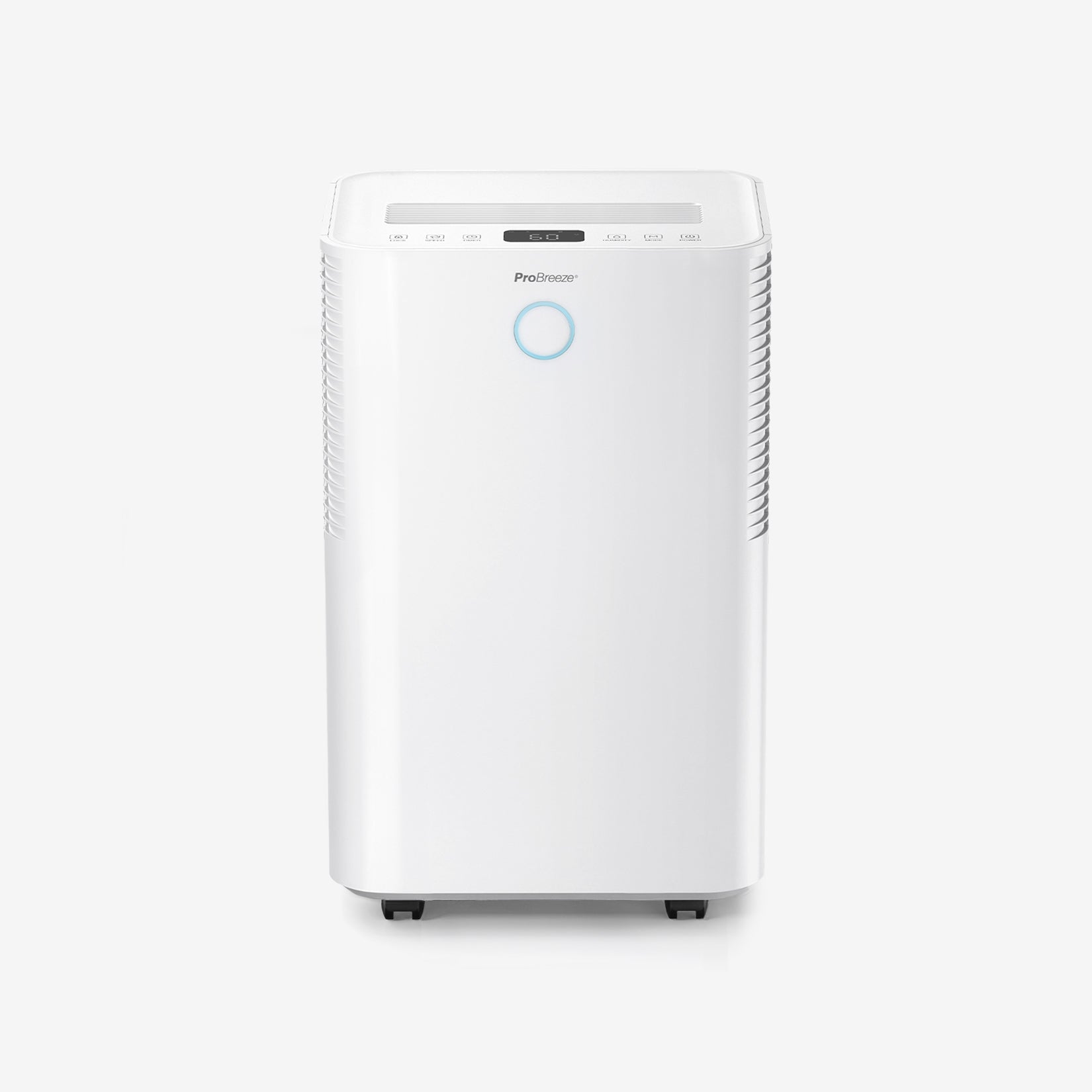
Where genuinely useful machines start. Expect 10–12L nominal, a 2–2.5 litre tank, a simple humidistat and perhaps a laundry mode. Build quality is plastic and the noise is noticeable, but the core job is done. Brands here include Pro Breeze, VonHaus, Devola and Igenix.
£130–£200 — the sweet spot
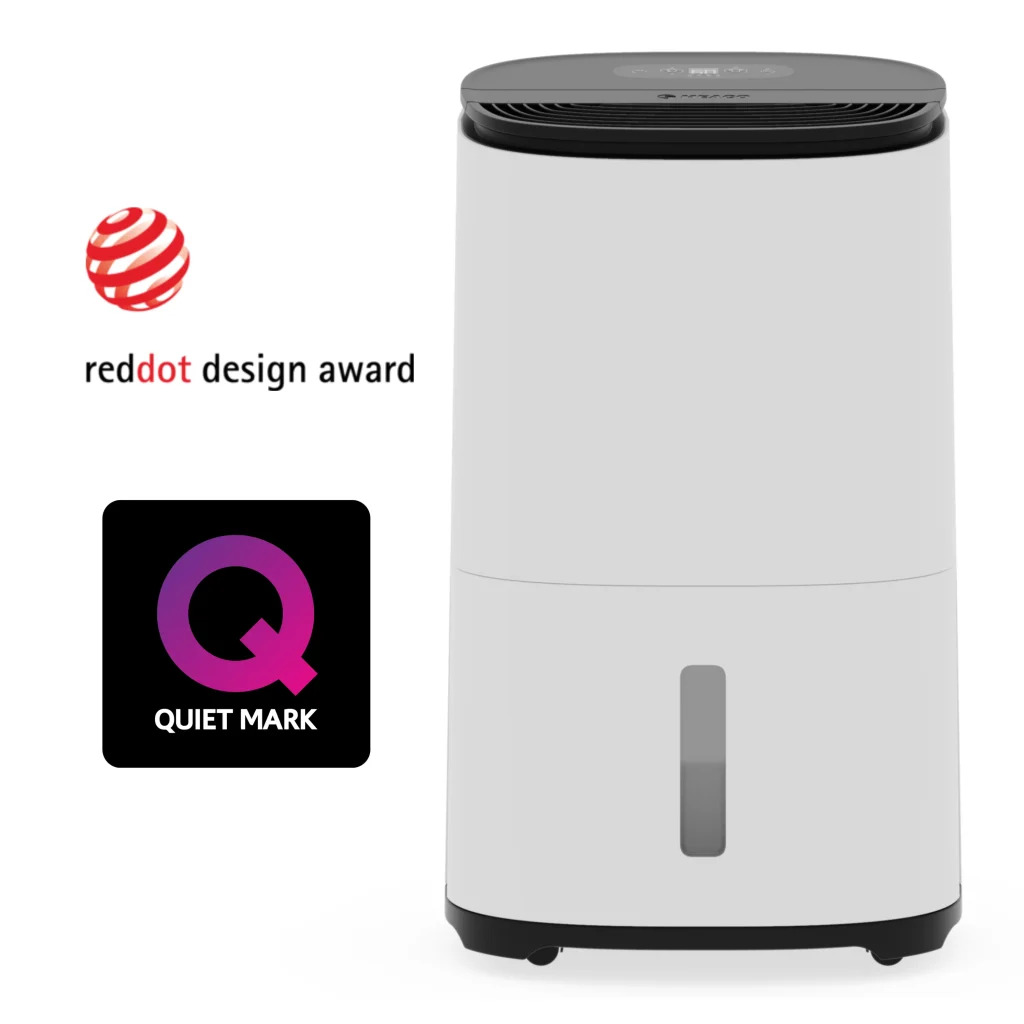
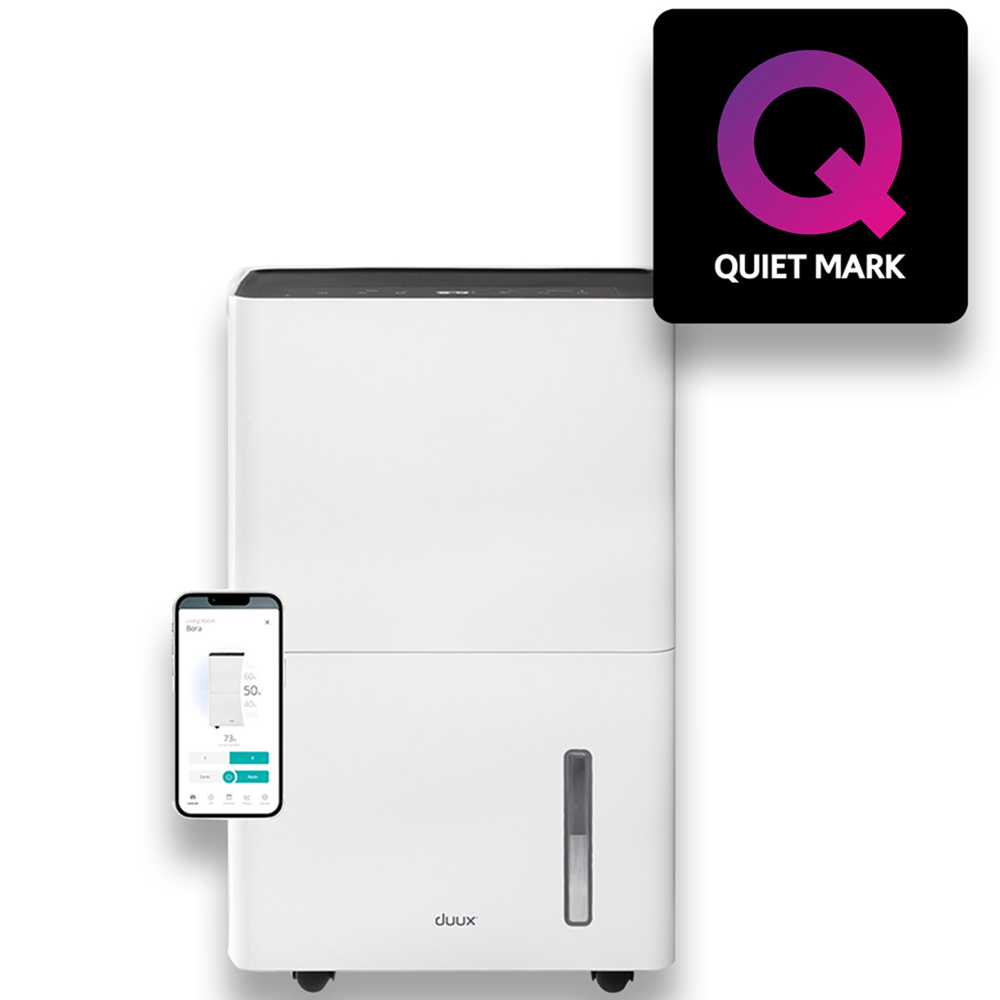
This is where most households should be shopping. You get 12–20L nominal extraction, a proper adjustable humidistat with 5% steps, a functioning laundry mode, a continuous drainage port, a 3-litre-plus tank, timers, and meaningfully quieter operation — typically high-30s to mid-40s decibels on low. Meaco, EcoAir and Duux compete hardest here.
£200–£300 — premium and specialist
Larger 20–25L capacities, better filtration including genuine HEPA on some models, app control, more sophisticated humidity sensing, quieter fans, and the good desiccant units. Also the band where you find dedicated laundry-focused machines with swing louvres that aim airflow at your airer.
Above £300 — whole-house and commercial
Ducted whole-house systems, building-drying units and crawl-space machines. Unless you are drying out a flood or a new build, you do not need this. If a builder has told you otherwise, get a second opinion first.
The specifications that actually matter
Humidistat (essential)
A humidistat lets the machine measure relative humidity and switch itself off at your target, then restart when it drifts back up. Without one, a dehumidifier runs flat out forever, over-dries the room and wastes electricity. Look for adjustment in 5% steps rather than vague "low/medium/high" settings. Target 45–55% RH in a home — below 40% and the air becomes uncomfortably dry.
Laundry mode (very useful)
Laundry mode overrides the humidistat and runs the fan at full speed to dry clothes as fast as possible. Combined with a closed door, this dries a full load overnight and keeps the moisture out of your walls. It is the single feature most likely to justify the purchase in a flat without outdoor drying space — see our guide to drying clothes with a dehumidifier.
Continuous drainage (underrated)
A port that takes a hose so the tank never needs emptying. Essential for garages, cellars and any unattended space, and a quiet luxury at home if you can run the hose to a drain or sink. Note that most units rely on gravity, so the machine has to sit above the outlet; only a few have a built-in pump.
Tank size (convenience, not performance)
Anything under 2 litres will need emptying daily in a damp house. Between 2.5 and 5 litres is comfortable. Tank size tells you nothing about how well a machine extracts — only how often you will be involved.
Noise (check the number, not the adjective)
Manufacturers quote the quietest setting. Under 40dB is genuinely quiet and fine in a bedroom. 40–45dB is noticeable but liveable. Above 50dB, you will not sleep next to it. Desiccants are usually a few decibels louder than compressors of the same capacity.
Low-temperature operation
If a compressor model is going in a cold space, check its stated minimum operating temperature and whether it has automatic defrost. Many list 5°C as a minimum but perform very poorly at anything under 12°C. If the room is regularly cold, this is the point at which you should switch to a desiccant.
Filtration and air purification
Most dehumidifiers have a washable dust pre-filter, which is all that is needed to protect the machine. Some add carbon or HEPA layers. Useful if you have allergies, but do not pay a large premium for "air purifying" claims — a dehumidifier is not a substitute for a proper purifier.
Specs that are mostly marketing
Ioniser functions, UV lamps, "silver nano" coatings and app control that only duplicates the front panel. None of these will make a measurable difference to damp in your home. Judge a machine on extraction in realistic conditions, humidistat quality, noise and running cost.
| Feature | How much it matters | What to look for |
|---|---|---|
| Humidistat | Essential | Adjustable in 5% steps |
| Laundry mode | High if you dry indoors | Full-speed override, ideally a louvre |
| Continuous drainage | High for unattended spaces | Hose included, gravity fall available |
| Noise rating | High for bedrooms | Under 40dB on low |
| Low-temp performance | Critical in cold rooms | Auto defrost, or buy desiccant |
| Tank size | Convenience only | 2.5L or more |
| HEPA / ioniser | Low | Nice to have, never the deciding factor |
What a dehumidifier really costs to run
This is the question that stops most people buying, and the fear is generally worse than the reality. Electricity is capped at roughly 25–27p per kWh for a typical direct debit customer, and the exact figure is published quarterly by Ofgem. The calculation below uses 26p.
| Machine | Power | Cost per hour | 8 hours a day | Six-month winter season |
|---|---|---|---|---|
| 12L compressor | 165W | 4.3p | 34p | £62 |
| 20L compressor | 300W | 7.8p | 62p | £113 |
| Desiccant (low setting) | 330W | 8.6p | 69p | £125 |
| Desiccant (high setting) | 650W | 16.9p | £1.35 | £247 |
| Peltier mini | 50W | 1.3p | 10p | £19 |
Two things temper those figures. A machine with a working humidistat spends much of its day idling rather than running, so real-world consumption in a house that is already reasonably dry is often half the table above. And a compressor returns some of its energy as gentle warmth, which marginally reduces heating demand in the same room.
Set against that, the alternative costs are worth remembering. A tumble dryer costs roughly 60p to £1.20 a cycle; treating a mould outbreak, replacing ruined plaster or losing a deposit costs a great deal more. Our detailed breakdown of dehumidifier running costs in the UK models several household scenarios.
Damp, mould and health — the part that matters most
Damp is not only a decorating problem. Mould spores and the house dust mites that thrive in humid air are established triggers for asthma, allergic rhinitis and respiratory infections, and the risk is greatest for children, older adults and anyone with an existing lung condition. The NHS sets out the health effects clearly in its guidance on whether damp and mould can affect your health.
Since the coroner's findings in the death of Awaab Ishak, the position for rented housing in England has hardened considerably. The government's damp and mould guidance for rented housing providers is explicit that damp and mould are not the fault of tenant "lifestyle", and that landlords must act. If you rent and have persistent damp, report it in writing, keep photographs with dates, and keep a copy of everything. A dehumidifier will help you live with the problem; it does not discharge your landlord's obligations.
For your own home, the practical target is 45–55% relative humidity. A £10 hygrometer is the best accessory you can buy alongside the machine, because it turns guesswork into a number.
Where to put it and how to run it
Placement changes results more than most people expect.
Put it in the room with the problem, and close the door. A dehumidifier treats the air it can reach. Left in a hallway with every door open, it will slowly work on the whole house and fix nothing quickly. Left in a damp bedroom overnight with the door shut, it will transform that room in a week.
Leave clearance all round. Most units draw air in at the back and exhaust at the front or top. Give them at least 20–30cm of space and keep them off curtains and out of corners.
Run it hard first, then maintain. A damp house needs a continuous first few days to pull the moisture out of soft furnishings and plaster. After that, a humidistat set to 50% will hold the line for a few hours a day.
Keep heating on low rather than off. Dehumidifiers work best in warmer air, and cold walls are what create condensation in the first place. Background heat plus a dehumidifier beats either alone.
Ventilate as well, not instead. Extractor fans in kitchens and bathrooms, trickle vents open, and a few minutes of window opening after showering all reduce the load on the machine.
Move it. One 20L unit rotated between bedrooms over a week is usually better value than two machines running permanently.
Maintenance
Dehumidifiers are undemanding, but neglect shortens their life and hurts extraction.
| Task | How often | Why |
|---|---|---|
| Empty the tank | As needed | Standing water grows bacteria; rinse weekly |
| Wash the dust filter | Every 2–4 weeks | A clogged filter is the top cause of poor extraction |
| Vacuum the rear grille and coils | Every few months | Dust insulates the coil and cuts efficiency |
| Replace carbon/HEPA filters | 6–12 months | Only on models that have them; budget £10–£25 |
| Store upright | Summer | Compressors need 12–24 hours upright before restarting if laid down |
How the main UK brands compare
These are general positioning notes based on each brand's published specifications, warranty terms and aggregated UK owner feedback, not our own laboratory testing.
Meaco
The default recommendation in the UK for good reason. A British company that specialises in humidity control, with strong humidistats, sensible laundry modes, quiet operation and a reputation for supporting products after sale. The Arete range covers the mainstream; the Zambezi desiccant is the go-to for cold spaces. You pay a modest premium over generic brands and generally get it back in reliability.
EcoAir
Meaco's closest UK rival, also humidity-focused. Strong on desiccants, good build quality, and often better value than Meaco on like-for-like specifications. Control panels can be less intuitive. Our Meaco vs EcoAir comparison sets the two head to head.
Pro Breeze
The volume seller at the budget-to-mid end. Competent compressors with the features most people need, at prices that undercut the specialists. Less refined, noisier, and the humidistat is less precise, but the value is real.
Duux
Dutch brand with a design-led approach, app control and unusually quiet fans. Attractive if the machine has to live in a visible part of the house. Prices sit at the top of the mainstream band.
Devola, VonHaus and Daewoo
Budget and mid-budget options that do the basics. Devola in particular has improved sharply and is worth a look around £120. Expect plainer controls, shorter warranties and more variability unit to unit.
Unbranded imports
The marketplace listings with invented brand names and dramatic litre claims. Some are rebadged versions of decent machines; many are Peltier units dressed up as something larger. Without a UK support route, a two-year-old failure is simply a write-off. If you buy here, buy cheap enough that you can accept losing it.
Independent testing is worth consulting too — Which? tests dehumidifiers under controlled conditions, which is the only way to compare extraction fairly.
Seven mistakes to avoid
1. Buying a mini Peltier unit for a whole room. The most common and most disappointing mistake. Match the technology to the size of the job.
2. Buying a compressor for a cold garage. It will frost, cycle and collect almost nothing. Cold spaces need a desiccant.
3. Comparing litre ratings across different test standards. A "20L at 30°C/80%" machine and a "20L at 27°C/60%" machine are not the same appliance.
4. Leaving doors and windows open while it runs. You are then dehumidifying the outdoors, at your expense.
5. Expecting it to fix penetrating or rising damp. Diagnose first. A dehumidifier cannot out-run water coming through a wall.
6. Skipping the filter clean. Extraction quietly halves and owners blame the machine.
7. Turning the heating off to "save money" while running it. Cold surfaces cause condensation. Low background heat plus a dehumidifier costs less overall than mould remediation.
A four-question decision framework
1. How cold does the space get? Regularly below 15°C means desiccant. Otherwise, compressor.
2. How big is the property, and will the machine move? One or two rooms, 12L. A whole three- or four-bed house, 20L on castors.
3. Do you dry washing indoors? If yes, laundry mode is non-negotiable and a swing louvre is worth paying for. Compare the options in our piece on dehumidifiers versus heated airers.
4. Where will it live? A bedroom demands sub-40dB. A garage demands continuous drainage. Answer those two and the shortlist writes itself.
The bottom line
For most British homes, a 12–20L compressor dehumidifier with a proper humidistat and a laundry mode, bought for £130–£200, is the right machine. Put it in the room with the problem, shut the door, aim for 50% relative humidity, keep a little background heat on and clean the filter once a month. Done that way, it will cost you somewhere between £60 and £120 across a winter, and it will do more for the comfort, smell and health of your home than almost anything else you could spend £150 on.
Buy a desiccant instead if the space is cold. Buy a mini only for a cupboard. And treat the number on the box as a guide to relative size, never a promise of litres in your hallway.
If you are planning to buy in the autumn sales, our notes on dehumidifier Black Friday deals cover what discounts are realistic.
Frequently asked questions
Should I leave a dehumidifier on all the time?
Not indefinitely. Run it continuously for the first few days to dry the property out, then switch to a humidistat setting of around 50% and let the machine decide when to run. In a stable home that usually works out at a few hours a day.
What humidity should I set my dehumidifier to in the UK?
Between 45% and 55% relative humidity. Below 40% the air feels dry and can irritate skin and airways; above 60% you are back in mould territory. A cheap hygrometer in the room lets you check the machine's own sensor is honest.
Will a dehumidifier get rid of mould that is already there?
It stops it spreading and prevents it returning, but it will not remove existing growth. Clean visible mould with a proprietary mould remover or a diluted bleach solution, wear gloves and a mask, ventilate while you work, then run the dehumidifier to keep the surface dry.
Is a dehumidifier cheaper than a tumble dryer?
Per load, usually yes. A dehumidifier drying a load on an airer overnight typically uses 20–50p of electricity against roughly 60p to £1.20 for a vented or condenser dryer cycle. Heat pump dryers narrow the gap considerably, and are faster.
Do dehumidifiers make a room warmer?
Slightly. A compressor raises the air temperature by around 1–2°C as a by-product. Desiccant models use a heater in the drying cycle and can raise it by 2–4°C, which is welcome in a cold garage and stuffy in a small bedroom.
Can I use a dehumidifier in a bedroom overnight?
Yes, provided the noise rating suits you — look for under 40dB on the lowest setting — and the unit has a full-tank auto shut-off. Most people set a humidistat target and a timer rather than running it flat out all night.
Why is my dehumidifier not collecting any water?
Usually one of four things: the room is already at the target humidity and the machine is idling; the air is too cold for a compressor model; the filter is clogged; or the unit is undersized for the space. Check the humidity with a separate hygrometer before assuming a fault.
How long do dehumidifiers last?
A decent compressor unit that is kept clean should give five to ten years of seasonal use. Budget machines often fail at three to five. Desiccant wheels degrade slowly and typically last a similar span to a good compressor.