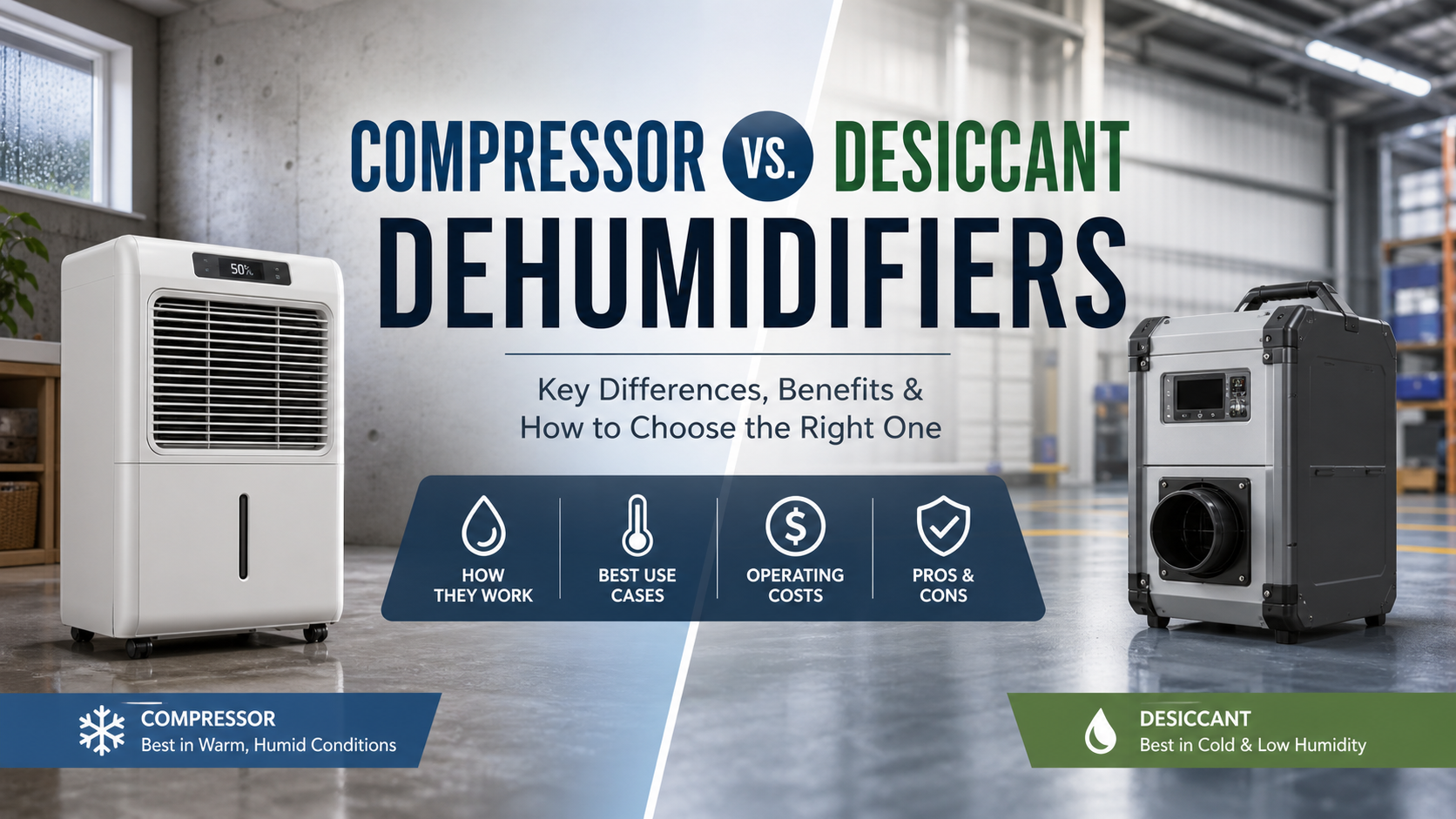
Every dehumidifier buying guide mentions the terms "compressor" and "desiccant" as if you already know the difference. Most people don't, and it matters — buying the wrong type for your situation means either wasting electricity or getting a machine that barely works. This guide explains how each type actually works, when one genuinely outperforms the other, and which you should buy for your home.
How a compressor dehumidifier works
A compressor dehumidifier works like a fridge. A refrigerant circulates through coils inside the unit. Warm, damp air from your room is drawn in by a fan and passed over cold coils, where the moisture condenses into water droplets — exactly the way condensation forms on a cold window. The water drips into a tank, and the now-dry air passes over warm coils on its way back out, returning to the room at roughly the same temperature.
Because the process relies on cooling the air to its dew point, compressor models work best in warm, humid conditions — typically above 15°C. Below about 10°C, the coils start to ice up and the machine has to run defrost cycles, which dramatically reduce its extraction rate. Below 5°C, most compressor units are essentially useless.
The big advantage is energy efficiency. A typical compressor dehumidifier draws 150–250W, which at current UK electricity rates (around 24.5p per kWh under the Ofgem price cap) costs roughly 4–6p per hour to run. Our full breakdown of dehumidifier running costs compares both types over a whole damp season.
How a desiccant dehumidifier works
A desiccant dehumidifier uses no refrigerant and no cold coils. Instead, a slowly rotating wheel of moisture-absorbing material (the desiccant — typically zeolite) passes through the incoming airstream. The desiccant absorbs moisture from the air. The wheel then rotates into a heated section, where a small internal heater drives the moisture back out of the wheel and into a condenser, where it collects as water in the tank.
Because there are no coils to freeze, desiccant models work at any temperature — right down to 1°C or even below. Their extraction rate stays consistent regardless of how cold the room is, which is why they're the only realistic option for garages, basements, conservatories, caravans and boats.
The trade-off is power consumption. That internal heater typically draws 500–670W, costing roughly 12–16p per hour. That's 2–3 times more than a compressor model. The exhaust air is also noticeably warmer — typically 10–12°C above room temperature — which is a positive for drying laundry or warming a cold room, but unwanted in summer. If summer heat is the problem you actually want to solve, our guide to portable air conditioner running costs covers the cheaper alternative.
The head-to-head comparison
| Factor | Compressor | Desiccant |
|---|---|---|
| Best temperature range | 15–35°C | 1–35°C |
| Power consumption | 150–250W | 500–670W |
| Running cost per hour | 4–6p | 12–16p |
| Extraction rate (warm room) | Higher | Lower |
| Extraction rate (cold room) | Very poor | Consistent |
| Noise level | 35–42 dB (quieter) | 36–47 dB (varies) |
| Weight | 10–15 kg (heavier) | 7–8 kg (lighter) |
| Exhaust air temperature | Neutral | 10–12°C warmer |
| Best for | Heated living spaces | Cold/unheated spaces, laundry |
When to buy a compressor dehumidifier
A compressor model is the right choice for the majority of UK households. If your dehumidifier will live in a heated room — a bedroom, living room, hallway or kitchen — a compressor is more efficient, quieter, and cheaper to run. The energy savings add up significantly over a year.
Compressor dehumidifiers are also the better choice if you want one primarily for:
- Condensation on windows. In a heated home, condensation is caused by warm, moist indoor air hitting cold glass. A compressor dehumidifier in the affected room will reduce relative humidity and stop the condensation forming.
- Preventing mould in a heated property. Mould needs sustained humidity above about 60% relative. A compressor model with a humidistat set to 50–55% will keep humidity below mould-growth levels for a fraction of the cost of a desiccant running continuously.
- General air quality. Several compressor models now include HEPA air purifiers, which filter pollen, dust and fine particles alongside the dehumidification. Desiccant models rarely offer this.
When to buy a desiccant dehumidifier
A desiccant model is the right choice in a narrower set of situations — but in those situations, it's the only choice that will actually work.
- Garages, sheds and workshops. Unheated and often poorly insulated. Temperatures regularly drop below 10°C in winter, which is where compressor models fail.
- Basements and cellars. Often the coldest room in the house, with limited ventilation and persistent damp. A desiccant model will extract moisture reliably year-round.
- Unheated conservatories. Glass rooms lose heat rapidly in autumn and winter. A compressor dehumidifier will frost up within hours; a desiccant won't.
- Caravans, motorhomes and boats. Lightweight (7–8 kg vs 10–15 kg for compressor), effective in cold or unheated environments, and the warm exhaust air is a genuine bonus in a small, cold space.
- Drying laundry in a cold room. The warm exhaust air from a desiccant actively helps dry clothes, making it more effective than a compressor for this specific task — especially in an unheated utility room or spare bedroom.
The running cost difference over a year
This is where the choice gets practical. Assume you run a dehumidifier for 6 hours a day, 200 days a year (a realistic pattern for a UK home with persistent damp or regular laundry drying):
| Type | Typical wattage | Hourly cost | Annual cost (1,200 hours) |
|---|---|---|---|
| Compressor (200W) | 200W | 4.9p | £58.80 |
| Desiccant (600W) | 600W | 14.7p | £176.40 |
That's a £117.60 per year difference. Over a 5-year lifespan, you'd pay roughly £588 more to run a desiccant. That's a real number, and it's the main reason you should not buy a desiccant for a heated living room just because a review said it was good — it may well be excellent, but it'll cost you three times as much in electricity for no meaningful benefit in a warm space.
Desiccant models also use their humidistats less aggressively. The heater element draws 500W+ regardless of humidity level, whereas a compressor model's consumption drops significantly once the target humidity is reached and the compressor cycles off. Real-world compressor costs are often 20–30% lower than the table suggests, because the humidistat prevents continuous running.
What about the noise?
Compressor dehumidifiers are generally quieter — the best models operate at 35–38 dB, which is barely audible. The compressor itself produces a low hum, similar to a quiet fridge.
Desiccant models don't have a compressor, so there's no hum — but the fan and rotating wheel create a different kind of noise, often a steady airflow sound at 36–47 dB. Some people find the consistent fan noise less intrusive than a compressor cycling on and off, which is a fair point. If you're noise-sensitive, check the dB rating of the specific model rather than assuming one type is quieter than the other.
Can you use a compressor dehumidifier in a cold conservatory?
Technically yes, if it has an auto-defrost function — and most modern ones do. The machine will detect ice forming on the coils, pause the compressor, run the fan to defrost, then restart. The problem is that in a cold room, this cycle happens constantly. The unit spends more time defrosting than dehumidifying, extraction drops to a fraction of its rated output, and you're paying to run a machine that's barely doing its job.
If the room drops below 10°C regularly, a desiccant is simply the right tool for the job. Trying to make a compressor work in a cold space is false economy.
What about health and allergies?
Both types reduce humidity, which reduces dust mite populations, mould spore counts and the musty smell associated with damp homes. The NHS notes that house dust mites and mould are common triggers for allergic rhinitis and asthma, and controlling indoor humidity is one of the recommended management strategies.
If allergies are your primary concern, a compressor model with a built-in HEPA filter offers the most benefit — it removes moisture and filters airborne particles in one pass. The MeacoDry Arete One range includes medical-grade HEPA H13 filtration, which is the same standard used in hospital air systems.
The simple decision
In most cases, the choice is straightforward:
- Heated room (bedroom, living room, kitchen, hallway)? Buy a compressor. It's cheaper to run, quieter, and more efficient in warm air.
- Cold or unheated space (garage, basement, conservatory, caravan)? Buy a desiccant. It's the only type that works reliably below 10°C.
- Laundry drying in a cold spare room? Desiccant. The warm exhaust air actively helps dry clothes.
- Laundry drying in a heated room? Either works. A compressor is cheaper to run; a desiccant dries slightly faster.
- Both heated and unheated rooms? A compressor for the main house and a small desiccant for the garage or conservatory is the ideal setup if budget allows. If you can only buy one, a desiccant is the more versatile option — it works everywhere, just at a higher running cost.
If you're still working out whether a dehumidifier is even the right answer to your damp problem, start with our guide to whether a dehumidifier stops condensation and mould — it covers how to tell condensation apart from rising or penetrating damp, which changes the solution entirely.
The worst decision is buying the cheapest model without checking the type. A cheap desiccant in a warm living room costs three times more to run than a cheap compressor — and a cheap compressor in a cold garage does essentially nothing. Get the type right first, then choose on features and price.