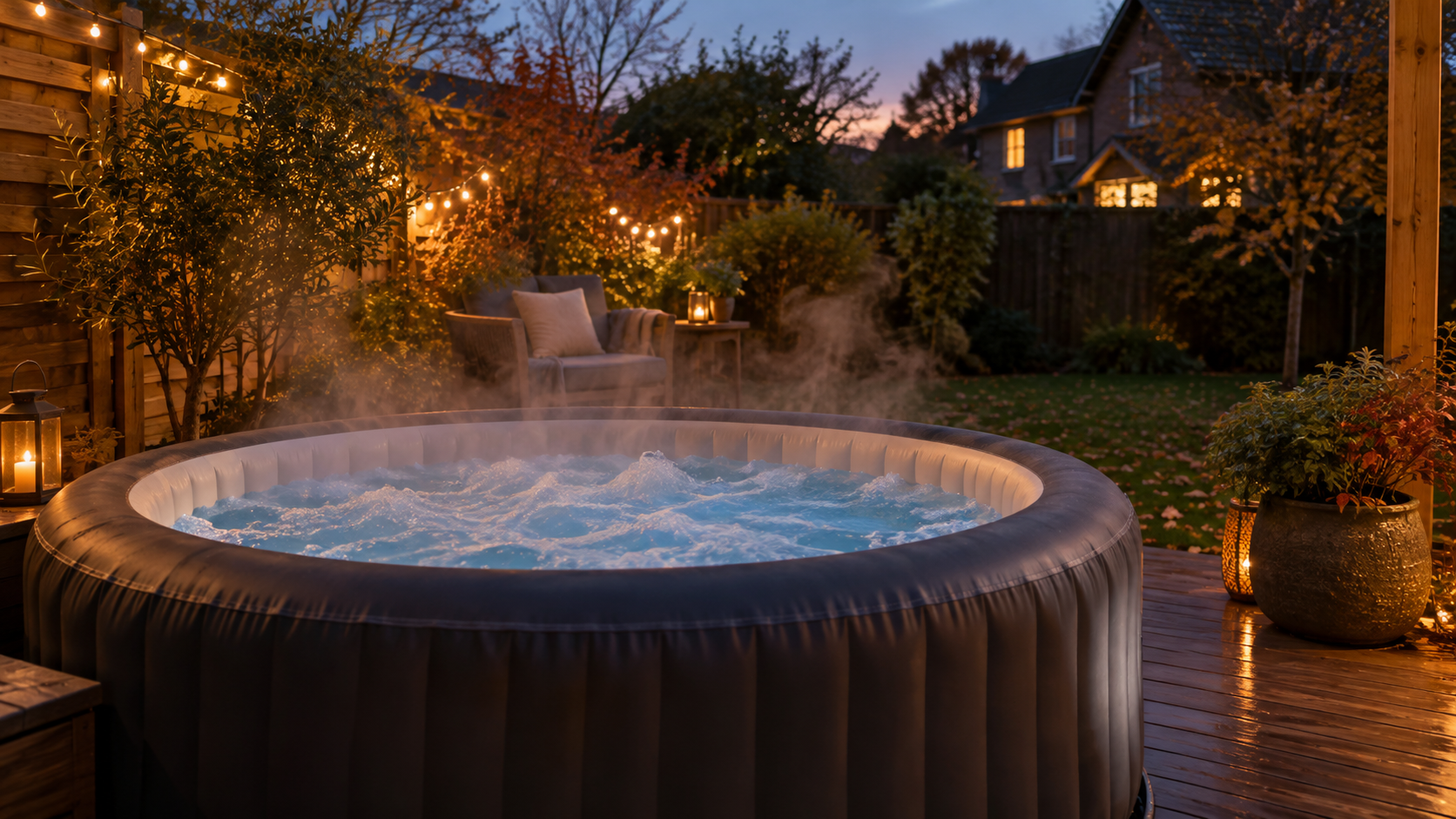
Hot tubs used to mean a £5,000 hardwired shell sunk into a professionally landscaped deck. That market still exists, but the one that actually sells in the UK is inflatable: a plug-in spa you can set up on a Saturday afternoon, run through the winter and pack away if you move house. The trouble is that the buying process is almost entirely led by marketing claims — "fits six people", "heats in hours", "costs pennies to run" — and most of them unravel in a British garden in November.
This guide covers what UK buyers genuinely need to know: the real differences between hot tub types, how many people they actually seat, what the electricity really costs at current energy prices, how to prepare your garden, what water care involves, and which features are worth paying for.
The 60-second answer
For most UK households, a 4-person inflatable hot tub from a brand with available replacement parts, costing £300–£600, is the sensible buy. Expect to spend £40–£80 a month on electricity in winter plus £15–£25 a month on chemicals. Set it on a flat, solid base that can take the weight, use a good thermal cover, and keep the water chemistry right — that is the whole job.
Spend more (£600–£900) if you want HydroJet massage, app control or a genuinely larger tub. Spend less only if you accept that the cheapest inflatables cut corners on insulation, pump power and spare-part availability, which raises your running costs and shortens the tub's life.
Do you actually need a hot tub?
Before spending anything, three honest questions are worth answering.
Will you use it in winter? The UK hot tub season runs year-round if you are prepared to maintain water temperature in single-digit weather. If you will only use it on a few warm weekends, the running cost per soak is high and a friend's tub or a local spa pass may be cheaper.
Are you comfortable with regular water maintenance? A hot tub is not a pool you can leave for weeks. It needs chemical checks two or three times a week, a filter rinse every week and a full drain-and-clean every four to eight weeks. If that sounds like a chore too far, you will end up with cloudy water and an expensive ornament.
Does your garden have a suitable spot? You need a flat, load-bearing surface (a filled 4-person tub with occupants weighs well over a tonne), access to a 13A or 32A power supply, and somewhere to drain water that is not your neighbour's patio. Our advice on whether inflatable hot tubs are worth it covers the lifestyle trade-offs in more detail.
The four types of hot tub available in the UK
Inflatable (plug-and-play)
The mainstream UK choice. A reinforced PVC shell inflated by the pump unit, which also handles heating, filtration and the air jets. You plug it into a standard 13A household socket, fill it with a garden hose and you are in business. Prices range from roughly £250 for an unbranded import to £900 for a top-spec Lay-Z-Spa. Setup takes under an hour; initial heating takes 12–24 hours depending on the weather.
The drawback is insulation. An inflatable wall is a thin layer of PVC and air. In a British winter, heat bleeds out fast, and the pump works hard to maintain 38–40°C. That is where most of the running cost sits.
Rigid portable (hard-shell plug-in)
A moulded acrylic or rotomoulded polyethylene shell with built-in jets, better insulation and a more powerful pump, but still plugging into a 13A or sometimes a 32A supply. These sit in the £1,500–£4,000 bracket, weigh considerably more, and need two people and possibly a crane or a wide enough side gate. They last longer and cost less to heat than an inflatable, but the up-front commitment is significantly larger.
Hardwired (permanent installation)
A full-size acrylic shell with a dedicated 32A or 40A supply installed by a qualified electrician. Prices start around £3,000 and run past £10,000. These are a different product category — better jets, better insulation, longer warranties — but they are fixtures, not purchases you make on a whim. Planning is rarely required (more on that below), but the electrical work adds £500–£1,500 and the base preparation may cost a similar amount.
Wood-fired
A wooden or fibreglass tub heated by an external or internal wood burner. No electricity needed for heating (though most still use a small pump for filtration). Popular in Scandinavia and gaining a niche following in the UK. They heat slowly (2–4 hours), need a constant wood supply, and require careful siting away from fences and outbuildings. Prices range from roughly £2,000 to £6,000. A genuine option if you have the space and the patience, but not the mainstream choice.
| Type | Price range | Best for | Insulation | Setup |
|---|---|---|---|---|
| Inflatable | £250–£900 | Most UK gardens, renters, first-time buyers | Minimal | Under 1 hour, no tradesperson |
| Rigid portable | £1,500–£4,000 | Long-term owners wanting better performance | Good | Delivery + access route needed |
| Hardwired | £3,000–£10,000+ | Dedicated spa setup, year-round heavy use | Excellent | Electrician required, base prep |
| Wood-fired | £2,000–£6,000 | Off-grid, rural settings, Scandi aesthetic | Variable | Delivery + clearance from structures |
Why "fits six people" almost never means six
This is the hot tub equivalent of the dehumidifier litres-per-day claim: technically correct and practically useless. A tub advertised as seating six will physically contain six adults if they all sit bolt upright with their knees touching and nobody moves. In practice, four adults will be comfortable; six will be sardines.
The honest sizing guide is simple. A "4-person" tub is comfortable for two adults with room to stretch, or three at a push. A "6-person" tub fits four comfortably. If you regularly entertain, buy one size up from the number you expect, and check the internal diameter rather than the marketing. A round tub under 180cm across is genuinely a two-person spa, whatever the listing says.
| Advertised capacity | Comfortable fit | Best for |
|---|---|---|
| 2–4 person | 2 adults | Couples, small patios |
| 4–6 person | 3–4 adults | Most families |
| 6–8 person | 4–5 adults | Regular entertaining |
What a hot tub really costs to run in the UK
The "costs pennies a day" line that appears on almost every product listing is one of the most misleading claims in the home-and-garden space. It may be true in August, when the air temperature does half the heating work. In January, it is not even close.
Running costs depend on the electricity price, the tub's insulation, the quality of the cover, the ambient temperature and how often you use it. At the current Ofgem price cap of roughly 25–27p per kWh (Ofgem energy price cap), here is what an inflatable hot tub actually costs in a UK garden.
| Season | Heater cycling | Monthly electricity | Notes |
|---|---|---|---|
| Summer (Jun–Aug) | Moderate | £25–£40 | Warm air reduces heat loss |
| Spring / Autumn | Frequent | £40–£65 | Cover quality starts to matter |
| Winter (Nov–Feb) | Near-constant | £55–£85 | Poor insulation pushes costs higher |
Annually, most owners of inflatable tubs running year-round report spending £450–£750 on electricity. A well-insulated hard-shell tub cuts that by roughly a third.
The single biggest lever you have is the cover. A tight-fitting, insulated thermal cover (not the basic inflatable lid that comes in the box) can cut winter heating costs by 30–40%. An aftermarket cover for a Lay-Z-Spa costs £40–£80 and typically pays for itself in two to three months. Our detailed breakdown of hot tub running costs models these figures across different tubs and seasons.
Chemical costs
Budget roughly £15–£25 a month for sanitiser (chlorine or bromine), pH adjusters, anti-foam and an occasional shock dose. A starter chemical kit costs £20–£35 and covers the first couple of months. Test strips are essential and cheap — buy a pot of 50 for under £10.
Budget bands: what your money buys
Under £300 — entry-level inflatables
Basic 4-person inflatables with air jets (bubbles only, no directional massage), a 1–2kW heater, and the standard inflatable lid. Build quality is variable and spare parts may be hard to find. Fine for summer use; expensive to heat in winter because insulation is virtually absent. Brands here include unbranded imports and entry Lay-Z-Spa models on promotion.
£300–£500 — the mainstream
This is where the best value sits. Lay-Z-Spa's mid-range (Miami, Cancun, Paris) and competing brands like CleverSpa and Wave sit here. You get AirJet massage, a digital pump, a timer, a slightly better cover, and widely available replacement filters and parts. Some models add an LED light ring. These are the tubs most UK owners buy, and they deliver exactly what most people want. Our Lay-Z-Spa vs CleverSpa comparison covers the two biggest names in this band.
£500–£900 — premium inflatables
Larger tubs (6-person), HydroJet or AirJet Plus systems with more powerful and directional massage, Wi-Fi app control, freeze shields for winter running, and better-insulated ground cloths. The Lay-Z-Spa Helsinki and Santorini sit here, along with a few premium CleverSpa and Bestway models. The extra money buys genuinely better massage, better cold-weather performance and smarter energy management.
Above £1,500 — rigid and hardwired
A different category. Better insulation, proper hydrotherapy jets, moulded seating, longer warranties and a semi-permanent garden feature. Worth it if you know you will use a hot tub for years and want lower running costs, but the gap in up-front price is large enough that most first-time buyers should start inflatable and upgrade later if the habit sticks.
The specifications that actually matter
Jet type (the one that changes the experience)
AirJets push air through small holes around the base — gentle all-over bubbles, relaxing but not therapeutic. HydroJets push heated water through directional nozzles — closer to a real spa massage, noticeably more powerful, and only available on higher-end models. If massage matters to you, HydroJets are worth the premium.
Heater power
Most inflatable tubs have a 1.3–2.2kW heater. A higher-wattage heater reaches temperature faster and recovers more quickly after use, but it also draws more current. On a standard 13A socket, the total draw of heater plus pump plus jets is limited to roughly 3kW — which is why inflatable tubs heat slowly (1–2°C per hour) and cannot run the heater and jets simultaneously on most models.
Insulation
The single biggest driver of running cost. Inflatable tubs have almost none — just the air chamber. Some add a ground mat or an insulated liner. Hard-shell tubs use foam insulation around the shell. The cover matters more than the tub walls for heat retention.
Freeze shield / winter mode
A freeze shield automatically runs the pump when the temperature drops near freezing, preventing ice damage to the pipes. Essential if you plan to keep the tub filled over winter — and most UK owners do. Without it, a hard frost can crack internal fittings and void your warranty. Our guide on whether to leave a hot tub empty over winter covers the options.
Timer
Lets you schedule heating so the tub reaches temperature before you plan to use it. On an inflatable this means starting the heater a few hours ahead rather than waiting or leaving it running 24/7. A small feature that makes a measurable difference to both convenience and running cost.
App control
Available on Lay-Z-Spa's "Smart" models and some CleverSpa units. Lets you start heating remotely, set schedules and monitor temperature. Genuinely useful in winter — you can fire it up from the sofa and know it will be ready by the time you step outside.
Specs that are mostly marketing
"120 jets" means 120 tiny air holes — not 120 massage nozzles. LED colour-changing lights are pleasant but cost the same £5 ring on Amazon. Inflatable "headrests" and "drink holders" are better bought separately for a few pounds each. Judge a tub on heater power, jet type, insulation and spare-part availability, not on accessory count.
| Feature | How much it matters | What to look for |
|---|---|---|
| Jet type | High — defines the experience | HydroJet for massage, AirJet for bubbles |
| Heater power | High | 1.8kW+ for reasonable heat-up time |
| Insulation / cover | Critical for running cost | Aftermarket thermal cover if not included |
| Freeze shield | Essential for winter use | Auto pump activation below ~4°C |
| Timer / scheduler | Very useful | Pre-heat scheduling |
| App control | Convenient, not essential | Remote start, temperature monitoring |
| Spare-part availability | Critical for longevity | Filters, pumps, liners available separately |
Setting up: base, electrics and planning
The base
A filled 4-person inflatable hot tub with occupants weighs roughly 1,000–1,500kg. A 6-person tub can exceed two tonnes. That weight needs to sit on something flat, level and strong enough not to shift or crack.
Suitable bases include a concrete patio slab in good condition, a purpose-built concrete pad (100mm thick, reinforced), paving slabs on a compacted sub-base, or a reinforced timber deck designed for the load. Grass, gravel and a standard garden deck are not suitable — they will sink, shift or collapse under load.
The base should be slightly larger than the tub on all sides and ideally slope very gently away from the house for drainage. Budget £200–£600 for a new concrete pad if you do not already have one.
Electrics
Most inflatable tubs plug into a standard outdoor 13A socket via an RCD (residual current device). The socket must be a weatherproof IP-rated outdoor unit on its own circuit, ideally installed by a qualified electrician. Using an extension lead or a multi-plug indoors is genuinely dangerous — water and electricity at close quarters need proper protection.
If you are buying a rigid or hardwired tub, you will need a dedicated 32A or 40A supply run from the consumer unit by a Part P certified electrician. Expect to pay £400–£1,200 depending on the cable run. This is not optional and not a DIY job.
Planning permission
In England and Wales, a hot tub placed on existing garden ground typically counts as permitted development and does not need planning permission, provided it is not in front of the house, does not cover more than half the garden, and the tub plus any housing does not exceed 2.5m in height within 2m of a boundary. Check the government's planning permission guidance if your situation is unusual. Listed buildings and conservation areas have stricter rules — always check with your local authority.
Water care — the part nobody enjoys but everybody needs
Hot tub water sits at 37–40°C, which is a perfect breeding ground for bacteria including Legionella and Pseudomonas. The NHS notes on Legionnaires' disease are worth reading — poorly maintained hot tubs are one of the known sources. This is not scaremongering; it is the reason water care is non-negotiable.
The basics
Sanitiser: Chlorine granules or bromine tablets keep the water free of bacteria. Maintain free chlorine at 3–5mg/L or bromine at 4–6mg/L. Test with strips before every use.
pH balance: Keep pH between 7.2 and 7.6. Outside that range, the sanitiser stops working properly and the water irritates skin and eyes. Adjust with pH plus or pH minus as needed.
Shock dosing: A weekly non-chlorine shock oxidises organic matter the sanitiser misses. Essential after heavy use or if the water looks hazy.
Filter care: Rinse the filter cartridge under a running tap every week. Soak it in filter cleaner every month. Replace it every two to three months, or sooner if it is discoloured or the water flow drops. A pack of replacement filters costs £10–£20.
Full drain and refill: Every four to eight weeks, depending on use. Drain the tub, wipe the shell with a non-abrasive cleaner, rinse thoroughly and refill with fresh water. This is also the time to clean the pipes with a system flush product.
How long does an inflatable hot tub last?
With reasonable care, two to five years. That is shorter than people hope and longer than critics suggest. The pump is usually the first thing to fail, followed by the liner developing slow punctures. Lay-Z-Spa and Bestway sell replacement pumps and liners separately, which can extend the life of a tub by a year or two at modest cost.
Factors that shorten lifespan include leaving the tub over-inflated in direct sun (UV degrades PVC), allowing the water chemistry to drift (acidic water attacks seals and fittings), and storing the tub damp over winter (mould and mildew eat the liner). Our guide to how long inflatable hot tubs last covers each of these in detail.
How the main UK brands compare
Positioning notes based on published specifications, warranty terms and aggregated UK owner feedback — not our own laboratory testing.
Lay-Z-Spa (Bestway)
The dominant brand in the UK inflatable market, and dominant for a reason. The widest range from budget to premium, the best spare-part ecosystem (filters, liners, pumps all available separately), and the most consistent owner satisfaction. The Cancun and Miami are solid budget picks; the Helsinki and Santorini are the best inflatable tubs available in the UK. The app-controlled "Smart" models are a genuine improvement over the basic digital pump.
CleverSpa
The main Lay-Z-Spa competitor, often slightly cheaper at similar specifications. Build quality is a step below on the entry models but competitive at the mid-range. Spare parts are available but the range is smaller. A good choice if you find a deal, but check part availability before buying.
Wave
A budget brand that has improved recently. Competitive pricing and reasonable quality at the entry level, but limited model range and thinner customer support. Worth considering under £300 if expectations are managed.
Intex
A large international brand with a decent range, but less well established in the UK than in the US market. Parts are available but sometimes harder to source domestically. Mid-range quality at mid-range prices.
Unbranded marketplace imports
The listings with unfamiliar brand names and aggressive pricing. Some are perfectly adequate rebrands; many use thinner PVC, weaker pumps and heaters that struggle in cold weather. The critical risk is spare parts — if the pump fails after 18 months and no replacement exists, the tub is landfill. If you buy here, buy cheap enough that you can accept that outcome.
For independent testing and ratings, Which? reviews hot tubs under controlled conditions, which is useful for comparing heat-up times and running costs objectively.
Seven mistakes to avoid
1. Setting up on grass or an unsupported deck. The weight will sink, shift or collapse the surface. Build or verify a proper base first.
2. Using an indoor extension lead or multi-plug. A hot tub needs a dedicated outdoor RCD-protected socket. Anything less is a genuine electrical hazard.
3. Believing the "fits 6 people" claim. Check internal dimensions and buy one size up from the number you expect to use regularly.
4. Skipping water chemistry. Cloudy water is not just unpleasant — it is a health risk. Test before every use, shock weekly, and drain regularly.
5. Leaving the basic inflatable lid on over winter. It traps almost no heat. An aftermarket thermal cover is the single best investment for cutting running costs.
6. Ignoring the filter. A clogged filter reduces water flow, strains the pump and lets the water quality slide. Rinse it weekly, soak it monthly, replace it quarterly.
7. Expecting "pennies a day" running costs in January. Electricity costs for an inflatable tub in a British winter are real — budget £55–£85 a month and you will not be caught out.
A four-question decision framework
1. How committed are you? First-time buyer unsure if the habit will stick — inflatable, £300–£500. Confirmed hot tub convert — rigid or hardwired.
2. Will you use it in winter? If yes, freeze shield is essential and a thermal cover is non-negotiable. Budget for the higher electricity months.
3. How much space do you have? Measure the area, confirm the base can take the weight, check the electrical supply. A 4-person inflatable needs roughly 2m × 2m plus clearance around it.
4. Does massage matter? AirJets are relaxing but gentle. If you want a spa-like massage, the HydroJet models are the only inflatables that deliver it, and they cost £700–£900.
The bottom line
For most UK buyers, a mid-range inflatable hot tub — a Lay-Z-Spa Cancun, Miami, Paris or similar — is the right first purchase. Expect to pay £300–£500 for the tub, invest in a proper thermal cover, prepare a solid base, set up an outdoor RCD socket, and commit to a simple water-care routine. Running costs will be £40–£80 a month depending on the season, plus £15–£25 on chemicals.
That is not pennies, but it is a fraction of a gym spa membership, and the tub is in your garden whenever you want it. Use it regularly, maintain it properly, and an inflatable will give you two to five good years before you decide whether to replace it or upgrade to something permanent.
Frequently asked questions
How much does it cost to run a hot tub per month in the UK?
For an inflatable hot tub kept at 37–40°C, expect roughly £25–£40 a month in summer and £55–£85 in winter at current electricity prices. A well-insulated hard-shell tub costs 25–35% less. Chemical costs add £15–£25 a month year-round.
Do I need planning permission for a hot tub?
Usually not. In England and Wales, a hot tub on existing garden ground is normally permitted development, provided it meets standard size and position rules. Listed buildings, conservation areas and front-garden placement are the main exceptions — check with your local authority.
Can I leave an inflatable hot tub out all winter?
Yes, if the model has a freeze shield that protects the pump and plumbing from frost. Keep it heated, covered with a thermal lid, and maintain the water chemistry. The alternative is draining it, drying it thoroughly and storing it indoors — which avoids running costs but means you lose winter use.
How often should I change hot tub water?
Every four to eight weeks for a tub used two to three times a week. Heavy use, more bathers, and poor chemical balance all shorten the interval. If the water is persistently cloudy or smells despite correct chemistry, drain and refill immediately.
Are inflatable hot tubs noisy?
The pump and air jets produce a steady hum, typically around 55–70dB depending on the model and setting. That is noticeable from a neighbouring garden. Consider your neighbours' proximity before running the jets late at night.
What is the best temperature for a hot tub?
Between 37°C and 40°C for adults. The NHS advises against exceeding 40°C, and pregnant women and people with heart conditions should consult a doctor before using a hot tub at high temperatures. Children should use a lower setting.
How long does it take to heat an inflatable hot tub?
From cold, typically 12–24 hours depending on the heater power, water volume and ambient temperature. In winter, allow a full day. Once at temperature, a good cover and timer will maintain it with much less energy. Most owners keep the tub heated continuously rather than starting from cold each time.
Is a hot tub expensive to maintain?
The ongoing costs are electricity (£450–£750 a year for an inflatable run year-round), chemicals (£180–£300 a year), replacement filters (£30–£60 a year), and an occasional pump or liner replacement. Total annual running cost for an inflatable is typically £700–£1,100. A hard-shell tub with better insulation runs roughly 25–35% cheaper on electricity.