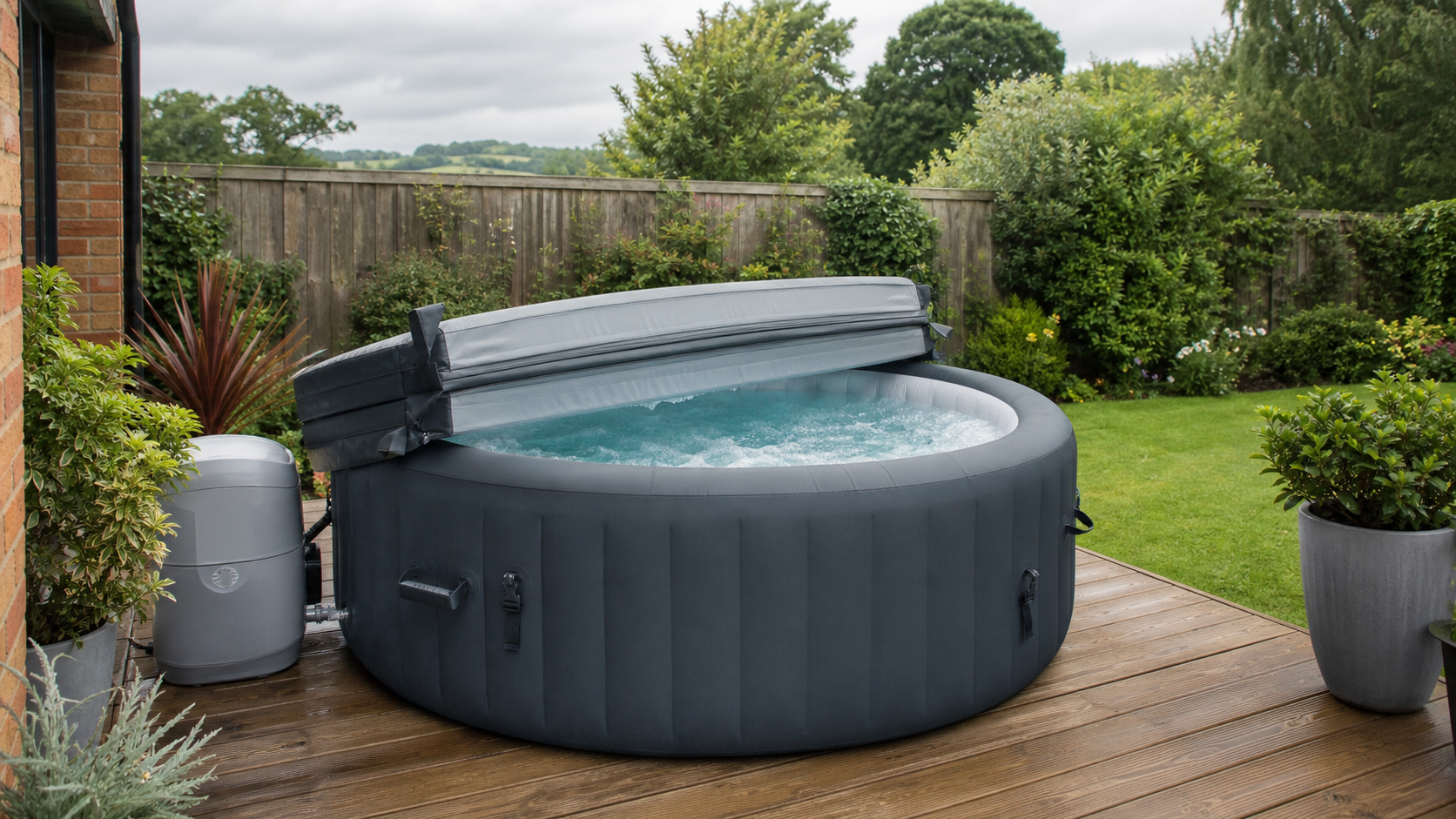
It's one of the first things people ask before spending £300–£900 on an inflatable hot tub, and the answer is less straightforward than you'd hope. The honest range is 2 to 7 years, with most owners landing somewhere in the middle — and the gap between the short end and the long end comes down almost entirely to how you look after it.
Here's what actually determines the lifespan, what kills them early, and how to get the most years out of yours.
The realistic lifespan by price bracket
| Price bracket | Typical lifespan | What limits it |
|---|---|---|
| Budget (under £350) | 2–3 years | Thinner PVC, basic pump, fewer reinforcement layers. Often the pump fails before the tub does. |
| Mid-range (£350–£600) | 3–5 years | Better materials and pump motors. The Lay-Z-Spa Miami and Paris Luxe sit here and are the most common models with 4–5 year track records. |
| Premium (£600+) | 4–7 years | Reinforced I-beam construction, FreezeShield, better insulation. The Lay-Z-Spa Santorini HydroJet Pro uses thicker TriTech material rated for longer outdoor exposure. |
For context, a rigid acrylic hot tub with a proper cabinet lasts 15–20 years but costs £3,000–£10,000+ installed. Year for year, inflatables are still the cheaper option by a wide margin — even if you replace one every four years.
The five things that actually kill an inflatable hot tub
1. UV damage
This is the biggest one and the most preventable. Sustained UV exposure breaks down PVC at a molecular level — the material gets stiff, loses elasticity and eventually cracks. A hot tub left inflated in direct sun all summer without a cover ages roughly twice as fast as one that's covered between uses. If yours sits on a south-facing patio, a simple gazebo or shade sail extends its life more than anything else you can do.
2. Poor water chemistry
Chlorine or bromine levels that swing wildly — too high, then too low, then too high again — attack the liner from the inside. Consistently too-high sanitiser is worse than slightly too-low, because it bleaches and weakens the PVC over time. Aim for 1–3 ppm of free chlorine (or 2–4 ppm of bromine) and test twice a week. A decent test strip kit costs under £10 and is the cheapest maintenance investment you'll make.
3. Leaving it up over winter (incorrectly)
You can leave a hot tub running through winter — and many people do, because a hot tub in January is genuinely lovely. But if the heating fails during a cold snap and the water freezes, the expanding ice can crack the pump, split internal pipes and warp the tub walls. Models with FreezeShield technology (like the Lay-Z-Spa Helsinki) have a built-in frost protection mode that kicks in automatically. If yours doesn't have this, either keep a reliable eye on it or drain it down for winter. We covered the full decision in our guide to whether to leave a hot tub empty over winter.
4. Pump failure
The pump is almost always the first component to fail, and it's often what ends the hot tub's useful life — because replacement pumps for specific models aren't always available, and a generic pump rarely fits. The heating element, the air blower and the filtration motor are all inside the same unit on most inflatables. Running the pump with a dirty or blocked filter makes it work harder and overheat; running it with low water level is worse. Keep the filter clean and the water above the minimum line, and the pump should last the life of the tub.
5. Punctures and seam failures
A puncture from a sharp stone, a dog's claw, or a stray thorn is fixable with a patch kit — every hot tub comes with one, and spares cost a few pounds. The more serious failure is a seam separation, where the glued or welded join between panels starts to peel. That's usually the result of prolonged UV exposure, over-inflation in hot weather (PVC expands when hot, so inflate to firm-not-tight), or a manufacturing defect. Seam failures on a tub more than a couple of years old are generally terminal.
How to get the maximum lifespan
- Always use the cover when you're not in it. Reduces UV damage, keeps debris out of the filter, and cuts heating costs significantly — a covered tub costs far less to run, as we explained in our hot tub running costs guide.
- Put it on a proper base. A ground cloth alone isn't enough on rough ground. Use interlocking foam tiles, a concrete pad, or decking boards to protect the base from stones and abrasion. The underside gets no UV but plenty of mechanical wear.
- Keep the water chemistry stable. Little and often beats big corrections. Test twice a week, dose small amounts, and drain and refill every 6–8 weeks (or sooner if the water goes cloudy and won't clear). Fresh water is cheaper than chemicals trying to rescue old water.
- Clean or replace the filter regularly. Rinse it weekly, give it a proper soak-clean monthly, and replace it every 2–3 months. A clogged filter stresses the pump and degrades water quality — it's a £10 part that protects a £400+ investment.
- Don't over-inflate in hot weather. PVC expands in heat. If the walls are drum-tight on a 30°C day, the seams are under strain. Let a little air out so it's firm but gives slightly when you press it. Re-inflate to normal when temperatures drop.
- Store it properly if you pack it away. Drain completely, clean the inside with a mild solution, dry it thoroughly (mould loves a damp, folded hot tub), and store it in a dry place out of direct sunlight. The pump unit needs to be bone dry inside too — run it empty for a minute after draining to clear the pipes.
When to repair vs when to replace
| Issue | Repair or replace? |
|---|---|
| Small puncture in the wall or base | Repair — patch kit, £5, ten-minute job |
| Slow leak you can't find | Try soapy water on every surface and seam. If it's a seam, it depends on the age — patch and monitor on a newer tub, consider replacing on one that's 3+ years old |
| Pump motor running but not heating | Check the thermal cutout and reset. If the element has gone, replacement pumps are £80–£150 if available for your model. Worth it on a 1–2 year old tub; probably not on a 4+ year old one |
| Pump not running at all | Check the RCD, the plug fuse and the power supply first. If the motor is dead, same calculation as above |
| Multiple seam separations | Replace. Once the PVC has degraded enough for seams to fail in more than one place, patching is chasing a losing game |
| Liner turning chalky or cracking | Replace. UV damage at this stage is irreversible — the material has lost its plasticiser and will only get worse |
Does the brand matter?
Honestly, yes. Bestway's Lay-Z-Spa range dominates the UK market for a reason — replacement parts, filters, covers and chemical kits are widely available for years after purchase. The Cancun AirJet at £299 and the Ibiza AirJet at £549 are two of the best-supported models we've reviewed. CleverSpa has carved out a solid position as the budget alternative, though with slightly thinner material and a shorter typical lifespan — our Lay-Z-Spa vs CleverSpa comparison breaks down the durability gap in detail. With lesser-known brands like Aoxun or Nordivale, the tub itself can be perfectly good, but finding a specific replacement pump or control board in three years' time is less certain.
That parts availability is a real factor in effective lifespan. A tub that still holds air but has a dead pump and no replacement available is finished just as surely as one with a split seam.
What about warranties?
Most inflatable hot tubs come with a 1–2 year manufacturer warranty. Lay-Z-Spa offers 2 years on most models. The warranty typically covers manufacturing defects in the liner and pump but won't cover UV degradation, chemical damage or normal wear — which is fair, since those are maintenance issues. If you're buying from Amazon, check whether the listing is sold and fulfilled by Amazon or by a third-party seller, as the returns process differs. For an independent view of how brands compare on durability and customer support, Which? includes reliability data from real owner surveys in their hot tub reviews.
The honest summary
An inflatable hot tub is not a permanent fixture. It's a seasonal or semi-permanent product with a realistic lifespan of 3–5 years for most owners, stretching to 6–7 for those who are genuinely diligent about UV protection, water chemistry and winter care. At £300–£600, that's roughly £60–£150 a year for the tub itself — add £30–£90 a month in running costs and you've got the full picture. If you're still weighing up the decision, our honest take on whether inflatable hot tubs are worth it covers the complete pros and cons.
The people who get the longest life from theirs almost always do three things: they cover it religiously, they test the water twice a week, and they clean the filter before it looks like it needs cleaning. None of that is difficult or expensive — it just has to be consistent.