Running costs updated 1 October 2026. Every electricity figure on this page is costed at the Ofgem price cap average electricity unit rate of 26.32p per kWh, which applies from 1 October to 31 December 2026. Your own tariff may be higher or lower, so check your latest bill before relying on these numbers.
Water care is the part of owning a hot tub that puts most people off. But if you keep it simple, it is about five minutes, two or three times a week. This guide covers the handful of products a beginner actually needs, the readings to aim for, and a routine you can stick to.
Always follow your manual. This guide gives general UK guidance, drawn from manufacturers' instructions and standard water-care practice. It is not a substitute for your hot tub's own manual or for a qualified electrician. Where the two disagree, your manufacturer's instructions win.
The short answer
You need a sanitiser (chlorine or bromine), test strips, a pH increaser and reducer, and ideally a non-chlorine shock. That is the starter kit. Test two or three times a week, and do the same things in the same order every time.
The beginner's starter kit
| Product | What it does | Do you need it? |
|---|---|---|
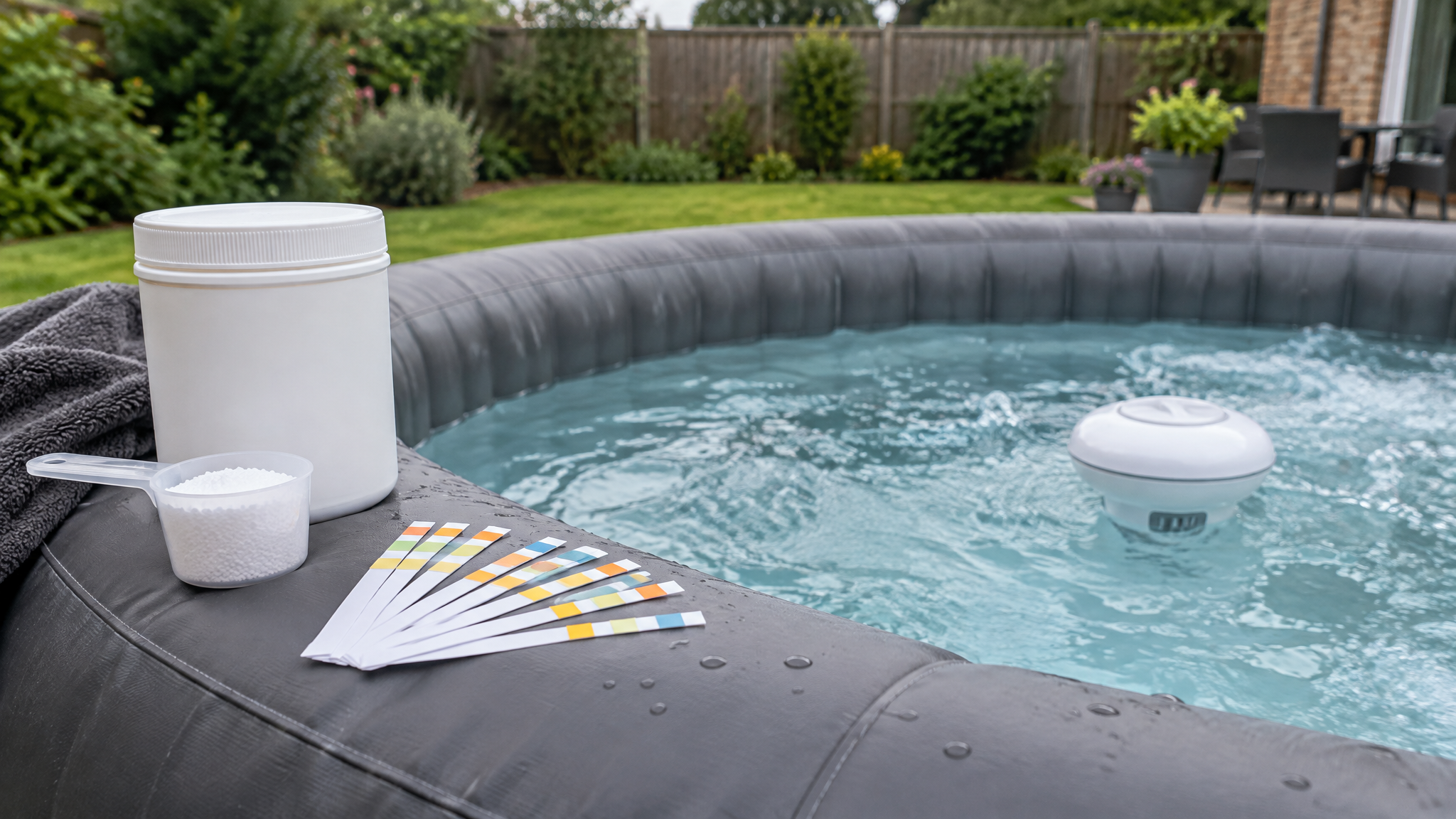
| Chlorine granules (or bromine tablets) | Kills bacteria and breaks down body oils | Yes. This is the essential one |
| Test strips | Show sanitiser, pH and alkalinity in about 15 seconds | Yes |
| pH increaser / pH reducer | Bring pH back into range | Yes |
| Non-chlorine shock (MPS) | Oxidises waste after heavy use without a big chlorine hit | Strongly recommended |
| Alkalinity increaser | Steadies pH so it stops swinging | Only if your alkalinity reads low |
| Filter cleaner and a spare filter | Keeps the filter flowing | Yes, and swap filters on a rota |
| Foam remover, clarifier | Fix foam or cloudy water | Only when needed |
The readings to aim for
| Reading | Typical target range | If it is wrong |
|---|---|---|
| Free chlorine | About 3-5 ppm (some inflatable makers give a lower range, so check your manual) | Low: add granules. High: leave the cover off and do not top up |
| Bromine (if used instead) | About 3-5 ppm | Adjust the floater setting |
| pH | 7.2-7.6 (up to 7.8 is acceptable) | Use pH increaser or reducer, a little at a time |
| Total alkalinity | 80-120 ppm | Fix this before pH; it holds pH steady |
| Calcium hardness | About 150-250 ppm | Soft water foams more; hard water scales up the heater |
These are standard spa water ranges. Follow your manufacturer's figures if they differ.
Chlorine or bromine?
Chlorine is cheap, works quickly and is what most UK inflatable owners use. You add granules after each session. Bromine is gentler-smelling and more stable at hot tub temperatures, and you can run it from a floater. It costs more and is slower to recover after a busy weekend. Pick one and stick with it, and never mix the two.
A simple routine
- After each use: add a small dose of chlorine granules with the pump running, then put the cover back on.
- Two or three times a week: test with a strip. Correct the alkalinity first, then pH, then sanitiser. Wait about 20 minutes with the pump running between products.
- Weekly, or after a party: shock the water.
- Weekly: rinse the filter. Every few weeks, swap in a clean filter while the old one soaks.
- Every one to three months: drain and refill. See how often to change hot tub water.
Five beginner mistakes
- Adding everything at once. Products can react, so add one at a time with the pump running.
- Chasing pH before alkalinity. If the alkalinity is off, pH will keep bouncing.
- Using pool chemicals. Pool chlorine tablets are often trichlor, which is too acidic and too strong for a small, hot volume of water.
- Getting in straight after a big dose. Wait until the sanitiser is back in range.
- Mixing chemicals in a container. Always add each product to the water, never to another chemical.
What it costs
A starter kit is usually a modest one-off spend, and ongoing chemicals are a small monthly cost next to electricity. Heating is the big bill. See how much a hot tub costs to run or try the hot tub running cost calculator.
The BestPicks UK hot tub guides
Choosing one
- Hot tub buying guide
- Are inflatable hot tubs worth it?
- Lay-Z-Spa vs CleverSpa
- Inflatable vs hard-shell hot tub
- How long an inflatable hot tub lasts
Setting up
- What to put under an inflatable hot tub
- How to set up an inflatable hot tub
- Hot tub accessories worth buying
Running and looking after it
- How much a hot tub costs to run
- How often to change hot tub water
- Should you empty a hot tub over winter?
- Using a hot tub in freezing weather
Compare models in our best hot tubs UK guide, or work out your bill with the hot tub running cost calculator.
Frequently asked questions
What chemicals do I need for a hot tub as a beginner?
A sanitiser (chlorine granules or bromine), test strips, pH increaser and reducer, and a non-chlorine shock. Add alkalinity increaser, foam remover or clarifier only if you need them.
How often should I test hot tub water?
Two or three times a week, and before use if the tub has been busy or left for a few days.
Can I use swimming pool chemicals in a hot tub?
Not as a rule. Pool chlorine tablets are often too strong and too acidic for a hot tub. Use products made for spas.
How long after adding chemicals can I get in?
Usually after about 20 minutes with the pump running, once the readings are back in range. Check the product label, as shock and large doses may need longer.