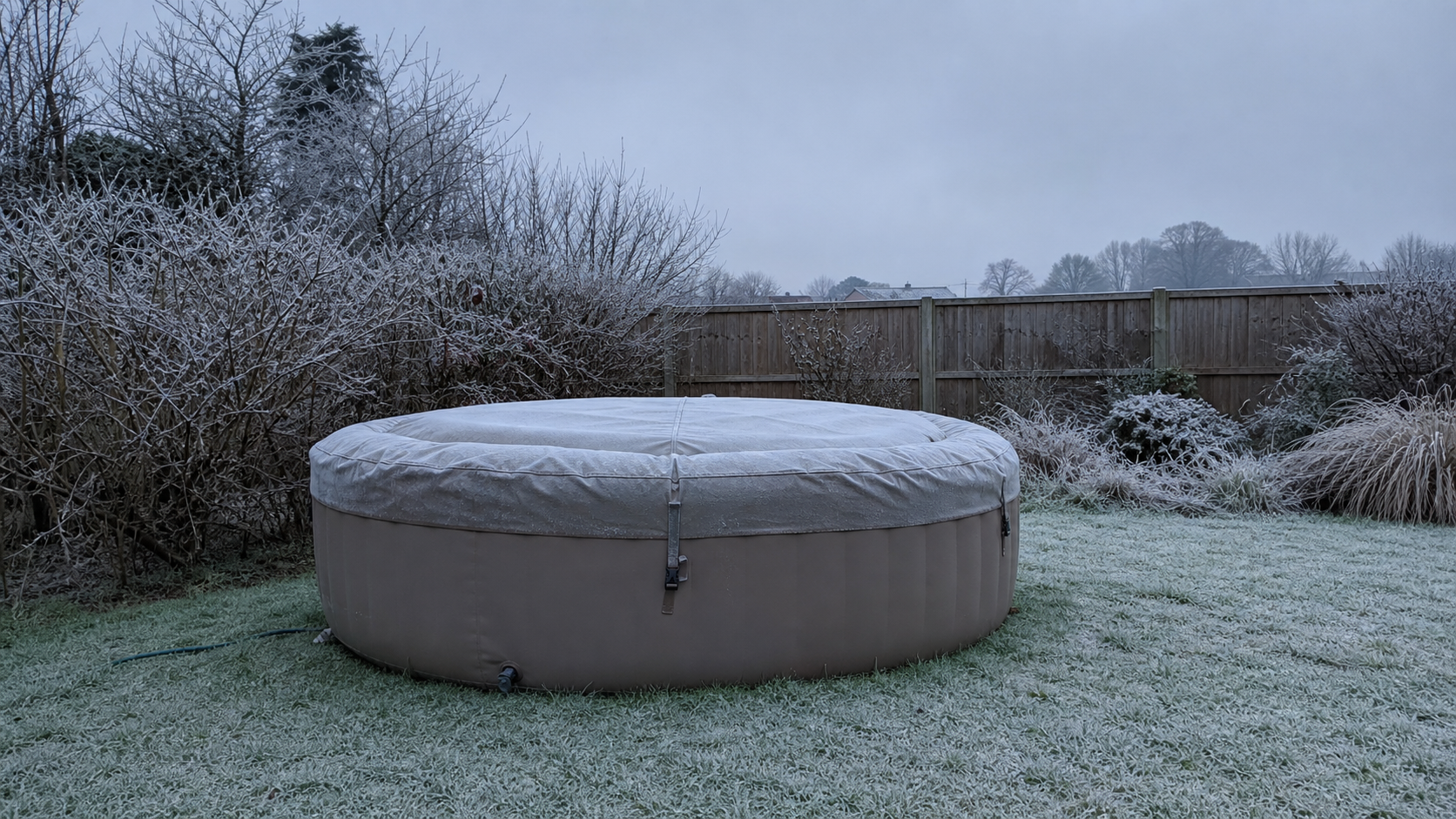
Every autumn the same question comes up: should you drain the hot tub and pack it away, or leave it running through winter? Both options have real trade-offs, and the right answer depends on what kind of tub you own, how cold your area gets, and whether you'll actually use it.
This guide covers the honest pros and cons of each approach, the running costs you can expect, and step-by-step instructions for draining and storing properly if that's the route you take — because doing it badly is worse than not draining at all.
The case for keeping it running
A hot tub in winter is, for a lot of people, the whole point. Sitting in 38°C water on a clear, freezing night is genuinely one of the best things about owning one. But the appeal isn't just about luxury — there are practical reasons to keep it going:
- No frost damage risk. A running tub circulates warm water through every pipe and jet. As long as the heater works and the power stays on, nothing freezes.
- Less wear and tear. Inflatable tubs in particular don't like being deflated, folded and stored repeatedly. The vinyl creases weaken over time, and folds that sit all winter in a cold shed can crack.
- Ready to use. Heating a tub from cold takes 12–24 hours and costs several pounds in electricity. A tub that's already warm needs only an hour or so to come up to bathing temperature.
- Water chemistry stays stable. A tub that's been maintained all summer has balanced water. Draining and refilling means starting the chemistry from scratch.
What it costs to run through winter
This is where people hesitate. Keeping an inflatable hot tub at temperature through a British winter costs more than summer, because the air temperature is lower and the heater runs more often.
Realistically, expect to pay £50–£80 per month in electricity during the coldest months (December to February) for a typical inflatable tub, compared to £30–£50 in summer. That's based on current average UK electricity rates of around 24.5p per kWh. The exact figure depends on your tub size, how well-insulated it is, how often you use it, and your local tariff. Insulation quality varies significantly between brands — our Lay-Z-Spa vs CleverSpa comparison shows how thicker material cuts winter electricity bills by roughly £80 per year. Our full breakdown of how much a hot tub costs to run covers the monthly figures in more detail, including the hidden costs beyond electricity.
If you're on a time-of-use tariff, heating overnight on cheap-rate electricity can cut costs significantly. The Citizens Advice energy guidance is worth checking if you're not sure what tariff options are available to you.
A good-quality insulated cover is the single biggest factor. Without one, heat loss through the surface can double your running costs. With one, the heater cycles far less often.
The case for draining and storing
Not everyone wants to use a hot tub in winter, and there's no point spending £50–£80 a month heating water nobody sits in. Draining makes sense if:
- You know you won't use it between November and March.
- You're going away for an extended period and can't maintain it.
- Your electricity costs are already tight and the winter premium isn't worth it.
- You've had issues with frost damage before and want to eliminate the risk entirely.
The risk of leaving a tub empty but not properly drained is higher than most people realise. Residual water in the pipes, pump and heater can freeze, expand and crack components. A replacement pump for an inflatable tub is typically £100–£200, and for some models the pump unit is the most expensive single part.
How to drain and store an inflatable hot tub properly
If you're draining for winter, doing it thoroughly is the difference between a tub that works perfectly in spring and one that doesn't. Here's the process:
1. Clean and treat the water first
Don't drain dirty water straight onto the garden. Run the jets for 15 minutes with a pipe-flush product to clear biofilm from inside the plumbing. This is the slimy buildup that accumulates in pipes over the season, and if you leave it there over winter it'll be worse in spring.
2. Drain completely
Use the drain valve and a garden hose to direct the water away from foundations and flower beds — the chemical content isn't great for plants. Let the last of the water drain out by gravity; don't rush it.
Be mindful of where the water goes. Several hundred litres of chlorinated water shouldn't go into a watercourse or storm drain. Waterwise has practical guidance on responsible water disposal and general water-saving advice that's worth a read.
3. Get the residual water out of the pump and pipes
This is the step most people skip, and it's the one that causes frost damage. After the tub has drained:
- Run the pump for 10–15 seconds to blow water out of the internal plumbing. Some tubs have a specific "winterise" or "blow out" procedure in the manual.
- Disconnect the pump unit and tip it gently to drain any trapped water from inside.
- Use a wet-dry vacuum or towels to soak up any puddles left in the bottom of the tub.
- Leave the drain cap and air valves open for a few hours to let everything air-dry.
4. Clean the shell
Wipe the inside with a non-abrasive cleaner and let it dry completely. Any moisture left inside a stored tub will grow mould over winter, and that's both unpleasant and difficult to remove in spring.
5. Deflate and fold carefully
Deflate fully. Fold loosely rather than tightly — tight folds create creases in the vinyl that can crack in cold temperatures. If you have the original box, use it. If not, a large plastic storage box or thick tarpaulin works.
6. Store somewhere dry and frost-free
A garage, shed or utility room is fine. Avoid leaving it outdoors even if it's covered — temperature swings and damp will degrade the material faster than anything else. Store the pump unit indoors too; the electronics don't like sustained cold or condensation.
What about leaving it empty but inflated?
Some people leave the tub inflated with the cover on, but drained. This is the worst option. An empty tub with no circulating warm water gives frost unrestricted access to every pipe and fitting, and the cover traps cold, damp air inside the shell — perfect conditions for mould and ice damage.
If you're not going to run it, drain and store it properly. Half measures cause more problems than either full option.
What happens if the power goes out?
This is the genuine risk of running through winter. A tub that loses power in a hard frost can start freezing within a few hours, depending on insulation and outside temperature. Internal pipes are the most vulnerable because they hold small volumes of water with a large surface area.
Practical steps to reduce the risk:
- Keep the cover on whenever you're not using the tub. A good cover holds heat for hours even without the heater running.
- Insulate exposed pipes. Wrap any external plumbing with pipe lagging — it's cheap and takes ten minutes.
- Check the tub after a power cut. If the power was off for more than a few hours in freezing conditions, run the jets gently to circulate water before heating. If water doesn't flow, something may already be frozen — let it thaw slowly before turning the pump on, or you risk damaging the impeller.
If your area is prone to power cuts in winter, that's a genuine reason to lean towards draining instead.
A quick decision guide
| Your situation | Best option |
|---|---|
| You'll use it at least twice a month in winter | Keep it running — the cost is justified and the tub stays in good condition |
| You won't use it at all until spring | Drain and store properly — save £150–£250 in winter electricity |
| You're going away for more than two weeks | Drain and store — unattended tubs in frost are a real risk |
| Your area gets frequent power cuts | Drain and store — one bad freeze can wreck the pump |
| You want to use it but hate the running costs | Keep it running but invest in a better cover and use off-peak electricity |
Whichever you choose, the decision also depends on how much life your tub has left in it — draining and storing a tub that's nearing the end of its lifespan makes more sense than spending money on chemicals and electricity through winter. Our guide to how long inflatable hot tubs last covers the signs that yours is on borrowed time.
The bottom line
There's no single right answer. Running a hot tub through a British winter costs roughly £150–£250 in electricity over the cold months, but you get to use it — and for many owners, that's the best season. Draining saves that money but only works if you do it thoroughly. The one thing you should never do is leave it sitting empty with water still in the pipes.
Whichever way you go, a proper insulated cover is the best investment you can make. It cuts running costs if you keep the tub going, and it protects the shell if you're storing it. Most of the tubs we've reviewed — from around £300 to £900 — come with a cover, but quality varies. Check it before autumn arrives.