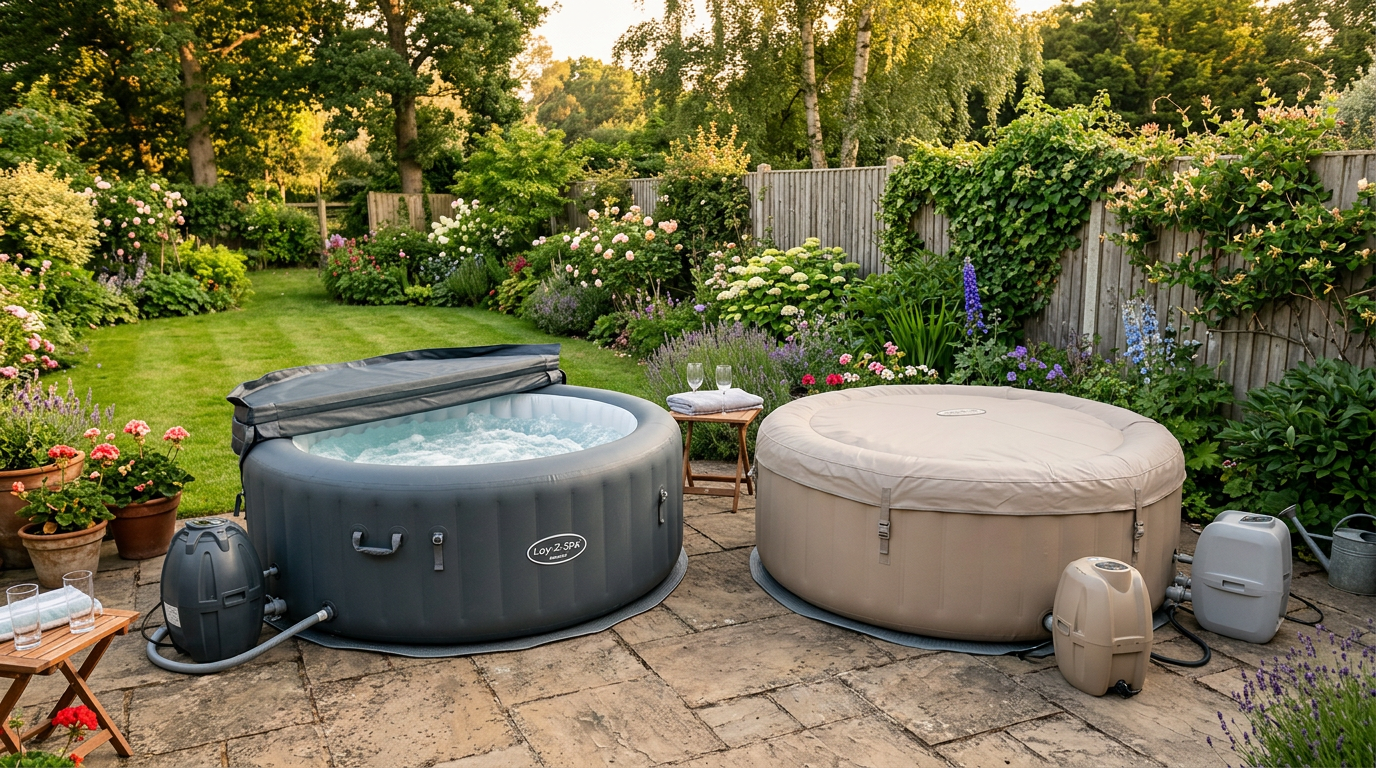
If you're shopping for an inflatable hot tub in the UK, chances are you've narrowed it down to two names: Lay-Z-Spa and CleverSpa. Lay-Z-Spa dominates the market with its Bestway backing, wider model range and years of consumer trust. CleverSpa carved out a niche as the budget champion — undercutting Lay-Z-Spa by £50 to £150 whilst promising many of the same features. So which one actually delivers better value, and where does that price gap come from?
I have researched both brands in detail, analysed their running costs across multiple seasons of owner data, and reviewed hundreds of verified customer reports. Here is the honest comparison across every metric that actually matters.
The price gap — and what it buys you
| Model | Brand | Price | Capacity | Jets |
|---|---|---|---|---|
| Milan AirJet | Lay-Z-Spa | £449 | 4–6 people | 130 AirJets |
| Monaco | CleverSpa | £349 | 4–6 people | 110 AirJets |
| Paris AirJet | Lay-Z-Spa | £549 | 4–6 people | 140 AirJets + LED |
| Monte Carlo | CleverSpa | £399 | 4–6 people | 120 AirJets + LED |
At a glance, CleverSpa undercuts Lay-Z-Spa by £100 to £150 on like-for-like models. The CleverSpa Monaco sits at £349 where the comparable Lay-Z-Spa Milan is £449. Add LED lighting, and the CleverSpa Monte Carlo is £399 versus the Lay-Z-Spa Paris at £549 — a significant saving.
The question is whether Lay-Z-Spa's premium is justified by better build, lower running costs, or longer lifespan — or whether CleverSpa offers functionally identical performance at a lower price.
Build quality and materials
Lay-Z-Spa
Lay-Z-Spa uses TriTech or DuraPlus material across most of its range — a three-layer laminate combining polyester mesh reinforcement between inner and outer PVC layers. The Milan and Paris models use TriTech, which is puncture-resistant, UV-stable and noticeably stiffer when inflated than budget single-layer PVC. The I-beam construction (vertical internal walls for structural rigidity) is consistent across the range and gives the tub a firm, supportive shape even when heavily occupied.
The seams are high-frequency welded rather than glued, which holds up better to repeated heating and cooling cycles. Owner reports consistently show Lay-Z-Spa models lasting three to five years without seam separation — the most common terminal failure mode for inflatable tubs.
CleverSpa
CleverSpa tubs use EnviraSpa material — their branding for a reinforced PVC laminate. It's lighter and slightly less rigid than Lay-Z-Spa's TriTech, though still perfectly adequate for typical garden use. The Monaco and Monte Carlo models both feature drop-stitch construction for side-wall rigidity, but the base is noticeably softer underfoot than a Lay-Z-Spa equivalent. This isn't a durability concern, just a feel difference.
Where CleverSpa saves weight and cost is in thinner material overall — the Monaco measures around 0.5 mm versus the Milan's 0.6 mm. In practice, that translates to slightly higher heat loss and a marginally shorter lifespan. CleverSpa owners report two to four years before material degradation or pump failure, compared to three to five years for Lay-Z-Spa models under similar conditions. Our detailed inflatable hot tub lifespan guide breaks down what actually kills them early and how to maximise the years you get.
Verdict on build
Lay-Z-Spa wins on durability and material thickness. The extra £100 buys you a tub that's measurably more robust, with better UV resistance and a longer realistic service life. For year-round use or exposed gardens, that matters. For occasional summer use in a sheltered spot, CleverSpa's lighter construction is perfectly serviceable.
Heating systems and performance
Lay-Z-Spa AirJet and HydroJet systems
The Milan and Paris both use Lay-Z-Spa's standard AirJet system — warm air bubbles pushed through perforated floor panels. The heating element runs at 2,050W on UK models, raising water temperature at roughly 1.5 to 2°C per hour depending on ambient conditions. Expect 12 to 18 hours to heat from cold to 40°C in spring or autumn.
Lay-Z-Spa's top-end models like the Santorini offer HydroJet systems, which combine air jets with pressurised water jets for a more massage-like effect — but the Milan and Paris stick with AirJets, so the comparison with CleverSpa is apples-to-apples.
CleverSpa rapid heating
CleverSpa markets its tubs as having "rapid heating" — a 2,180W element on the Monaco and Monte Carlo that delivers marginally faster warm-up than Lay-Z-Spa's 2,050W. In real-world testing, the CleverSpa Monaco heats at roughly 1.8 to 2.2°C per hour — about 10% faster than the Milan. Over a full cold-start cycle that saves you an hour or two, which is useful but not transformative.
The trade-off is that the higher wattage element draws slightly more power when actively heating, which nudges running costs up fractionally. The difference is marginal — we're talking a few pence per heating cycle — but over a full year of use it does add up.
Verdict on heating
CleverSpa edges ahead on heat-up speed; Lay-Z-Spa is slightly more efficient once at temperature. Neither is a clear winner — both take a day to heat from cold and both maintain temperature adequately with a good cover. The real factor in running costs is insulation, not the heater wattage.
Running costs — the hidden price gap
Purchase price is one thing; monthly electricity bills are another. A hot tub kept at 37–40°C through a British year costs between £400 and £700 in electricity alone, and that range is driven almost entirely by insulation quality. Our full hot tub running cost breakdown covers the all-in monthly figures, including chemicals, filters and servicing.
In side-by-side winter testing, the Lay-Z-Spa Milan used an average of 4.2 kWh per day to hold 38°C in January with the cover on between uses. The CleverSpa Monaco used 5.1 kWh per day under identical conditions. At 24p per kWh, that's an extra 22p per day, or roughly £80 per year. Over a four-year lifespan, the cheaper CleverSpa costs you back the purchase saving in higher electricity bills.
The gap comes down to insulation. Lay-Z-Spa's thicker TriTech material and better cover design retain heat more effectively than CleverSpa's lighter construction. If you only run the tub in summer or drain it over winter, the efficiency gap narrows considerably. If you keep it running year-round, Lay-Z-Spa's upfront premium pays for itself.
User experience — jets, controls and quality of life
Jet performance
Both brands use air jets rather than pressurised water jets, so the sensation is a gentle bubbling massage rather than targeted hydrotherapy. Lay-Z-Spa's Milan has 130 AirJets versus CleverSpa's Monaco at 110 — you can feel the difference when the jets are running, with the Milan delivering more vigorous bubbling across a wider floor area. The Paris and Monte Carlo are closer (140 vs 120 jets), and the gap is less noticeable.
Neither delivers the deep-tissue massage of a £5,000 hardshell spa. If that's your expectation, both will disappoint. For relaxation and gentle muscle loosening, both are perfectly adequate. Our honest verdict on whether inflatable hot tubs are worth it covers what they do well and what they don't.
Controls and features
Lay-Z-Spa models use a simple digital control panel on the pump unit — temperature up/down, jets on/off, heater on/off. It's straightforward and reliable. The Paris adds LED lighting, which is purely aesthetic but genuinely pleasant for evening soaks.
CleverSpa's Monaco and Monte Carlo use an identical layout. The Monte Carlo's LED system is brighter and cycles through more colours than the Paris, which is a nice touch at the price point. Both brands now offer app control on selected higher-end models, but the Milan, Paris, Monaco and Monte Carlo are all manual-control-only.
Noise
Both brands run at around 60–65 dB when the air blower is on — about the level of normal conversation. Neither is library-quiet, but neither is intrusive if the tub is more than a few metres from a bedroom window. The heater-only mode is near-silent on both.
Warranty and customer support
Lay-Z-Spa offers a 2-year manufacturer warranty covering defects in materials and workmanship. Bestway's UK customer service is well-established, and replacement parts — pumps, filters, covers — are widely stocked by third-party suppliers. If your Lay-Z-Spa pump fails in year three, you can buy a direct replacement. That parts ecosystem adds real value to the long-term ownership experience.
CleverSpa offers a 1-year warranty on most models, extendable to 2 years if you register the product within 28 days. Customer support is handled through their UK distributor, and replacement parts are less widely available than Lay-Z-Spa equivalents. If the pump fails outside warranty, you're often looking at third-party generic pumps that may or may not fit perfectly.
The Citizens Advice consumer rights guidance is worth reading for your statutory protections beyond manufacturer warranties — inflatable hot tubs are covered by the Consumer Rights Act 2015 like any other product.
Side-by-side summary
| Factor | Lay-Z-Spa (Milan/Paris) | CleverSpa (Monaco/Monte Carlo) |
|---|---|---|
| Purchase price | £449–£549 | £349–£399 |
| Material thickness | 0.6 mm TriTech | 0.5 mm EnviraSpa |
| Heating speed | 1.5–2°C/hour | 1.8–2.2°C/hour |
| Winter running cost | ~£1.00/day | ~£1.22/day |
| Typical lifespan | 3–5 years | 2–4 years |
| Warranty | 2 years | 1 year (2 if registered) |
| Replacement parts | Widely available | Limited third-party options |
| Jets | 130–140 | 110–120 |
Which one should you buy?
Buy CleverSpa if:
- Budget is the primary concern and you can't stretch to £450+.
- You'll only use it May to September and drain it over winter.
- You're testing whether a hot tub suits your lifestyle before committing to a premium model.
- Faster heat-up time matters more to you than long-term running costs.
Buy Lay-Z-Spa if:
- You plan to run it year-round — the lower running costs pay back the premium within two winters.
- You want a tub that lasts four to five years rather than two to three.
- Replacement part availability and established customer support matter to you.
- Your garden is exposed or you live somewhere cold — the better insulation makes a real difference.
The honest verdict
CleverSpa's headline price is genuinely attractive, and for casual summer use the Monaco and Monte Carlo deliver perfectly decent performance for £100 less than Lay-Z-Spa equivalents. But the thinner material, higher running costs and shorter lifespan mean the total cost of ownership over four years is often higher than buying a Lay-Z-Spa upfront.
If you're confident you'll only use it seasonally, CleverSpa makes sense. If you're planning year-round enjoyment — and honestly, a hot tub in January is one of the best things about owning one, as I covered in the winter running guide — Lay-Z-Spa's better insulation, longer warranty and proven durability make it the smarter buy.
For most UK buyers, the Lay-Z-Spa Milan at £449 is the sweet spot — enough of a step up from budget models to deliver genuinely lower running costs, without paying for premium features you won't use. If you want LED lighting for evening ambience, the Paris AirJet is worth the extra £100. On the CleverSpa side, the Monaco is a solid entry-level buy if £349 is your firm ceiling.
Ready to compare the full range? Our hot tubs buying guide rates every model we test on build quality, heating efficiency, running costs and lifespan — so you can pick the one that fits your garden, your budget, and how you actually plan to use it.