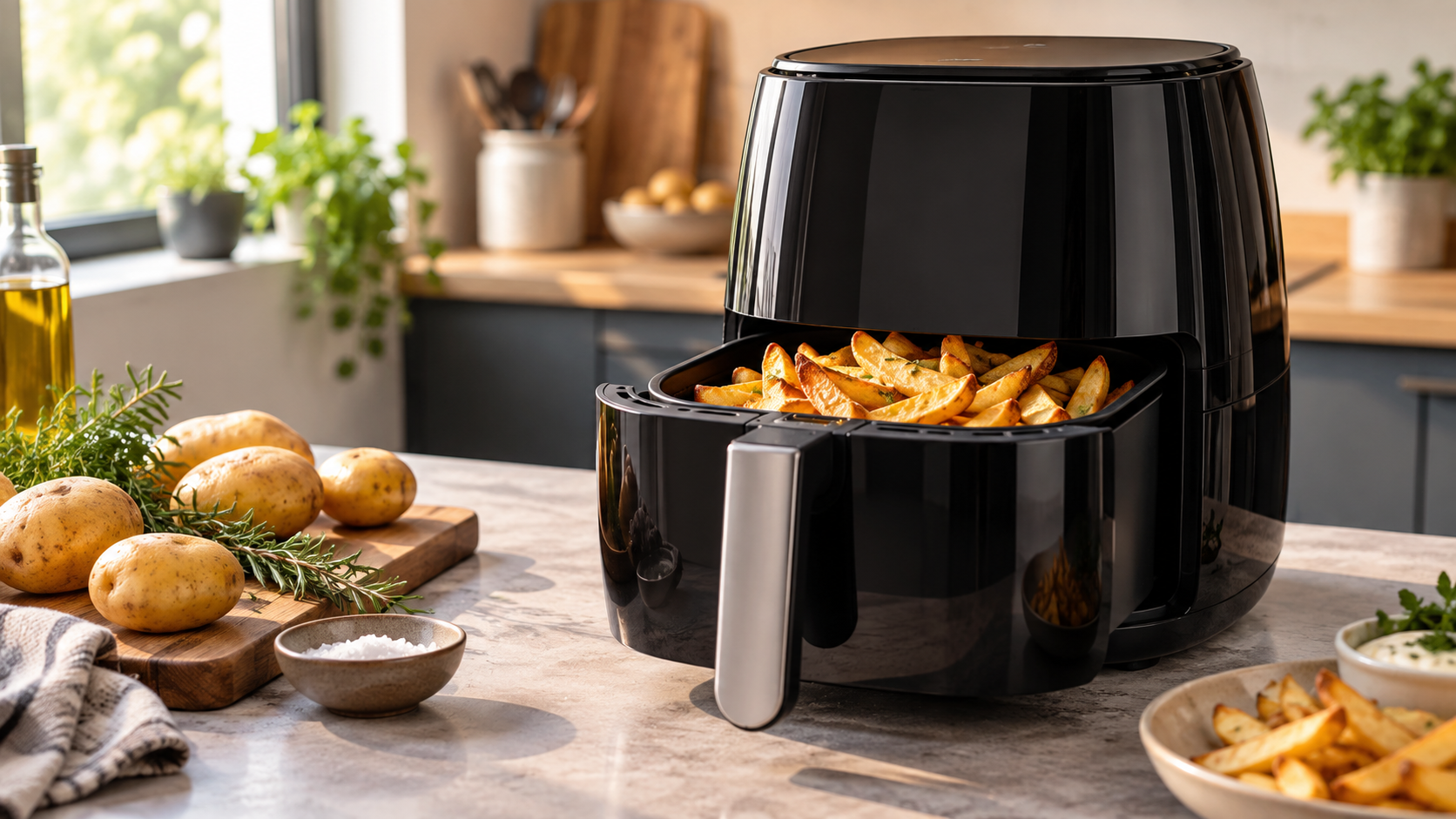
The air fryer went from novelty to national obsession faster than almost any kitchen appliance in living memory, and for good reason: it cooks a lot of everyday food faster, crispier and far more cheaply than a full-size oven. But the market has exploded, prices run from £40 to over £250, and the spec sheets are a confusing muddle of litres, watts, zones and "presets" that mostly do not matter.
This guide cuts through it. We cover the types, the sizes that actually suit UK households, what each budget band gets you, the specifications worth paying for, the running-cost reality, and which brands are genuinely worth your money — so you buy once and buy right rather than replacing a too-small bargain within six months.
The 60-second answer
If you just want a steer:
- One or two people: a single-drawer 4–5L, or a dual-zone 7–8L if you cook two things at once. Budget £60–£100.
- Family of three or four: a dual-zone model of 8–9L total is the default sensible choice. Budget £100–£200.
- Family of five or more, or batch cooking: a large dual-zone (around 9–11L) or a flexible single-basket that can take a whole chicken. Budget £150–£250.
- Tight on space: a compact single drawer, and accept you will cook in batches.
The single most common regret is buying too small. Everything below explains why, and how to avoid the other traps.
Do you actually need one?
Honestly, most UK households will get real use from an air fryer — but it helps to be clear about what it is. An air fryer is a compact, powerful fan oven. A heating element and a strong fan circulate very hot air around food in a perforated basket, crisping the outside quickly while using a fraction of the energy of a large oven because there is far less empty space to heat.
What it does brilliantly: chips, roast potatoes, chicken, fish, bacon, sausages, reheating leftovers so they crisp rather than go soggy, frozen party food, and roasting vegetables. What it does not do: replace an oven entirely. It cannot bake a large cake, roast a big joint, cook for a dinner party of eight, or do anything that needs a lot of space or gentle, even heat over a long time.
If you cook mostly for one or two, reheat a lot, or find yourself firing up a huge oven to cook a handful of chips, an air fryer will pay for itself in convenience and energy savings. If you already have a small, efficient oven and rarely cook the sort of food air fryers excel at, the benefit is smaller. Our honest verdict on whether air fryers are worth it weighs this up in detail.
The types of air fryer
There are four main formats, and choosing the right one matters more than any individual spec.
1. Single-drawer (basket) air fryers
The classic format: one drawer with one basket, typically 3.5–6L. Simple, compact, cheap and easy to clean. Perfect for one or two people, or as a supplement to an oven.
The limitation is obvious once you cook a full meal: everything has to go in together or be cooked in sequence, so your chips and your chicken share the same time and temperature, and a second batch means waiting. For solo cooks and couples this is rarely a problem; for families it quickly becomes one.
2. Dual-zone (twin-drawer) air fryers
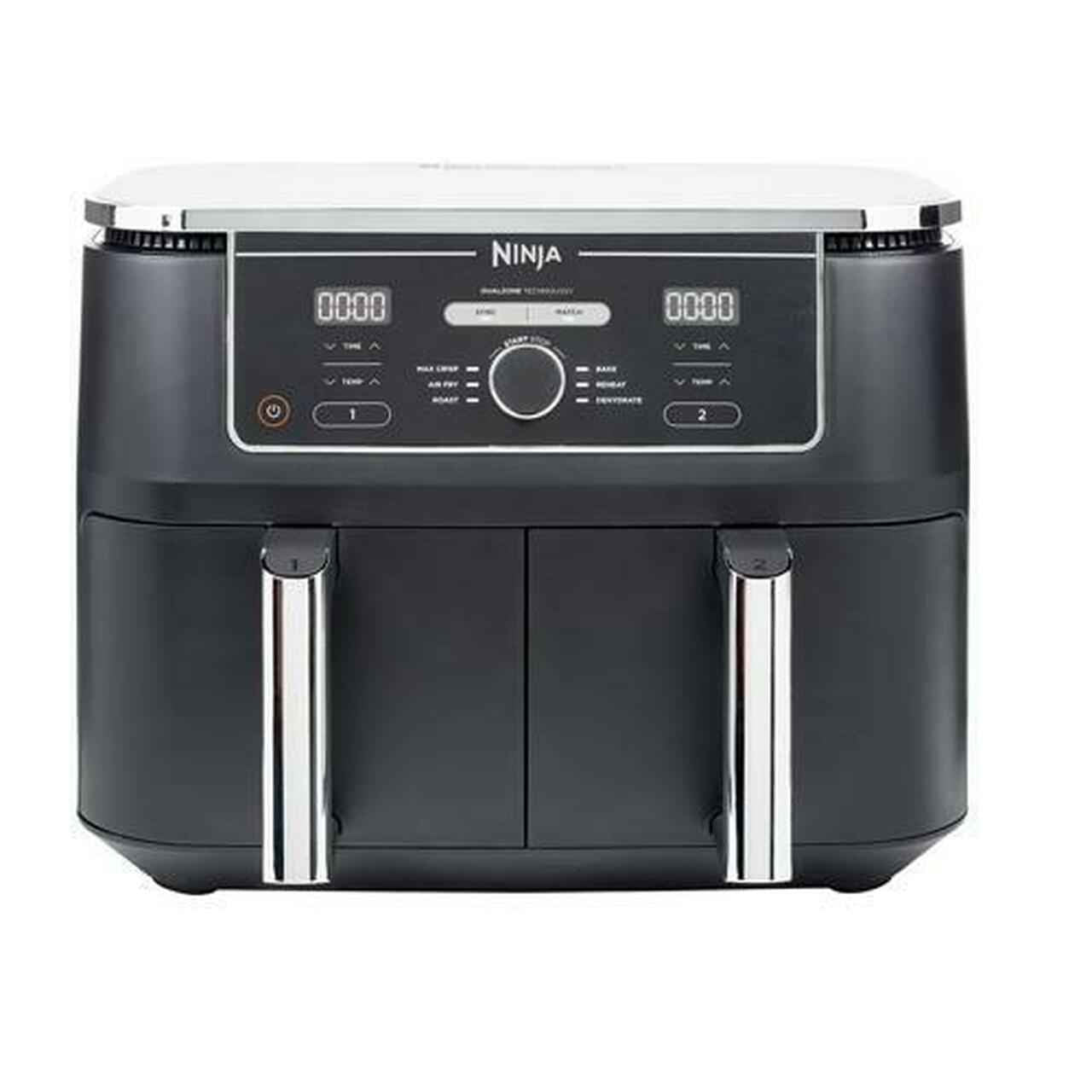
Two separate drawers, each with its own basket, element and fan, so you can cook two different foods at two different temperatures at the same time — chips in one, salmon in the other — and use a "sync finish" function so both are ready together.
This is the format most UK families should buy. It solves the single biggest frustration of air frying: getting a whole meal to land on the plate at once. The trade-off is size — a dual-zone unit has a noticeably larger worktop footprint — and that each individual drawer is smaller than the total litre figure suggests.
3. Flexi-basket and single-large-basket models
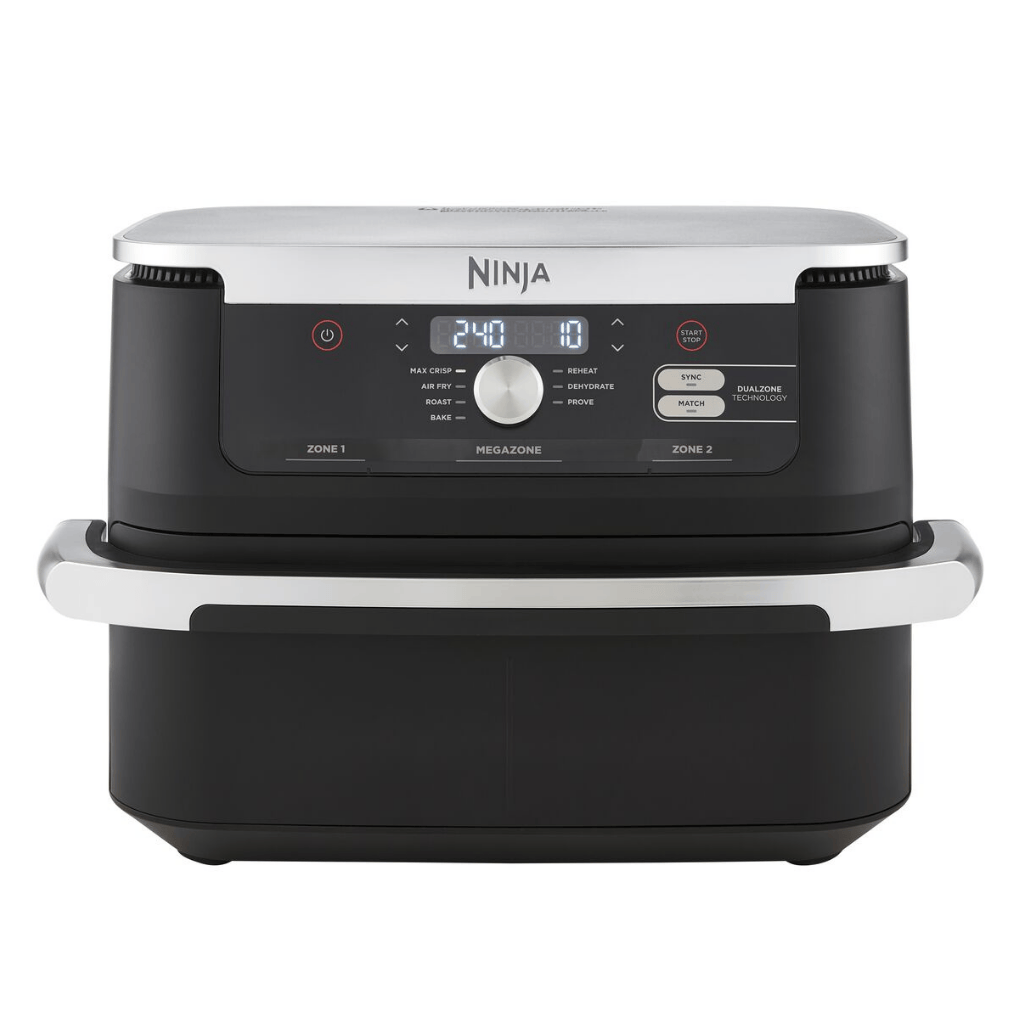
A newer middle ground: one large drawer with a removable divider, so it works as one big space or two smaller ones as needed. You get the flexibility of dual-zone cooking plus the ability to cook one large item — a whole chicken, a large gammon — that would not fit in either drawer of a twin unit.
For households that sometimes cook two things and sometimes one big thing, this is often the smartest buy. It is usually a little pricier than an equivalent twin-drawer model.
4. Oven-style and multi-function air fryers
Larger countertop units with a door, shelves and a viewing window, often combining air frying with baking, grilling, dehydrating and rotisserie. Some are marketed as "air fryer ovens".
They offer the most capacity and versatility and let you see the food cooking, but they take up serious worktop space, heat up less efficiently than a sealed drawer (more empty volume), and can be fiddlier to clean. Worth considering if you want a genuine mini-oven that can also air fry, less so if pure air-frying efficiency is the goal.
| Type | Typical capacity | Best for | Main limitation |
|---|---|---|---|
| Single drawer | 3.5–6L | 1–2 people, small spaces | One food at a time |
| Dual-zone | 7–11L total | Families, full meals | Big footprint; each drawer smaller than total |
| Flexi-basket | 9–11L | Mix of two foods and big single items | Usually pricier |
| Oven-style | 10–25L | Versatility, seeing food cook | Bulky, less efficient |
What size do you actually need?
Getting the size right is the decision people most often get wrong, so it deserves its own section. The key thing to understand is that litres are not portions — a 5L basket does not hold five people's worth of chips, because the air has to circulate around the food and food only cooks well in a roughly single layer.
As a rough guide for how much a basket cooks well in one go:
| Capacity | Cooks well for | Suits |
|---|---|---|
| 2–3.5L | 1 person, sides | Solo, small kitchens, caravans |
| 4–5L (single) | 1–2 people | Couples, supplement to an oven |
| 7–8L (dual-zone) | 2–3 people, two foods | Small families |
| 9–11L (dual-zone/flexi) | 4–5 people, full meals | Families, batch cooking |
| 12L+ (oven-style) | 5+ people, whole chicken | Large households, versatility |
Two practical warnings. First, if you are choosing between two sizes, go larger — nobody regrets the extra capacity, but plenty of people replace a unit that turned out too small. Second, check the physical dimensions and, crucially, the height clearance if you plan to keep it under a wall cabinet; big dual-zone units are taller than people expect and vent hot air upwards. Our dedicated guide on what size air fryer you actually need has room-by-room advice.
What you get at each budget band
Under £60
Basic single-drawer models, usually 3.5–5L, with a simple dial timer and temperature control. They air fry perfectly well — the fundamental technology is cheap — but expect a smaller basket, a louder fan, a shorter warranty and more basic build quality. Perfectly sensible for a solo cook or as a second unit.
£60–£100
The value heartland. This band gets you a good single-drawer model with digital controls and presets, or an entry-level dual-zone unit around 7–8L. Build quality, non-stick coatings and fan noise all improve noticeably. For most couples and small families, the best value in the whole category sits here.
£100–£150
Mid-range dual-zone territory: larger total capacity (8–9L), better presets including sync-finish, clearer displays, sometimes a viewing window, and dishwasher-safe drawers. This is the default band for a family that wants to cook a full meal in one go.
£150–£200
Premium dual-zone and flexi-basket models. Bigger capacity, the best sync functions, higher-quality non-stick, quieter fans, more even cooking, and features like probe thermometers on some models. Worth it for larger families and people who use the air fryer as their primary cooking appliance.
£200 and above
Flagship dual-zone, large flexi-drawer, and multi-function oven-style units. You are paying for maximum capacity, the ability to cook one large item, premium build, and versatility (rotisserie, dehydrate, bake). Genuinely useful for big households and enthusiasts; overkill for a couple.
The specifications that matter (and the ones that do not)
Capacity and drawer shape: matters most
As covered above, this is the spec that determines your day-to-day satisfaction. Beyond raw litres, look at the shape of the basket — a wide, shallow basket cooks a single layer of chips far better than a tall, narrow one of the same volume, because more food sits in the fast-moving air.
Wattage: relevant, but not a simple "more is better"
Most air fryers run at 1,400–2,400W. Higher wattage generally means faster pre-heat and cooking, and dual-zone units draw more because they are effectively two appliances. But a higher wattage does not mean higher running cost per meal if it cooks faster — what matters is total energy used, which is wattage multiplied by time. A punchy 2,000W single drawer that cooks in 15 minutes can use less energy than a weak one grinding away for 30.
Temperature range: check the top end
Look for a maximum of at least 200°C, ideally higher. The very hot end of the range is where you get proper crisping and browning. A model that only reaches 180°C will struggle to get chips genuinely crispy.
Controls: dial vs digital
Dials are simple, cheap and never suffer from unresponsive touchscreens; digital controls offer presets, precise temperatures and sync-finish functions. Presets are convenient but not essential — they are just pre-set time and temperature combinations you could set yourself. Do not pay a big premium for a long list of them.
Sync finish: genuinely useful on dual-zone
If you buy a twin-drawer model, a sync-finish function (which staggers the start of each drawer so both finish at the same moment) is the feature that makes the format worthwhile. It is standard on most decent dual-zone units.
Non-stick and dishwasher-safe parts: matters for daily use
You will clean this appliance constantly, so removable, dishwasher-safe, well-coated baskets make a real difference to whether you keep using it. Cheap coatings degrade; check owner feedback on longevity. A crisper plate that lifts out separately is much easier to clean than one fixed in place.
Viewing window and interior light: nice, not essential
Being able to see the food without opening the drawer is pleasant and reduces the temptation to interrupt cooking, but it is a convenience rather than a performance feature. Do not let it drive the decision.
| Spec | How much it matters | What to look for |
|---|---|---|
| Capacity & shape | Critical | Right size for your household; wide, shallow baskets |
| Format (single/dual/flexi) | Critical | Dual-zone for families, single for couples |
| Max temperature | High | At least 200°C for proper crisping |
| Sync finish (dual-zone) | High on twin drawers | Standard on good models |
| Cleaning / non-stick | High (daily use) | Dishwasher-safe, removable crisper plate |
| Wattage | Moderate | 1,400W+ single; total energy matters, not peak watts |
| Presets | Low | Convenient but not worth a premium |
| Viewing window | Low | Nice to have, not a deciding factor |
What it actually costs to run
Low running costs are one of the air fryer's biggest selling points, and the maths genuinely stacks up — though the popular claim that they cost "pennies" needs a little nuance.
The electricity
An air fryer's running cost is its wattage multiplied by how long it runs. A 1,500W air fryer running for 20 minutes uses 0.5kWh; a 2,000W dual-zone running for 25 minutes uses about 0.83kWh. At the current Ofgem energy price cap unit rate, that is roughly 12–21p per cooking session for a typical meal.
The saving versus an oven comes from two things: an air fryer draws less power than a large fan oven at full tilt, and, more importantly, it needs little or no pre-heating and heats a tiny sealed space rather than a large cavity. For cooking small-to-medium portions, that can cut the energy used for that dish by half or more. For cooking a large quantity of food, a full oven can actually be more efficient per portion — the air fryer's advantage is greatest for small and medium meals.
We have run the full comparison in two dedicated guides: how much it costs to run an air fryer in the UK and air fryer vs oven: which actually saves money.
The purchase and the hidden costs
Beyond electricity, factor in the purchase price (£40–£250), occasional replacement of baskets or crisper plates if the coating wears, and liners if you choose to use them (though a well-coated basket rarely needs them). There is no filter or consumable to replace on a routine basis, which makes the air fryer one of the cheapest appliances to own over its life.
Health: what an air fryer does and does not do
Air fryers are frequently sold on health benefits, and there is truth in the claim — but also some overstatement worth clearing up.
The genuine benefit is fat reduction. Because hot air does the crisping, you need little or no added oil — a light spray rather than a deep-fat fryer's litre. For anyone trying to cut down on the fat in fried favourites like chips, this is a real, meaningful reduction, and it comes without the smell, mess and hazard of a pan of hot oil.
What an air fryer does not do is make inherently unhealthy food healthy. Air-fried chips are still chips; processed party food is still processed. The appliance reduces added fat, but the underlying ingredients matter far more, as the NHS advice on a balanced diet makes clear.
One nuance worth knowing: cooking starchy foods such as chips and roast potatoes at high temperatures produces a compound called acrylamide, and this applies to air frying just as it does to oven roasting and deep frying. The practical advice from the Food Standards Agency is simple — aim for a golden colour rather than dark brown, and do not overcook. It is not a reason to avoid air frying, just to cook sensibly.
Cleaning and maintenance
Air fryers are low-maintenance, but a little routine care keeps them performing and stops them smelling.
- After each use: let it cool, then wash the basket and crisper plate in warm soapy water or the dishwasher if they are dishwasher-safe. Wipe the interior of any splatter.
- Every few uses: check the heating element above the basket for grease build-up and wipe it gently once cool — this is the main cause of the "burning smell" people report.
- Never: use metal scourers or abrasive pads on the non-stick coating, or submerge the main unit in water.
The two things that shorten an air fryer's life are letting grease bake onto the element over time, and damaging the non-stick with metal utensils or harsh cleaning. Avoid both and a good unit will last many years.
The brands, honestly assessed
Ranges change constantly, so treat this as a guide to what each brand tends to be good and bad at rather than a verdict on any one model.
Ninja
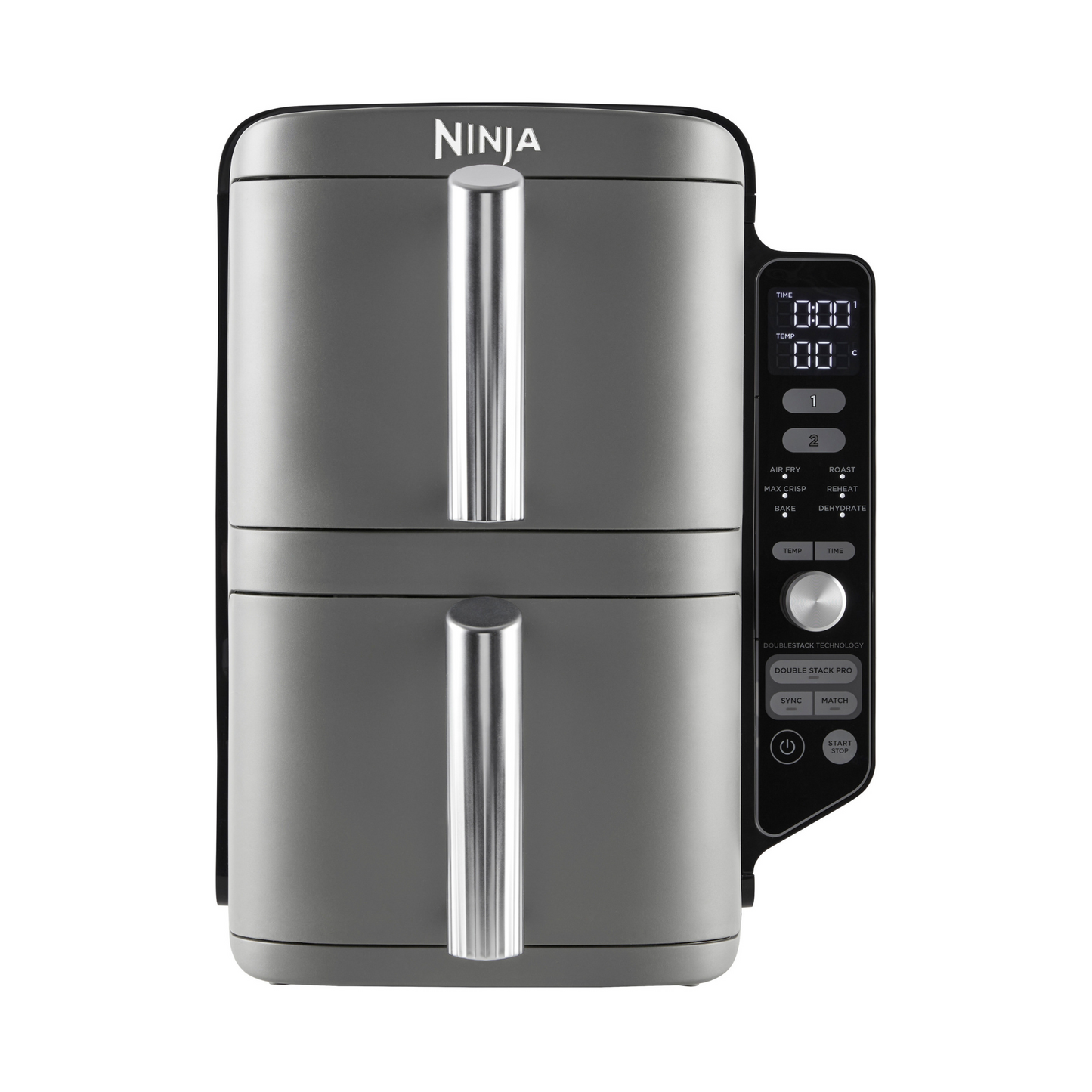
The dominant name in the UK and, on the whole, deservedly so. Ninja effectively popularised the dual-zone format and its build quality, even cooking and app-free ease of use are consistently strong. The range is broad — single, dual-zone, flexi-drawer and stacked models. The downside is price: Ninja rarely offers the cheapest option on paper, and you pay a premium for the badge and the reliability. Our comparisons of Ninja vs Cosori and Ninja vs Tower put this in context, and Ninja Crispi vs a standard Ninja air fryer covers the newer portable format.
Cosori
Excellent all-rounder, particularly strong on single-drawer models and increasingly on dual-zone. Good build, clear controls, quieter than many rivals, and often better value than Ninja for comparable capacity. A very safe recommendation for couples and small families.
Tower
The value champion. Tower consistently undercuts the big names, and its air fryers cook perfectly well — you are giving up some polish, some non-stick longevity and some of the quieter-fan refinement, not the core performance. A strong choice for buyers on a budget.
Tefal
Best known for the ActiFry range, which uses a distinctive paddle to stir food automatically — brilliant for chips, curries and anything that benefits from tossing, less relevant for items you would not want stirred. Also makes conventional basket models. Well-built and durable, with a loyal following.
Instant (Instant Vortex)
The brand behind the Instant Pot, with a solid range of single and dual-zone air fryers. Good value, reliable, clear controls, and widely available. A dependable mid-market choice.
Philips
The brand that arguably invented the modern air fryer. Premium build and even cooking, with the price to match. Its dual-basket models compete at the upper end. Worth considering if build quality and brand heritage matter to you, though you can get similar performance for less elsewhere.
Salter, Russell Hobbs, Tefal and supermarket own-brands
Plenty of capable budget and mid-range options here, frequently discounted. Performance on the basics is usually fine; the compromises are typically in non-stick durability, fan noise, warranty length and parts availability. Buy from a retailer with an easy returns process and check owner feedback on longevity.
Seven mistakes people make buying an air fryer
- Buying too small. The number one regret. Litres are not portions — size up if in doubt.
- Assuming a single drawer will feed a family a full meal. It will not, at least not in one go. Families want dual-zone.
- Paying for a long list of presets. They are just saved time-and-temperature settings you could enter yourself.
- Ignoring worktop and height clearance. Big dual-zone units are taller and deeper than expected and vent heat upwards.
- Chasing the highest wattage or suction-style numbers. Total energy used and basket shape matter more than a peak figure.
- Overlooking cleaning. If the parts are not dishwasher-safe or easy to hand-wash, you will use it less.
- Expecting it to replace the oven entirely. It is a brilliant partner to an oven, not a total replacement.
A four-question decision framework
Answer these honestly and the right air fryer narrows down fast.
1. How many people are you usually cooking for?
One or two: a single 4–5L drawer, or a small dual-zone if you like cooking two things. Three or four: a dual-zone of 8–9L. Five or more: a large dual-zone or flexi-basket of 9–11L.
2. Do you want to cook a whole meal at once?
If yes — chips and a protein and a vegetable, all ready together — you want dual-zone with sync finish, not a single drawer. This single question rules out or in the twin-drawer format.
3. Do you ever cook one large item?
A whole chicken, a large gammon, a big traybake: if so, a flexi-basket (one big space with a removable divider) or an oven-style unit will serve you better than a twin-drawer, where neither drawer is large enough.
4. How much worktop space do you have?
Be realistic and measure it, including height under any wall cabinets. A large dual-zone unit is a permanent worktop resident. If space is tight, a compact single drawer and batch cooking may be the sensible compromise.
The bottom line
For most UK families, the right answer is a dual-zone air fryer of around 8–9L, from a reliable brand, costing £100–£200 — it handles a full family meal in one go, and that convenience is what turns an air fryer from a gadget into the appliance you reach for every day. Couples and solo cooks are better served by a single 4–5L drawer at £60–£100, and only large households or those who cook big single items need to go bigger or opt for a flexi-basket.
Whatever you choose, size up rather than down, prioritise basket shape and easy cleaning over a long preset list, and check it physically fits your worktop. Get those right and an air fryer is one of the best-value, most-used purchases you can make for a UK kitchen. For independent lab testing to sense-check any specific model, Which?'s air fryer reviews are a reliable reference before you commit.
Frequently asked questions
What size air fryer do I need for a family of four?
A dual-zone model of around 8–9L total is the sweet spot for a family of four. That gives you two baskets big enough to cook, say, chips in one and chicken or fish in the other at the same time, with both ready together. A single drawer of the same total litres will not manage a full family meal in one go. If in doubt, size up — the most common air fryer regret is buying one that turns out too small.
Is a dual-zone air fryer worth it over a single drawer?
For families, yes — it is the single most useful upgrade. Two independent drawers let you cook two different foods at different temperatures and finish them at the same moment, which solves the biggest frustration of air frying a whole meal. For solo cooks and couples who mostly cook one thing at a time, a single drawer is cheaper, more compact and perfectly adequate.
How much does it cost to run an air fryer in the UK?
Roughly 12–21p for a typical cooking session, depending on the wattage and how long it runs. An air fryer usually uses less energy than a large fan oven for small-to-medium portions because it barely needs pre-heating and heats a tiny sealed space. The saving shrinks for very large quantities, where a full oven can be more efficient per portion. Over a year, most households save a meaningful amount versus using the oven for everyday small meals.
Are air fryers actually healthier?
They reduce added fat, which is a real benefit — hot air does the crisping, so you need little or no oil compared with deep frying. That said, an air fryer does not make unhealthy food healthy; air-fried chips are still chips. As with any high-temperature cooking of starchy foods, aim for golden rather than dark brown to limit acrylamide. Used sensibly, it is a genuinely useful tool for lower-fat versions of fried favourites.
Can an air fryer replace my oven?
Not entirely. An air fryer is brilliant for chips, roast potatoes, chicken, fish, bacon, reheating and frozen food, and for many households it takes over most everyday cooking. But it cannot bake a large cake, roast a big joint, or cook for a large gathering. Think of it as a fast, efficient partner to your oven rather than a full replacement.
How many watts should an air fryer be?
Most good single-drawer models run at 1,400–1,700W and dual-zone units at 2,000–2,400W because they are effectively two appliances. Higher wattage means faster heating, but it does not automatically mean higher running costs — what matters is total energy used, which is wattage multiplied by cooking time. A powerful model that cooks quickly can use less energy overall than a weak one that takes far longer.
Do air fryers need liners or special accessories?
No. A well-coated, non-stick basket rarely needs liners, and using them can actually block airflow and reduce crisping if they cover too much of the perforated base. Paper or silicone liners are optional for very sticky or messy foods and easier clean-up, but they are a convenience, not a necessity. The accessories genuinely worth having are limited to what your cooking needs — a rack, or a tin that fits your basket.
Which air fryer brand is the most reliable?
Ninja has the strongest overall reputation in the UK for build quality and consistency, with Cosori, Tefal, Instant and Philips also well regarded. Tower is the standout value brand — its air fryers cook well, you simply give up some refinement and non-stick longevity. Whichever brand you choose, buy from a retailer with a straightforward returns process and check owner feedback on how the non-stick coating holds up over time.