"What size air fryer do I need?" is the question that decides whether you love the thing or resent it. Buy too small and you're cooking dinner in two batches every night. Buy too big and it dominates the worktop, won't fit under the wall cupboards, and takes longer to preheat than the oven you were trying to avoid.
The frustrating part is that the litre figure on the box tells you much less than you'd think. Here's what actually matters, with real capacities and dimensions from the models we've reviewed.
Litres don't mean what you assume
Quoted capacity is the total volume of the basket — right up to the brim. You can't cook to the brim. Air frying works by circulating hot air around the food, so the food has to sit in a single layer, or close to it, with room for air to move. Overfill a basket and you get steamed, pale, soggy results.
As a rough working figure, usable cooking space is around 60–70% of the quoted litre capacity. A 5L air fryer gives you roughly a 3–3.5L working volume. That's still plenty for two people, but it's not what the marketing implies.
Independent testers make the same point: Which? assesses air fryers on how much food they genuinely cook well rather than on the manufacturer's stated volume, and the ranking often looks nothing like the litre figures would suggest.
The other thing litres won't tell you is basket shape. A tall, narrow 6L basket is worse for chips and chicken thighs than a wide, shallow 5L one, because what you actually need is surface area. Check the basket footprint, not just the volume.
What size for how many people
Here's the realistic guide, assuming you want to cook a full meal component — chips, roast veg, chicken pieces — in one go:
| Household | Capacity to look for | What it handles comfortably |
|---|---|---|
| 1 person | 3–4L | A portion of chips, two chicken thighs, a piece of fish |
| 2 people | 5–6L | Chips for two, or a small chicken, or four sausages plus veg |
| 3–4 people | 7–10L (usually dual drawer) | A main and a side simultaneously, or chips for four |
| 5+ people | 9–11L dual, or two appliances | Full family meal, though you may still batch |
| Batch cooking / entertaining | 10L+ | Large joints, big trays of roast veg |
The single most common sizing mistake is a family of four buying a 5L single-basket model because it's cheap and the box says "family size". It isn't. You'll cook the chips, then cook the chicken, and the chips will be cold.
Single basket vs dual drawer
This matters more than raw capacity. A 9L dual-drawer air fryer is not the same as a 9L single basket — it's two separate 4.5L compartments that cannot be combined.
Single basket
Better if you frequently cook one large item: a whole chicken, a big tray of chips, a joint of meat. All the space is in one place. Cheaper, lighter, and simpler to clean. The limitation is that everything cooks at the same temperature at the same time.
Dual drawer
Better for actual weeknight meals. You can run chips at 200°C in one drawer and salmon at 180°C in the other, with sync functions that finish both at the same moment. That convenience is genuinely transformative for family cooking. The trade-off is that neither drawer alone is very big, and you can't cook anything larger than a single compartment.
Flexible designs
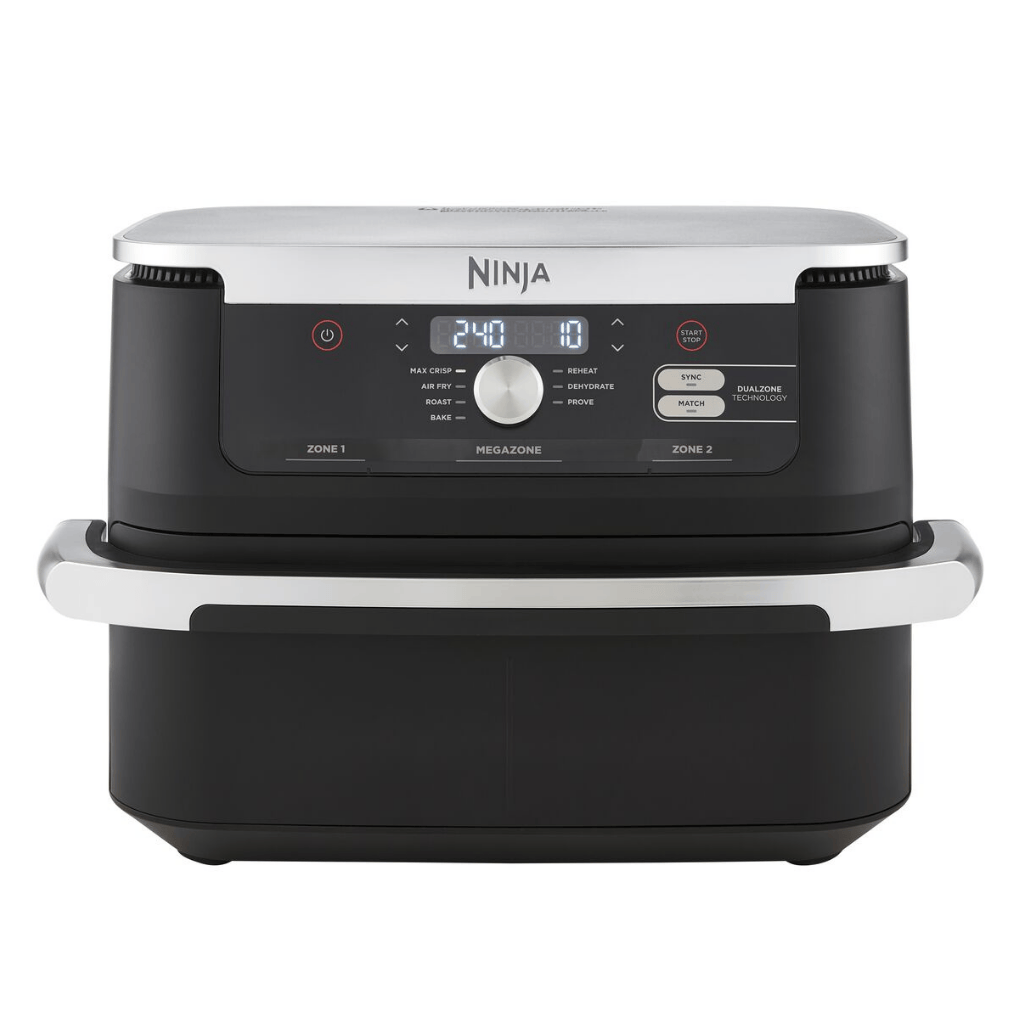
A few newer models solve this. The Ninja Foodi FlexDrawer AF500UK has a 10.4L drawer with a removable divider — use it as two 5.2L zones for a two-part meal, or take the divider out and use the whole 10.4L for a large joint. It's the most versatile layout on the market, and it's why it sits at £249 rather than £100.
The dimension nobody checks: will it fit?
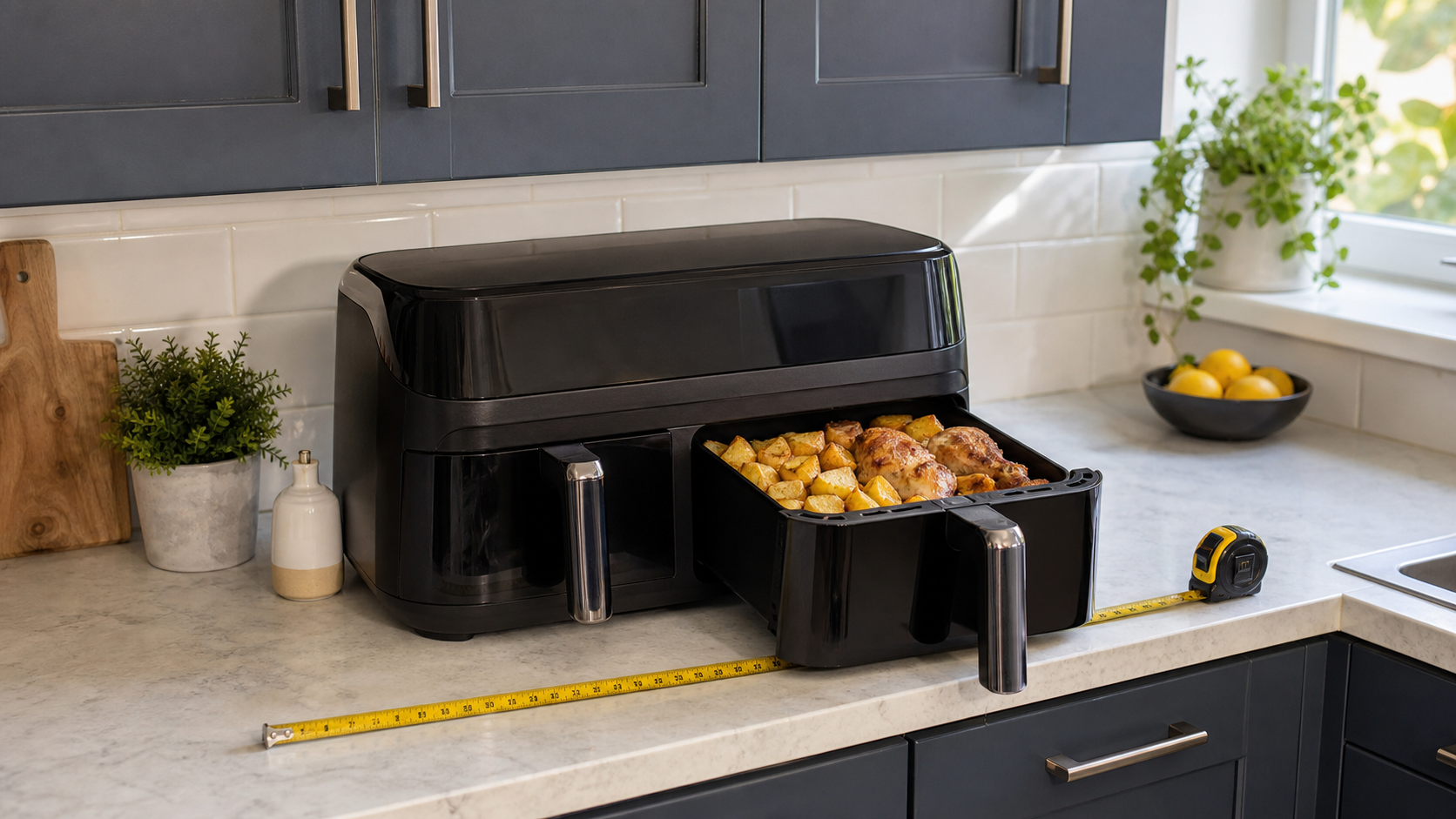
This catches people out constantly. Air fryers are tall, and the standard gap between a UK worktop and the wall cupboards above is often around 45–50cm — in many kitchens less. Several large air fryers are close to that limit before you account for the lid clearance they need to vent.
Look at the actual dimensions of the models we've reviewed:
| Model | Capacity | Footprint (W × D) | Height |
|---|---|---|---|
| Tefal Easy Fry Max 5L | 5L single | 38 × 27 cm | 32 cm |
| Cosori Pro LE 5L | 4.7L single | 30 × 30 cm | 32 cm |
| Cosori TurboBlaze 6L | 6L single | 36 × 28 cm | 32 cm |
| Instant Vortex Plus Dual | 7.6L (2 × 3.8L) | 39 × 33 cm | 28 cm |
| Tower Vortx 9L Duo | 9L (2 × 4.5L) | 42 × 33 cm | 27 cm |
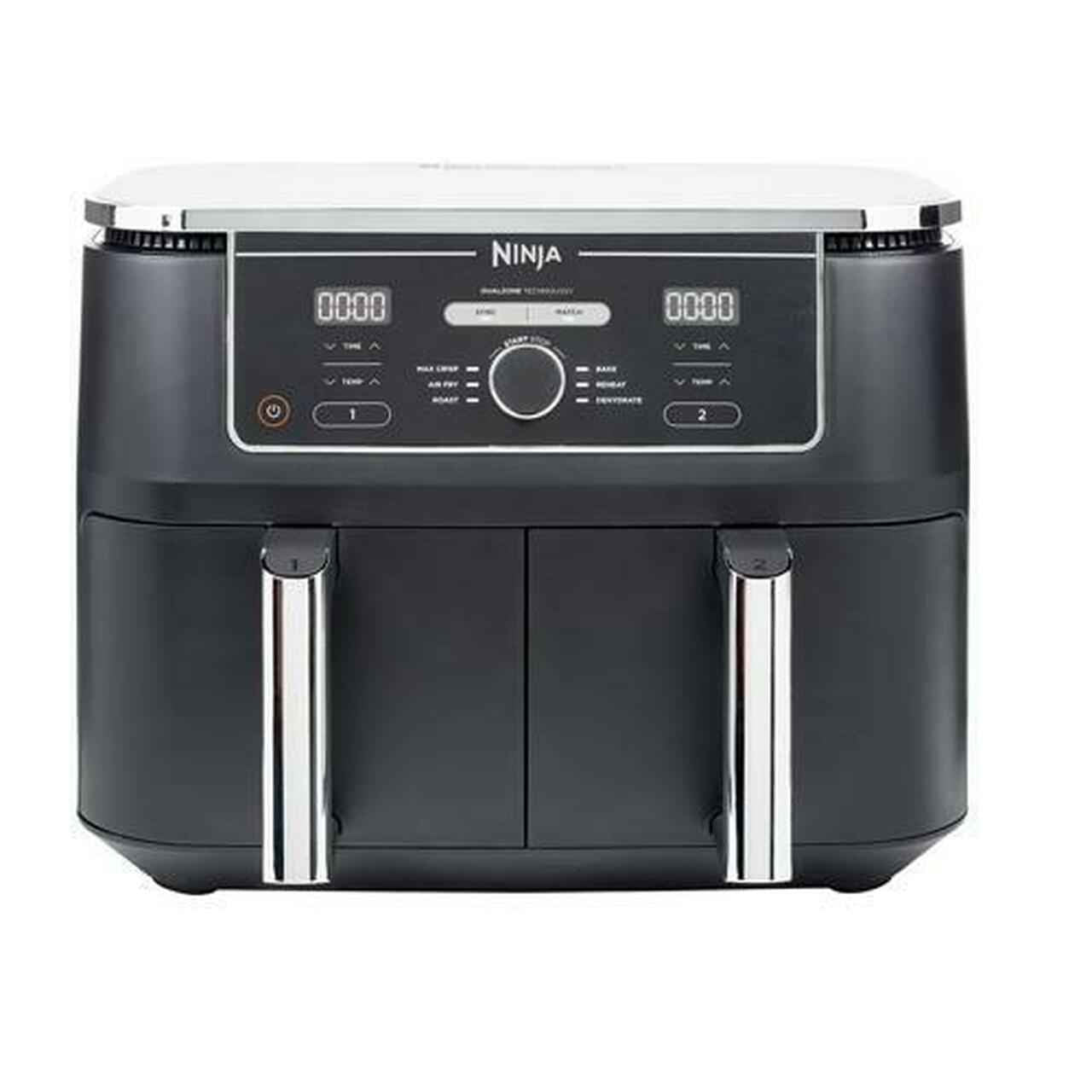
| Ninja Foodi MAX Dual Zone | 9.5L (2 × 4.75L) | 41 × 32 cm | 27 cm |
| Philips 5000 Dual Basket | 9L (6L + 3L) | 44 × 38 cm | 36 cm |
| Ninja Foodi FlexDrawer | 10.4L flexible | 44 × 35 cm | 27 cm |
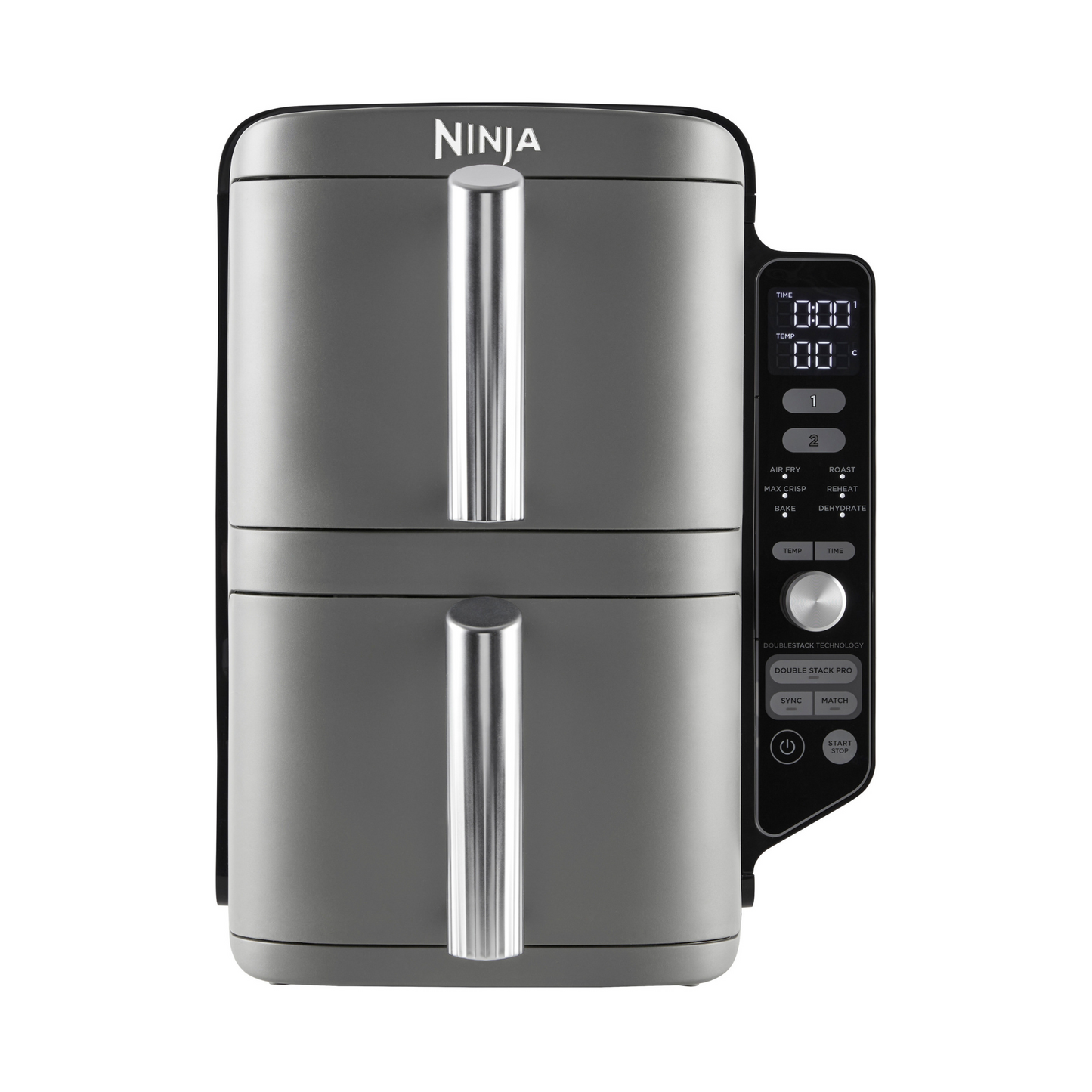
| Ninja Double Stack XL | 9.5L (2 × 4.75L stacked) | 30 × 30 cm | 41 cm |
Two things jump out. First, the biggest-capacity models aren't necessarily the widest — the FlexDrawer holds 10.4L in a 44cm-wide body, while the Philips holds less in a similar footprint.
Second, and more usefully: the Ninja Double Stack XL is the answer for small kitchens. It holds 9.5L across two drawers but occupies just 30 × 30cm of worktop, the same footprint as a 4.7L Cosori, because it stacks the drawers vertically instead of side by side. The trade-off is a 41cm height, so measure your cupboard clearance carefully before buying it.
Before you buy anything, do this: measure the width and depth of the space you'll put it in, and the height to the underside of the cupboard. Then add about 10cm behind and above for ventilation — air fryers exhaust a lot of hot air and shouldn't be boxed in against a wall or under a shelf.
Weight matters if it won't live on the worktop
If you plan to store the air fryer in a cupboard and lift it out when needed, be realistic about that. Compact 5L models weigh 4–5kg, which is easy enough. Large dual-drawer models are 8–9kg — the Ninja Double Stack XL is 9.3kg. Lifting nine kilos out of a low cupboard several times a week gets old fast, and most people who intend to store one end up leaving it out permanently. Plan the worktop space from the start.
Does a bigger air fryer cost more to run?
Marginally, yes — but the difference is surprisingly small. If running costs are a concern, our comparison of air fryer vs oven energy costs shows just how much cheaper any air fryer is compared to a conventional oven, regardless of size. Still on the fence? Our are air fryers worth it guide covers the broader question, and our Ninja vs Tower head-to-head helps you choose between premium and budget.
Somewhat, but less than you'd expect. Larger models draw more power — 2,470W for the Ninja MAX against 1,500W for the Tefal Easy Fry — but they also preheat and cook faster, and crucially they let you cook everything in one go rather than running two batches.
Cooking one full load in a big air fryer is usually cheaper than two loads in a small one. Where an oversized air fryer wastes energy is heating a large empty basket to cook one jacket potato. If you mostly cook small amounts, a smaller unit genuinely is more efficient.
Size affects food safety too
An overloaded basket doesn't just cook badly — it cooks unevenly, and with meat that's a real concern. Food packed in layers leaves cold spots where the air can't circulate, so pieces at the bottom may not reach a safe temperature even though the ones on top look done. The Food Standards Agency's guidance on cooking food thoroughly is worth reading if you regularly cook chicken or mince in an air fryer.
The practical answer is a meat thermometer and a basket you're not tempted to overfill. Buying slightly bigger than you think you need makes it far easier to avoid cramming.
A quick decision framework
- Count the portions you cook most often — not the maximum you'll ever cook at Christmas.
- Add 20–30% to allow for the gap between quoted and usable capacity.
- Decide single or dual. Cooking two different things at once? Dual. Cooking one big thing? Single. Both? Look at a flexible-divider model.
- Measure your space — width, depth, and height to the cupboard — and add ventilation clearance.
- Check the footprint, not the capacity, if worktop space is tight. A stacked design gets you far more litres per square centimetre.
For the wider picture — types, budgets, running costs and the specs that matter beyond capacity — see our ultimate air fryer buying guide.
For most UK households the sweet spot is a dual-drawer model between 7L and 9.5L, at somewhere around £100–£200. Below that you're batch cooking; above it you're paying for capacity you'll use a handful of times a year. The exception is a genuinely small kitchen — in which case a stacked design gives you family capacity without surrendering half the worktop.