Sage and De'Longhi dominate the premium coffee machine market in the UK, but they come at the question from completely opposite directions. Sage builds manual and assisted espresso machines for people who want barista-level control. De'Longhi specialises in bean-to-cup automatics that do everything at the push of a button. Choosing between them is less about which brand is "better" and more about which philosophy suits the way you actually make coffee. This guide breaks it down honestly.
The short answer
Buy a Sage if you want the highest possible espresso quality, you enjoy the process of dialling in a shot, and you are happy to invest time learning. Buy a De'Longhi if you want consistently good coffee for a busy household with zero skill required, auto-milk, and one-touch convenience. Most UK families are better served by De'Longhi; serious home baristas will be happier with Sage.
What each brand does differently
Sage — the barista's tool
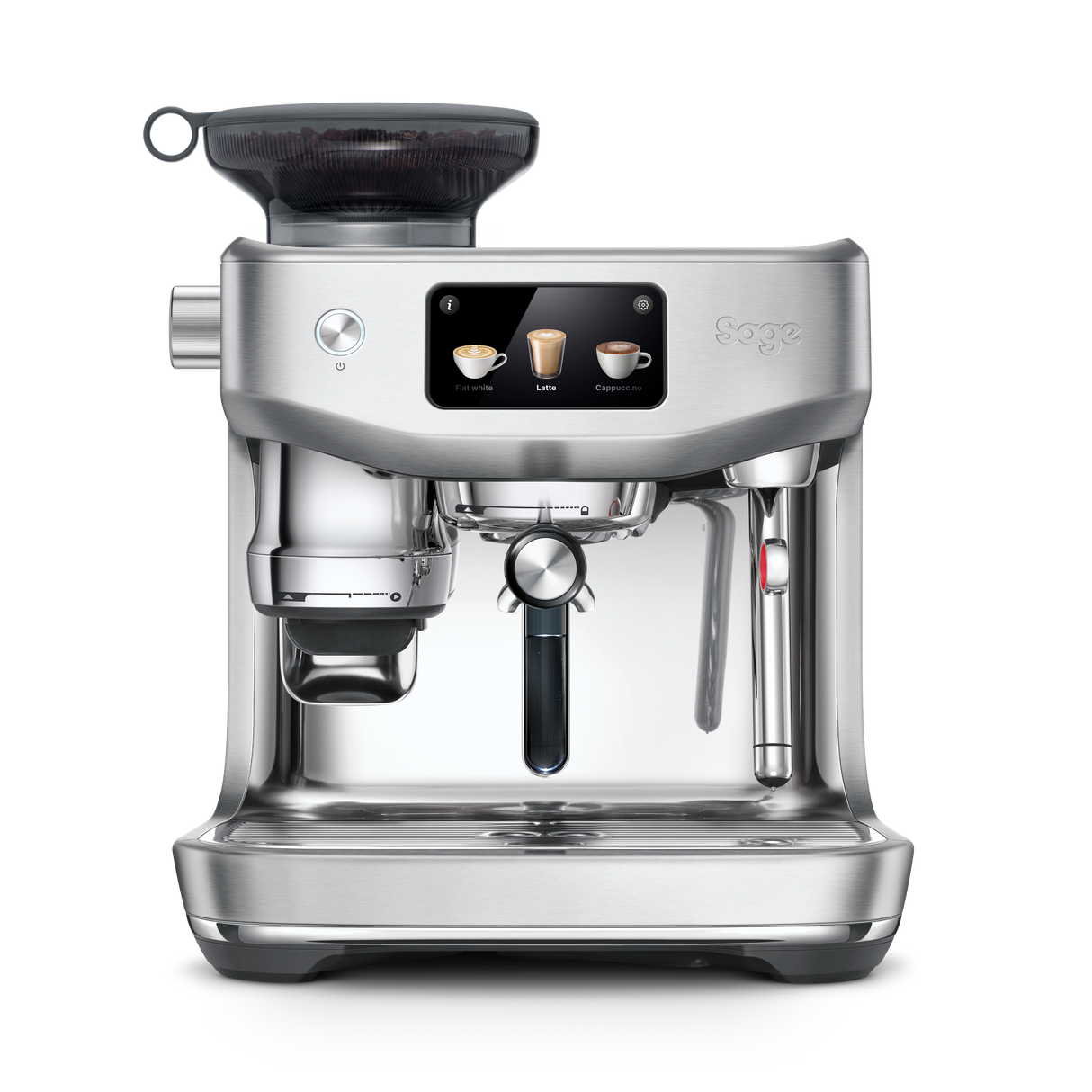
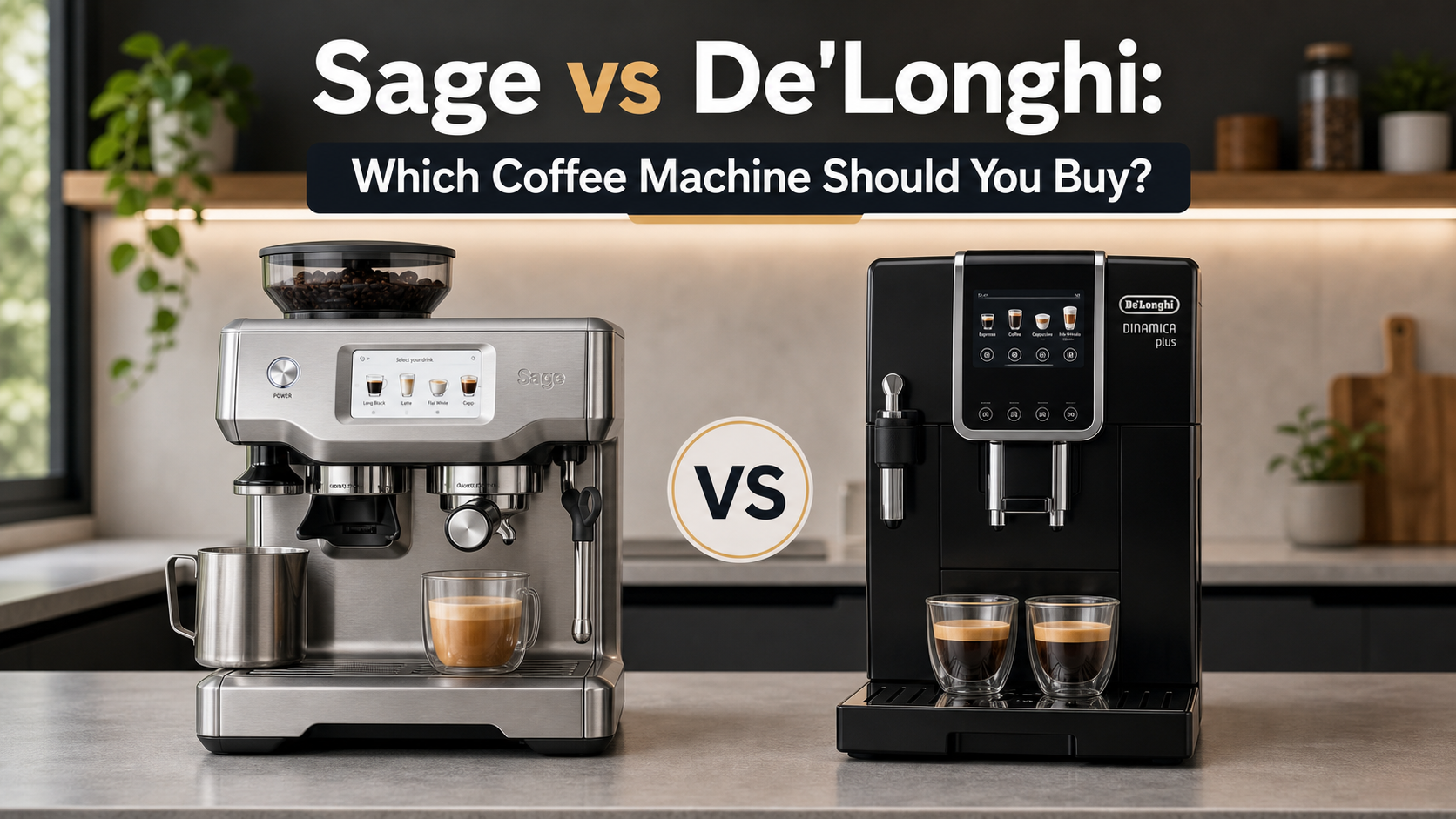
Sage (known as Breville outside the UK) makes semi-automatic and assisted espresso machines. The Sage Oracle Jet (around £1,404) is the flagship — it automates grinding, dosing and tamping but lets you control the shot and steam the milk yourself. The Barista Touch Impress (around £1,099) sits a step below, with a touchscreen interface and assisted tamping that makes it more approachable for beginners while still delivering genuine espresso. Both use commercial-style 58mm portafilters, PID temperature control, and dedicated steam wands — the same fundamentals found in café machines.
The trade-off is time and learning. You need to understand grind size, dose weight, extraction time and milk texturing. On a good day, a skilled operator on a Sage produces espresso that beats any automatic. On a bad day — wrong grind, stale beans, rushed technique — it can taste worse than a £400 bean-to-cup.
De'Longhi — the one-touch automatic
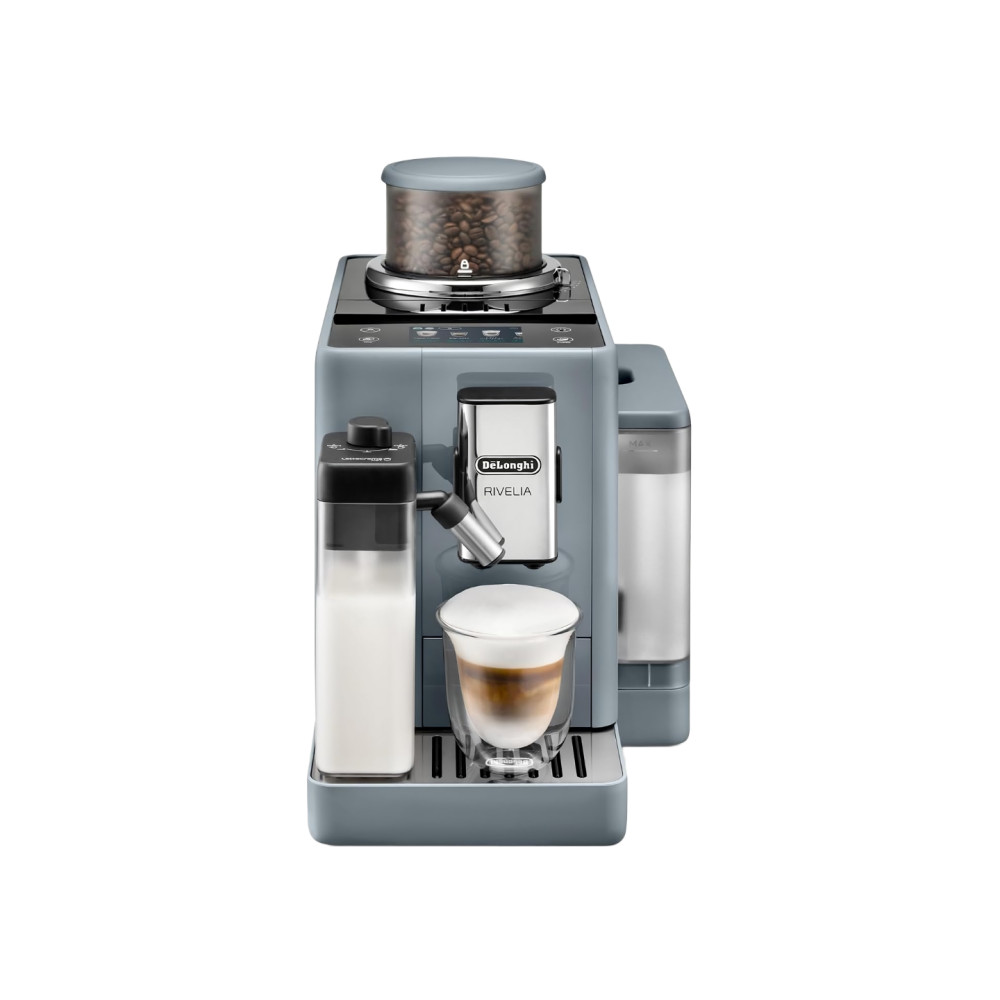
De'Longhi builds fully automatic bean-to-cup machines. The Rivelia EXAM440.55 (around £599, our Best Overall pick) grinds, doses, tamps, brews and textures milk automatically — press a button, walk away, come back to a flat white. The Magnifica Evo Next (around £449) does the same job at a lower price, and the Eletta Explore (around £899) adds hot and cold drink options.
The trade-off is the ceiling. De'Longhi machines make consistently good coffee — better than most high-street chains — but they cannot match the peak quality of a well-pulled manual shot. The grinder is smaller, the brew pressure is fixed, and you cannot fine-tune extraction the way you can with a portafilter machine. For most people, that ceiling is far higher than they will ever notice.
Head to head
| Sage (Oracle Jet / Barista Touch) | De'Longhi (Rivelia / Magnifica Evo) | |
|---|---|---|
| Price range | £1,099–£1,404 | £449–£899 |
| Type | Semi-automatic / assisted espresso | Fully automatic bean-to-cup |
| Grinder | Conical burr, stepless (Oracle Jet) / stepped | Conical burr, stepped (13 settings typical) |
| Milk system | Manual steam wand | Automatic LatteCrema / frother |
| Skill required | Medium to high | None |
| Drinks per session | One at a time (manual process) | Back-to-back, fully automated |
| Espresso quality ceiling | Excellent (barista-dependent) | Very good (consistent) |
| Maintenance | Backflushing, group cleaning, descaling | Auto-rinse, descaling, milk path clean |
| Best for | Enthusiasts, couples, quality-first | Families, convenience, multiple users |
Espresso quality: the honest verdict
From what owners consistently report, a properly dialled-in Sage Oracle Jet produces espresso that is noticeably better than any bean-to-cup at any price. The combination of precise temperature control, a full-size portafilter and a dedicated steam wand gives you the tools to extract flavours that an automatic simply cannot reach. Independent reviewers at Which? consistently rate Sage machines highly for espresso quality, while noting their steeper learning curve.
But that quality only appears when you invest the time. Based on verified owner reviews, first-time Sage buyers spend two to four weeks learning to pull a good shot consistently. De'Longhi owners report good coffee from day one. If you are buying a machine that will be used by multiple family members — especially anyone who just wants their morning coffee without a tutorial — De'Longhi wins on real-world quality, because consistency matters more than peak performance when you are making four drinks before 8am.
Milk drinks: a bigger gap than you might expect
Latte art aside, De'Longhi's automatic milk systems produce genuinely good microfoam — the Rivelia's LatteCrema system is widely regarded as one of the best auto-frothers available, creating silky, well-textured milk with no input from you. The convenience factor is huge: press one button and the machine makes your flat white, rinses the milk path, and is ready for the next drink.
Sage's manual steam wand gives you more control and — in skilled hands — produces better microfoam with a tighter, more velvety texture. But steaming milk properly is genuinely a skill. It takes practice, it takes attention, and it adds 60–90 seconds per drink. For a household that drinks mostly milky coffees, De'Longhi's automatic system is a significant practical advantage.
Running costs and long-term value
Both brands use the same beans, so bean cost is identical. The differences are elsewhere:
- Electricity: Both use roughly similar energy per drink — typically 0.1–0.15 kWh per shot. At current UK energy rates (around 24.5p/kWh as of mid-2026), that is about 2–4p per drink. Negligible either way.
- Grinder replacement: Sage machines use larger, more durable burrs that can last 5–10 years. De'Longhi's smaller ceramic burrs are designed to last the life of the machine but are harder to replace if they do wear.
- Descaling: Both need regular descaling, especially in hard water areas — our UK limescale guide covers this in detail. Sage machines are generally easier to descale manually; De'Longhi machines run an automatic programme.
- Hidden cost — the grinder: If you are comparing a standalone Sage Barista Express (lower-tier) against a De'Longhi, remember Sage machines include a grinder. But if you are stepping up from a Sage to a standalone E61 machine later, you will need a separate grinder (£200–£400+). De'Longhi buyers never face this cost. Our bean-to-cup vs espresso machine guide covers the full cost picture.
Who should buy Sage
- You drink espresso or americanos primarily, and quality is everything.
- You enjoy the ritual — weighing, grinding, tamping, timing the shot.
- You are a couple or a single-person household where one person makes the coffee.
- You want to develop a genuine skill and are willing to make bad coffee for a few weeks while you learn.
- You already know you prefer manual control (perhaps you have used an AeroPress or V60 and want to go further).
Who should buy De'Longhi
- You have a household of 3+ people with different drink preferences.
- You want great coffee immediately, with no learning curve.
- Milky drinks (lattes, flat whites, cappuccinos) are the main order.
- You value convenience and speed over the absolute best possible espresso.
- You want a machine that multiple people can use without training.
What about Sage for beginners?
The Sage Barista Touch Impress is specifically designed to bridge this gap. It automates the grind, dose and tamp — the three steps that trip up beginners most — and uses a touchscreen to guide you through drink selection. It is still a portafilter machine (you pull the shot and steam the milk), but the assisted workflow makes it far more approachable than the Oracle Jet. Based on owner feedback, it is the most recommended Sage for someone transitioning from a bean-to-cup who wants to try the manual route without committing to the full learning curve. Our barista-quality coffee at home guide walks through the technique step by step.
The verdict
For most UK households, De'Longhi is the smarter buy. The Rivelia at £599 produces consistently excellent coffee for the whole family, handles milk drinks automatically, cleans itself, and costs significantly less than either Sage machine. It is the machine that actually gets used every day by everyone in the house.
Sage is the right choice for dedicated enthusiasts — people who genuinely care about espresso extraction and view coffee-making as a craft, not a chore. If that is you, the Barista Touch Impress is the sweet spot of quality and approachability, or go straight to the Oracle Jet if you want the best Sage makes. Just know that the extra £500–£800 buys potential, not guaranteed quality — it is only as good as the person pulling the shot.
If you have not yet settled on a machine type or a budget, our ultimate coffee machine buying guide walks through every category, price band and spec that actually matters.
Whichever route you take, fresh beans and regular descaling matter more than the machine itself. Get those right and both brands will serve you well for years. Browse our full premium coffee machine rankings to see how every model stacks up, or check Good Housekeeping's bean-to-cup reviews for another independent perspective.