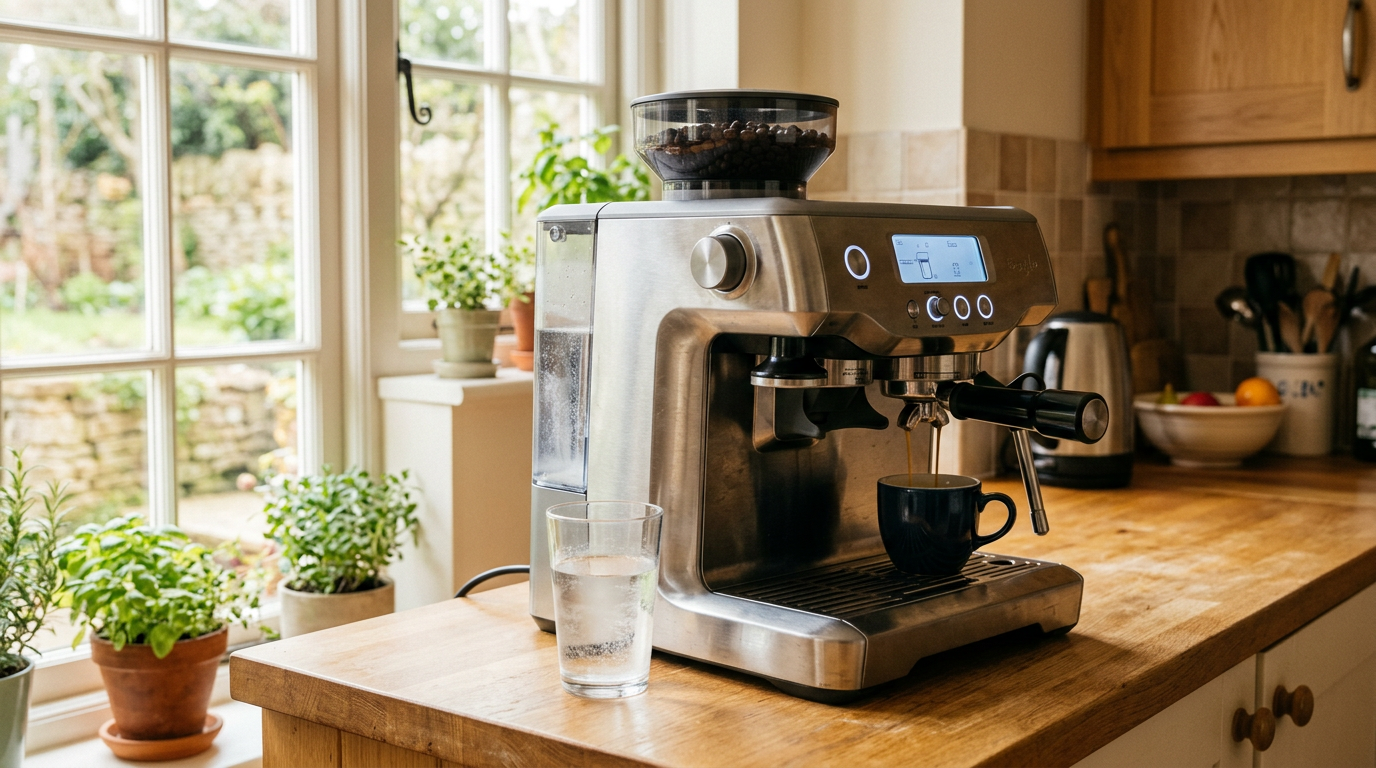
If you live in London, Cambridge, Kent, Essex, Bristol or most of the South East and Midlands, your tap water is hard — and that single fact will do more damage to your coffee machine over the next five years than anything else you do to it. Limescale is the number one reason bean-to-cup machines end up in the bin long before their time.
Nobody tells you this when you spend £600 on a machine. This guide explains what hard water actually does, how to find out what you're dealing with, and what genuinely works — including the bits the manuals gloss over.
First, find out how hard your water really is
Water hardness in the UK varies enormously depending on the geology under your feet. Areas sitting on chalk and limestone — the South East, East Anglia, the Cotswolds, parts of the Midlands — have very hard water. Areas on granite and older rock, such as Scotland, Wales, Cornwall and much of the North West, are naturally soft.
The quickest way to check is your water supplier's website. Every UK water company publishes hardness figures for your postcode, usually in milligrams per litre of calcium carbonate (mg/l CaCO₃) or in Clark degrees. Thames Water's hardness page is a good example of the format most suppliers use, and the Drinking Water Inspectorate — the body that regulates water quality in England and Wales — has consumer guidance if you want the official picture.
Roughly speaking:
| Hardness (mg/l CaCO₃) | Classification | What it means for your machine |
|---|---|---|
| Under 100 | Soft | Descale every 4–6 months. Filters optional. |
| 100–200 | Moderately hard | Descale every 2–3 months. A filter is worth it. |
| 200–300 | Hard | Descale every 4–8 weeks without a filter. Use one. |
| Over 300 | Very hard | Filter is essential. Expect visible scale within weeks. |
Most machines with a hardness setting ask you to test the water with a supplied strip and enter a value from 1 to 4. It takes two minutes and it changes how often the machine nags you to descale. Skipping this step is one of the most common setup mistakes.
What limescale actually does inside the machine
Limescale is calcium carbonate that comes out of solution when water is heated. Inside a coffee machine it builds up in three places, and each causes a different problem:
- The boiler or thermoblock. Scale acts as insulation, so the heating element has to work harder and longer to hit temperature. Your machine uses more electricity, takes longer to warm up, and eventually the element burns out.
- The pipes and solenoid valves. Narrow internal tubing furs up, flow rate drops, and the pump strains. This is why an old machine starts producing thin, slow, dribbling shots.
- The brew group and grouphead. Scale here affects water distribution and temperature stability, which shows up in the cup as inconsistent, sour or bitter espresso.
The insidious part is that the coffee gets worse gradually. Most people blame the beans, the grinder or their technique long before they suspect the water.
Filters vs descaling — you need both
There's a persistent myth that a water filter means you never have to descale. It doesn't. Filters and descaling do different jobs.
Water filters (prevention)
Most bean-to-cup machines take a cartridge filter that drops into the water tank — Brita Intenza, Sage's Claro Swiss, Jura Claris, De'Longhi DLSC002 and so on. These use ion exchange resin to reduce calcium and magnesium before the water is heated. They typically cost £8–£15 each and last around two months or 50 litres, whichever comes first.
A filter slows scale formation dramatically, but it doesn't eliminate it, and its capacity is finite. Leaving an exhausted cartridge in the tank is worse than having none at all — it stops filtering and starts harbouring bacteria.
Descaling (cure)
Descaling runs an acidic solution through the water circuit to dissolve scale that has already formed. Every machine has a cycle for it, and it takes 15–25 minutes.
Use a proper descaler — either the manufacturer's own or a reputable generic based on citric, lactic or sulphamic acid. Do not use neat vinegar in a modern machine. It's an old trick from the days of simple drip filters, and while it does dissolve scale, it can attack rubber seals and aluminium components, and the smell lingers in the plastics for weeks.
How often should you actually descale?
Follow the machine's own prompt if it has one and you've set the hardness correctly — it counts litres and adjusts. If yours doesn't, here's a realistic schedule for a household making four to six drinks a day:
| Your water | With a filter | Without a filter |
|---|---|---|
| Soft | Every 6 months | Every 4 months |
| Moderately hard | Every 4 months | Every 8–10 weeks |
| Hard | Every 3 months | Every 6 weeks |
| Very hard | Every 2 months | Every 4 weeks |
Ignoring the descale warning is a false economy. Many manufacturers will decline a warranty claim on a heating element or pump if the fault is clearly scale-related, and it's usually obvious when they open the machine up.
Should you use bottled or filtered water instead?
Some people fill the tank from a Brita jug or use bottled water. Both work, with caveats.
A jug filter is fine and cheap, though it filters less aggressively than an in-machine cartridge. Bottled water is a mixed bag: still mineral water like Volvic is low in calcium and works well, but many UK bottled waters are actually quite mineral-rich and no better than the tap. Check the calcium figure on the label — under about 50mg/l is good for coffee.
What you should not use is fully deionised or distilled water. Coffee needs some mineral content to extract properly — completely pure water makes flat, hollow-tasting espresso, and some machines can't even detect it with their water sensors.
Which machines cope best with hard water?
Good equipment helps, but it's only half the equation — your beans, grind and technique matter just as much. If you're still dialling in your setup, our guide to making barista-quality coffee at home covers the full process from bean to cup. And if you have not chosen a machine yet, our bean-to-cup vs espresso machine comparison explains which type suits your household.
If you're buying and you know you're in a hard water area, a few features are genuinely worth paying for:
- A proper filter system built into the tank. Machines from Sage, Jura, Melitta, Philips and De'Longhi all support cartridges. Check the ongoing cartridge cost before you buy — it varies from about £6 to £18 each.
- An automatic hardness test and setting. Better machines ship with a test strip and let you enter the result, so descale intervals are based on your actual water rather than a generic guess.
- A removable brew group. Being able to take the brew unit out and rinse it weekly makes a real difference to longevity. Most Philips, Melitta and Saeco machines allow this; many Jura and De'Longhi models don't.
- Stainless steel or brass boilers rather than aluminium. They tolerate descaling chemicals better over many cycles.
Across the machines we've reviewed — from around £450 up to £1,500 — the ones that survive longest in hard water areas are almost always the ones where the owner set the hardness level on day one, kept the filter fresh, and descaled when told to. The brand matters far less than the maintenance.
A simple routine that works
- Day one: test your water with the supplied strip and set the hardness level in the menu.
- Every use: empty and refresh the water tank rather than topping it up. Standing water concentrates minerals and goes stale.
- Weekly: rinse the brew group if it's removable, and wash the tank properly.
- Every 2 months: replace the filter cartridge, even if it looks fine.
- When prompted: run the full descale cycle with a proper descaler. Don't postpone it more than a week or two.
That's perhaps fifteen minutes of work every couple of months. For a machine costing several hundred pounds, it's the difference between three years of service and ten.
The bottom line
Hard water isn't a reason to avoid a good coffee machine — it's a reason to buy one with a decent filter system and then actually use it. The people who complain that bean-to-cup machines "don't last" are, in our experience, overwhelmingly people in hard water areas who never set the hardness level and never changed a cartridge.
Find out how hard your water is, set the machine up properly on day one, and budget around £60–£90 a year for filters and descaler. Do that and the machine will outlast the guarantee by years. For everything else that goes into the decision — machine types, budgets, boilers, grinders and running costs — see our ultimate coffee machine buying guide.