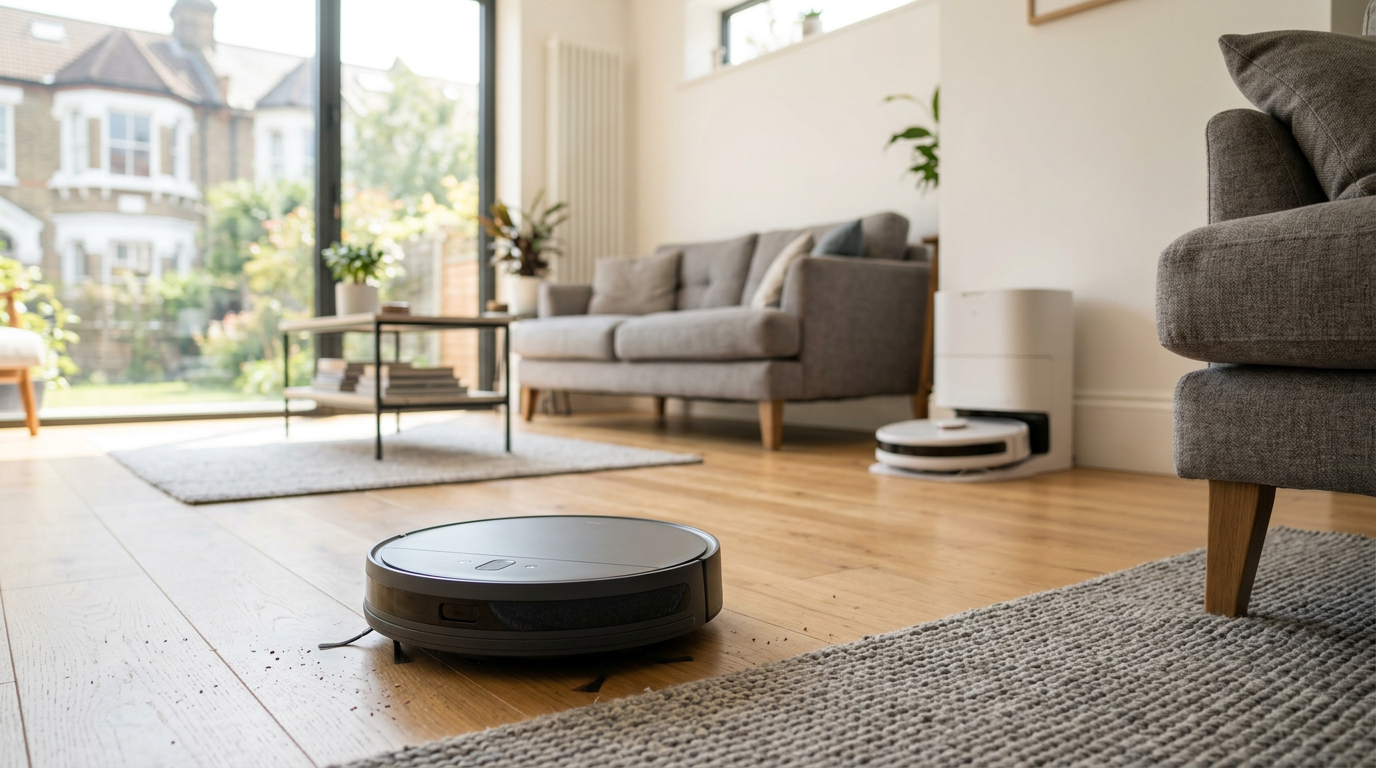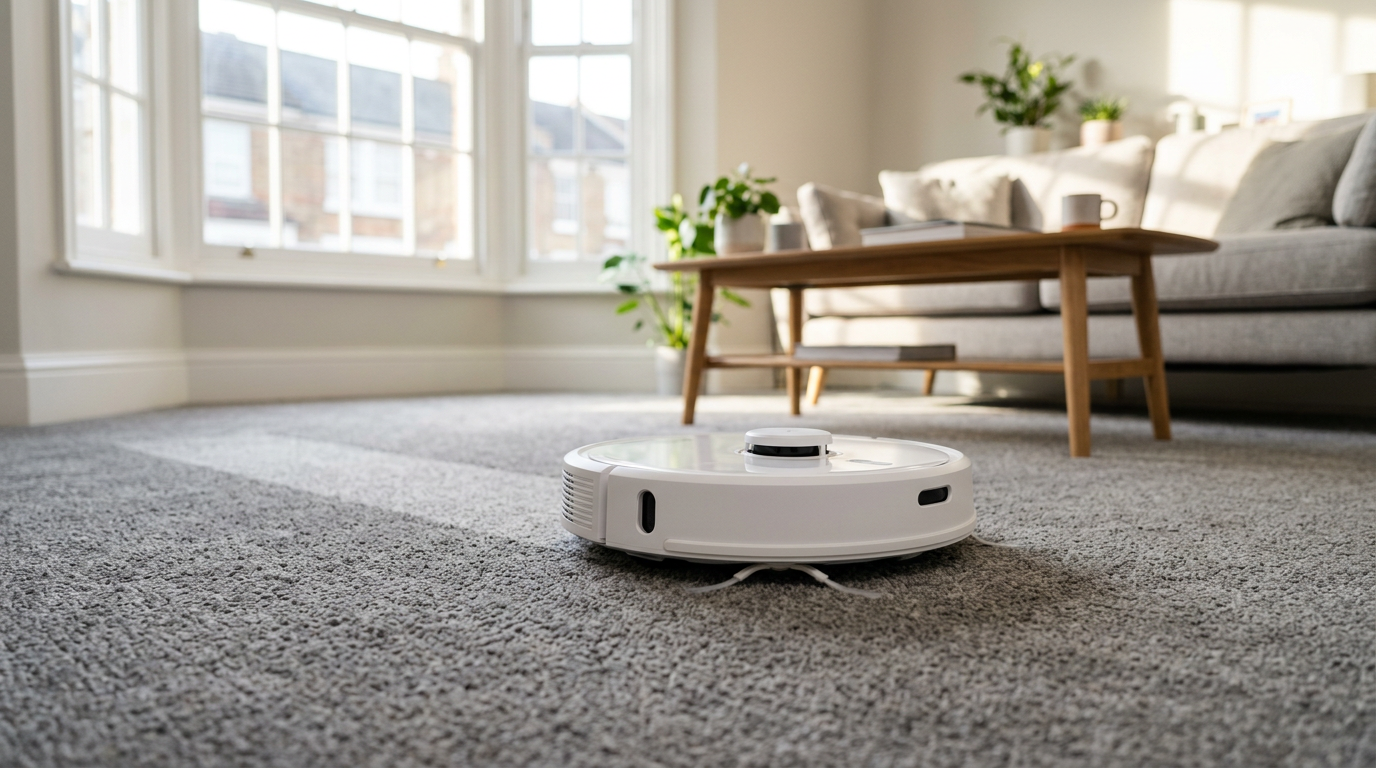
It is the single question that stops most people buying a robot vacuum: they look brilliant gliding across a hard floor in the adverts, but will one actually get anything out of a carpet?
The honest answer: yes — but the gap between a good robot vacuum and a poor one is far wider on carpet than it is on hard floors. On laminate, almost anything works. On a mid-pile carpet, suction, brush design and how the machine handles pile all suddenly matter enormously.
Here is what actually determines whether a robot vacuum copes with your carpet, and where they still fall short of an upright.
The short version
- Low-pile carpet: genuinely excellent. Most decent robots handle this without complaint.
- Mid-pile carpet: good, provided you buy a model with strong suction and a rubber brush.
- High-pile carpet, deep shag or thick rugs: this is where robots struggle. Expect surface-level cleaning at best, and possible getting stuck.
Put simply, a robot vacuum is superb at keeping carpet consistently tidy day to day. It is not a replacement for an occasional deep clean with a proper upright.
What actually matters on carpet
Suction power (measured in Pa)
Suction is quoted in pascals, and it is the number manufacturers shout loudest about. On hard floors it is almost irrelevant — debris sits on the surface and is easily swept up. On carpet it matters a great deal, because the machine has to pull grit and hair out from between the fibres.
As a rough guide for UK homes:
- Under 4,000 Pa — fine for hard floors and thin rugs, weak on carpet.
- 4,000–8,000 Pa — the sensible minimum for a carpeted home.
- 8,000 Pa and above — genuinely capable on mid-pile carpet, and where the better 2026 models sit.
Be a little sceptical of the headline figure, though. There is no independent standard governing how manufacturers measure it, so a 10,000 Pa claim from a budget brand is not necessarily better than 8,000 Pa from an established one. Brush design and airflow sealing matter just as much.
Brush type — the part nobody mentions
This is the detail that separates a robot that works on carpet from one that infuriates you.
Bristle brushes agitate carpet pile well, but they are magnets for long hair, which wraps around the roller and needs cutting off with scissors every couple of weeks. If anyone in the house has long hair, or you have a shedding dog, this becomes a genuine chore.
Rubber or silicone brushes flex against the carpet rather than combing it, and hair slides off the ends rather than wrapping. They are marginally less aggressive on deep pile but vastly less maintenance. Most premium 2026 models now use rubber, often with an anti-tangle comb built into the housing.
If you have carpet and pets, prioritise a rubber anti-tangle brush over a slightly higher suction figure. You will use the machine more if you are not dismantling it every fortnight.
Carpet boost
Most mid-range and premium models now detect carpet — usually via an ultrasonic or optical sensor — and automatically ramp suction up when they roll onto it. It is a genuinely useful feature rather than marketing fluff, because it means the machine is not running at maximum power (and maximum noise, and minimum battery life) across your hard floors as well.
Anything without carpet detection either runs quietly and cleans carpet poorly, or runs loudly everywhere and drains its battery.
Where robot vacuums genuinely struggle
To be fair to the sceptics, there are real limitations:
- Deep-pile and shag carpet. The robot either cannot generate enough airflow through the pile, or it physically beaches itself. Many models simply refuse to climb onto very thick rugs.
- Embedded grit. A single pass by a 0.4 kg-of-suction robot will never match a 900 W upright pressed down into the pile. Robots clean well by cleaning often, not deeply.
- Edges and corners. Side brushes help, but carpet meeting a skirting board is still the weak spot. Some 2026 models now have extending side brushes, which help noticeably.
- Small bins. Carpet holds far more dust than hard floor, so bins fill faster. A self-emptying dock is close to essential in a fully carpeted home.
- Dark carpet. Some older cliff sensors misread very dark carpet as a drop and refuse to cross it. Far less common now, but worth knowing if your carpet is near-black.
The mopping problem
Most robots now mop as well as vacuum, which creates an obvious hazard in a home with carpet: a wet pad being dragged across your living room rug.
Manufacturers have solved this in three ways, and the difference matters:
- Mop lifting — the pads raise a few millimetres when carpet is detected. Fine for low pile, marginal on thicker carpet.
- Mop retraction — the pads pull back into the body entirely. Much safer.
- Mop detaching — the machine leaves the pads at the dock before vacuuming carpeted rooms. The most reliable approach, and increasingly common at the top end.
If you have a mostly carpeted home, a vacuum-only robot is often the smarter, cheaper purchase. Mopping is genuinely excellent on tiles and hard flooring, but it is an expensive feature to pay for and then avoid using.
Are they worth it for allergies?
This is one of the strongest arguments for a robot on carpet, and it has little to do with raw suction.
House dust mites live in carpet, and their droppings are among the most common indoor allergy triggers in the UK. The realistic defence is frequency — vacuuming often enough that dust never accumulates. A robot running every single day does that in a way almost nobody manages manually. The NHS guidance on preventing allergic reactions makes exactly this point: regular, consistent cleaning of soft furnishings matters more than any single deep clean.
Two practical caveats. First, buy a model with a sealed HEPA filtration system — a robot that captures dust and then blows the fine particles straight back out is counterproductive. Second, if you are sensitive, empty the bin outdoors, or buy a self-emptying dock that seals the dust into a bag.
It is also worth remembering that vacuuming is only one part of the picture. Asthma + Lung UK's guidance on indoor air pollution notes that ventilation, damp and humidity all play a significant role in indoor air quality — a robot vacuum helps, but it will not fix a poorly ventilated room on its own.
What to look for if your home is carpeted
| Feature | Why it matters on carpet |
|---|---|
| 8,000 Pa+ suction | Enough airflow to lift grit out of mid-pile fibres |
| Rubber anti-tangle brush | Stops hair wrapping; far less maintenance |
| Automatic carpet boost | Full power on carpet, quiet elsewhere |
| Self-emptying dock | Carpet fills the bin quickly; avoids daily emptying |
| Sealed HEPA filtration | Traps fine dust rather than recirculating it |
| Mop retraction or detaching | Keeps wet pads off your carpet entirely |
| LiDAR navigation | Methodical coverage; no missed patches |
Common questions
Will it damage my carpet?
No. Robot vacuums are lighter and far gentler than an upright, and the brush speeds are lower. If anything, they are kinder to carpet pile than a powerful beater bar used weekly.
Do I still need a normal vacuum?
For most homes, a good robot handles 80–90% of the vacuuming. If pet hair is your main concern, our dedicated guide to the best robot vacuums for pet hair ranks the models that cope best with fur, dander and the dreaded brush-bar tangle.
Yes, but you will use it far less. The realistic pattern in a carpeted home is a robot running daily for maintenance, with an upright brought out every few weeks for a deep clean, stairs and upholstery. Robots cannot do stairs, and none are likely to any time soon.
How do they handle the transition between carpet and hard floor?
Most models climb thresholds of around 20 mm without difficulty, and the better ones manage 30 mm or more. A standard UK carpet edge or door bar is well within that. Very thick rugs with a hard edge are the usual sticking point.
Is it noisy on carpet?
Noticeably louder than on hard floors, because carpet boost kicks the motor up. Expect roughly 65–75 dB in boost mode — similar to a dishwasher. Most people simply schedule it to run while they are out, which is arguably the whole point of owning one.
The verdict
Robot vacuums absolutely work on carpet, and in a low- or mid-pile UK home a good one will keep your floors noticeably cleaner than manual vacuuming ever did — purely because it runs every day rather than every Sunday.
But the specification matters more than it does on hard floors. Buy a cheap model with weak suction and a bristle brush and you will conclude that robots do not work on carpet. Buy one with strong suction, a rubber anti-tangle brush and automatic carpet boost, and you will wonder why you waited.
If you have deep shag carpet throughout, be realistic — this is not the product for you. For everyone else, it is one of the few smart-home purchases that genuinely gives you time back. For the full picture on types, budgets and specs, see our ultimate robot vacuum buying guide. And if running costs are a concern, they shouldn't be — we've broken down the real electricity cost of running a robot vacuum and it's less than you'd think. And if you're still on the fence about buying one, our honest verdict on whether robot vacuums are worth it weighs up the full picture. Deciding between the two big brands? See our Shark vs Roborock head-to-head.