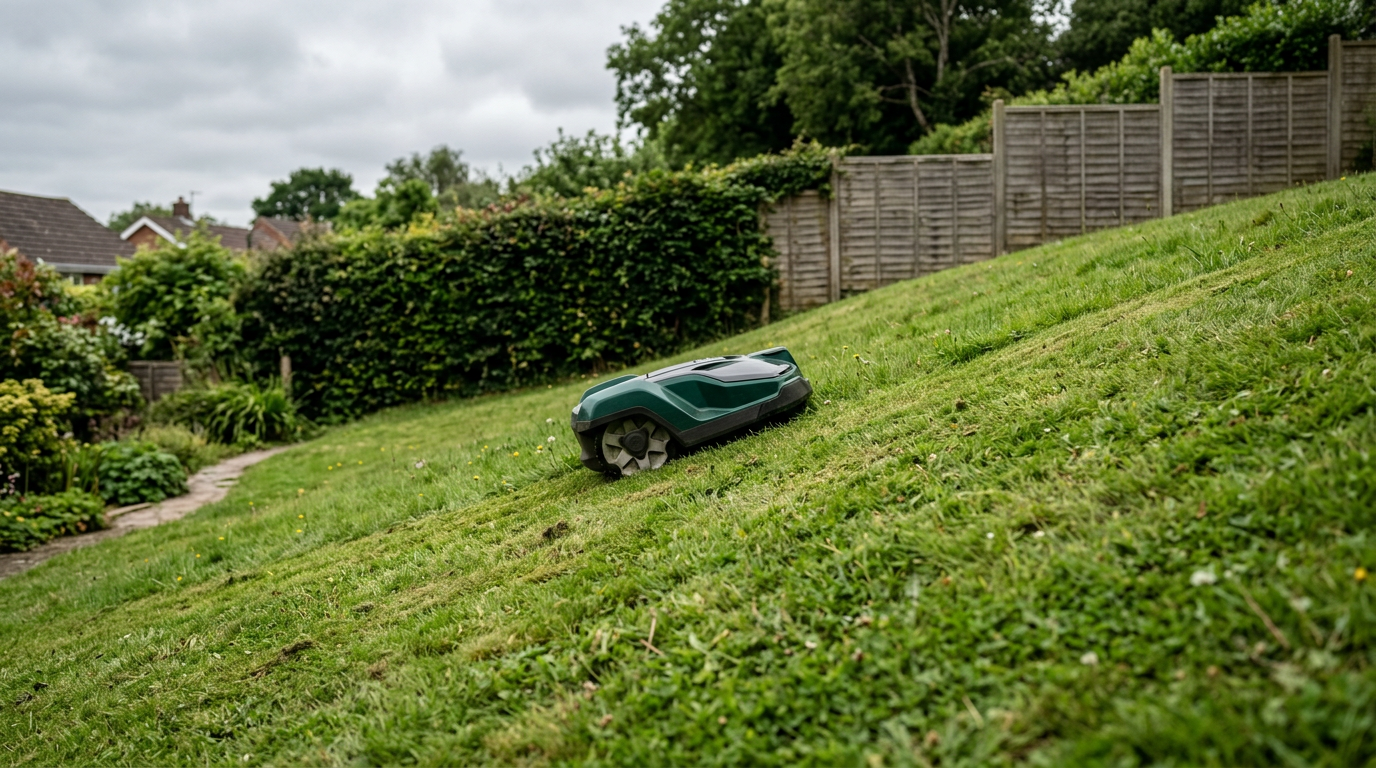
Almost every robot mower review is filmed on a flat, rectangular lawn. Very few British gardens look like that. Ours slope towards the house, dip where an old flower bed used to be, and have a tree root running under the grass that nobody has ever got round to dealing with.
So the honest question isn't "is this a good robot mower" — it's "will it cope with my garden". This guide explains how slope ratings actually work, what uneven ground does to a mower that a gradient figure won't tell you, and how to work out before you buy whether a machine will manage.
Percentages vs degrees — the number that confuses everyone
Manufacturers quote maximum slope as a percentage, and it looks alarmingly high. A "45% slope" sounds close to vertical. It isn't. Percentage gradient is rise over run, so 45% means the ground rises 45cm over every metre travelled — which works out at about 24 degrees.
| Quoted rating | In degrees | What that looks like |
|---|---|---|
| 25% | 14° | A gentle, barely noticeable incline |
| 35% | 19° | A clear slope; you'd notice pushing a mower up it |
| 45% | 24° | Steep. Hard work with a petrol mower |
| 80% | 38° | Very steep bank — awkward to even stand on comfortably |
To measure your own, put a spirit level on the grass, raise the downhill end until it's level, and measure the gap to the ground. A 1m level with a 30cm gap is a 30% slope. It takes a minute and it's far more reliable than guessing.
What the mowers we have reviewed are actually rated for
There's a genuine spread across the market, and it doesn't track price as neatly as you'd expect:
| Model | Max slope | Drive |
|---|---|---|
| LawnMaster OcuMow MX 24V | 25% (14°) | Rear-wheel |
| Bosch Indego S+ 500 | 27% (15°) | Rear-wheel |
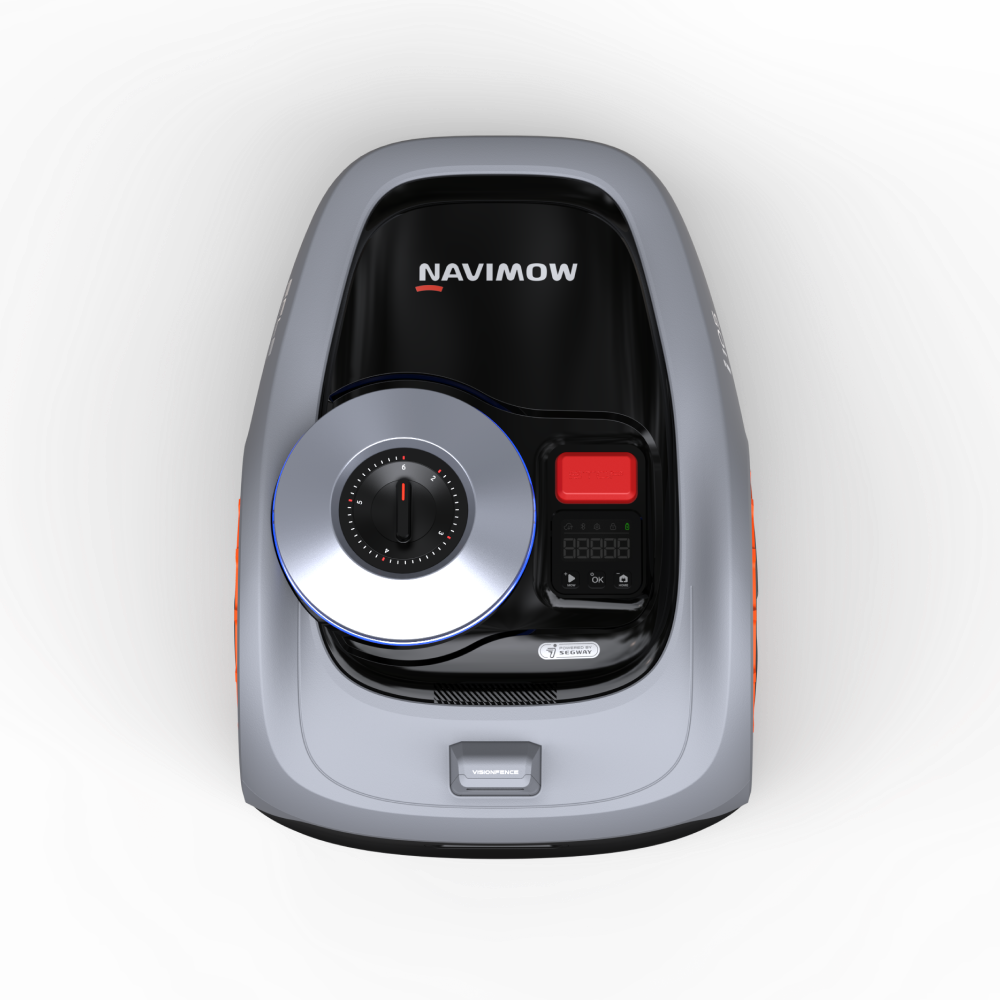
| Segway Navimow i105E | 30% (17°) | Rear-wheel |
| Flymo EasiLife GO 500 | 35% (19°) | Rear-wheel |
| Gardena SILENO City 600 | 35% (19°) | Rear-wheel |
| Stiga A 1500 | 45% (24°) | Rear-wheel |
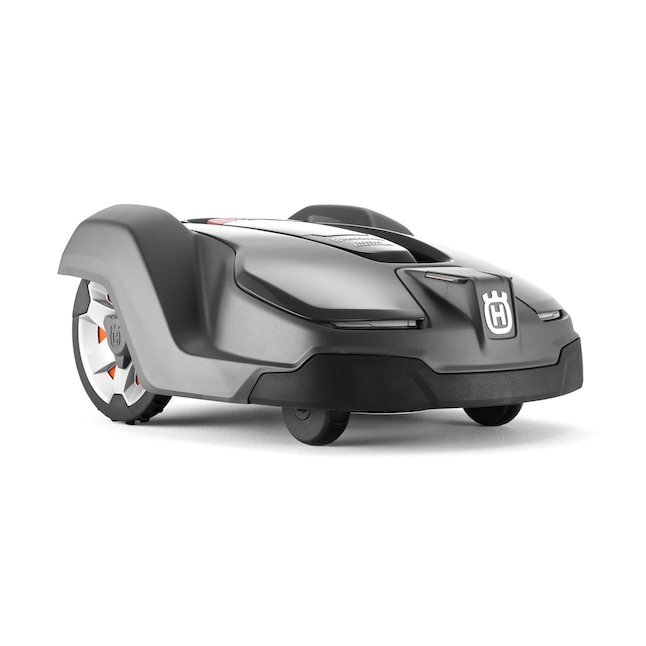
| Husqvarna Automower 430X | 45% (24°) | Rear-wheel |
| ECOVACS GOAT G1 | 45% (24°) | Rear-wheel |
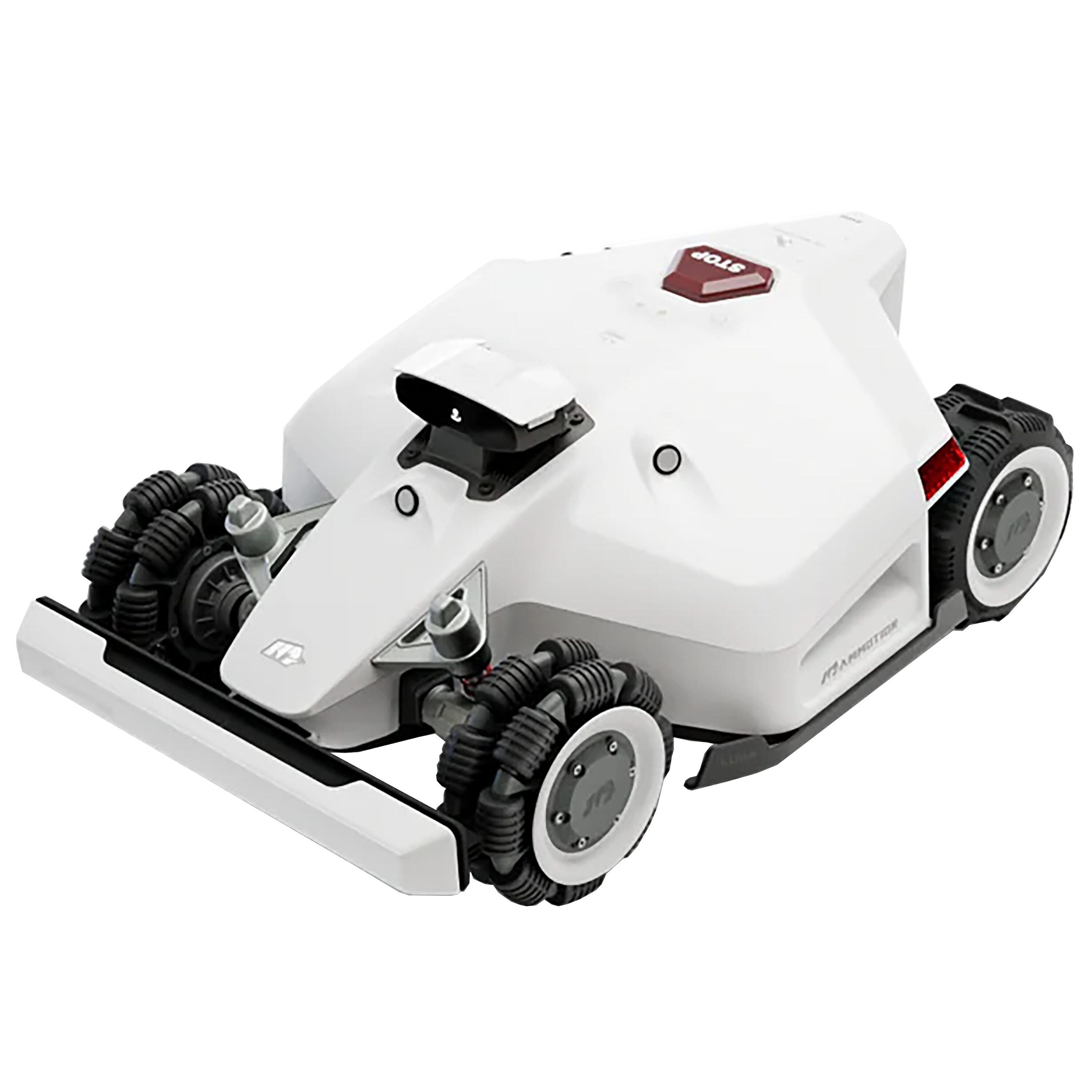
| Mammotion LUBA 2 AWD 3000 | 80% (38°) | All-wheel drive |
Notice that the £799 Bosch is rated lower than the £499 Flymo. Slope capability is an engineering choice about drive layout, weight distribution and tyre design — not a premium feature you unlock by spending more.
The one genuine outlier is the Mammotion LUBA 2, and the reason is in the name: it's the only all-wheel-drive machine here. Four driven wheels on chunky tyres is a completely different proposition to two, which is why it manages 80% when almost everything else tops out at 45%.
The rating assumes dry grass — and Britain isn't dry
This is the part that catches people out. Maximum slope figures are measured on dry, well-established turf. Wet grass roughly halves usable traction.
In practice, a mower rated at 35% will handle a 35% slope in July and slide sideways on it in November. Robot mowers run year-round on a schedule, in drizzle, on morning dew, on ground that has been soaked for a week. If your slope is anywhere near the machine's limit, it will fail on the wet days.
The practical rule: buy at least 10 percentage points of headroom above your steepest section. If your worst slope measures 30%, get a machine rated 40% or more. That headroom is the difference between a mower that works all season and one that reports "wheel slip" errors every time it rains.
Slopes at the boundary are worse again. A mower that slides while turning near the edge of a wire or virtual boundary can end up in a flower bed, or on a patio, or against a fence. Most manufacturers advise keeping the steepest ground away from the perimeter, and it's sound advice.
Uneven ground is a separate problem entirely
A garden can be almost flat and still defeat a robot mower. Slope ratings say nothing about bumps, dips, ruts and roots, and these cause a different set of failures:
- Scalping. Over a hump, the deck bottoms out and shaves the grass to soil. You get brown patches along every ridge. Raising the cutting height helps, but only so far.
- Grounding out. In a dip, the body catches and the wheels lose contact. The mower sits there spinning until it times out and reports an error.
- Missed patches. In hollows the blade never reaches the grass at the bottom, so you get tufts the mower cannot see it has left.
- Lifted mowers. Many machines have a lift sensor that stops the blades if the body tilts or rises unexpectedly. A sharp bump can trigger it repeatedly and halt the cut.
Lighter machines generally ride bumps better — there's less mass to slam the deck down. Larger wheels help enormously. And a wider cutting deck, counterintuitively, struggles more on uneven ground, because a wide deck has to bridge more variation in the surface.
What to do about it
Most uneven lawns can be improved rather than replaced. Top dressing — spreading a sandy loam mix over the lawn and brushing it into the hollows — levels minor dips over a couple of seasons without killing the grass. For deeper depressions, cut and lift the turf, backfill with soil, and lay it back down. The RHS lawn care guidance covers the technique and the right time of year for it in the UK climate.
Exposed tree roots are the one thing you generally cannot fix. Cutting them risks the tree. If you have surface roots, either fence the area off from the mowing zone or accept you'll strim it by hand.
Wire or wire-free on a difficult garden?
Boundary wire systems are physically pegged into the ground, so they don't care about slope or terrain — the wire follows the contour. The catch is installation: laying wire across a steep bank is genuinely unpleasant work, and pegs work loose in soft or frequently waterlogged ground.
Wire-free RTK-GPS systems avoid the installation entirely, but need a clear satellite view. Sloping gardens are often sloping because they're cut into a hillside with trees or a high wall on the upper side, and that's exactly what blocks the signal. Check the coverage carefully before committing.
Camera and LiDAR systems sit somewhere in between and generally handle overhung, awkward gardens best, though they cost more.
Safety on slopes — the bit worth taking seriously
Robot mowers are far safer than the alternative. Slopes are where conventional mowing accidents happen, particularly with ride-ons and petrol mowers that can slide or overturn, and RoSPA has long flagged garden machinery as a significant source of home accidents. Handing the steep bank to a machine that weighs 14kg and stops its blades the moment it's lifted is a clear improvement.
That said, a few sensible precautions on sloping ground:
- Don't schedule mowing when children or pets are likely to be in the garden — a mower that slides is unpredictable.
- Keep the charging base on level ground. Docking on a slope causes repeated failures to connect.
- Check for wheel slip marks after wet weather. Bare, muddy arcs mean the mower is struggling and will damage the lawn over time.
- Fence off any drop, pond or steep step at the bottom of a slope, rather than relying on the boundary alone.
So — will one work in your garden?
If you're still weighing up the basic question of whether a robot mower is the right choice at all, our guide to whether robot lawn mowers are worth it covers the broader pros, cons and running costs. But assuming you've decided you want one, here's the slope-specific advice:
Work through this before you buy:
- Measure your steepest section with a spirit level. Don't estimate.
- Add 10 percentage points for wet-weather headroom, and shop above that figure.
- Walk the lawn looking for bumps and dips. Anything more than a few centimetres of variation over half a metre will cause scalping.
- Check what's overhead if you're considering a wire-free GPS model.
- Consider all-wheel drive if your steepest ground is over about 45%. Below that, a well-chosen two-wheel-drive machine is fine.
The short answer is that most British gardens — gently sloping, a bit lumpy, a few awkward corners — are well within the capability of a mid-range machine, provided you buy with headroom rather than to the exact spec. It's the people who buy a 35% mower for a 34% slope who end up disappointed. If you're choosing between the two big premium brands for a tricky garden, our Husqvarna vs Worx comparison covers how each copes with slopes and uneven ground. And if longevity is on your mind, slopes do put more strain on motors and tyres — our guide to how long robot mowers last covers the parts that wear fastest and how to extend the lifespan.