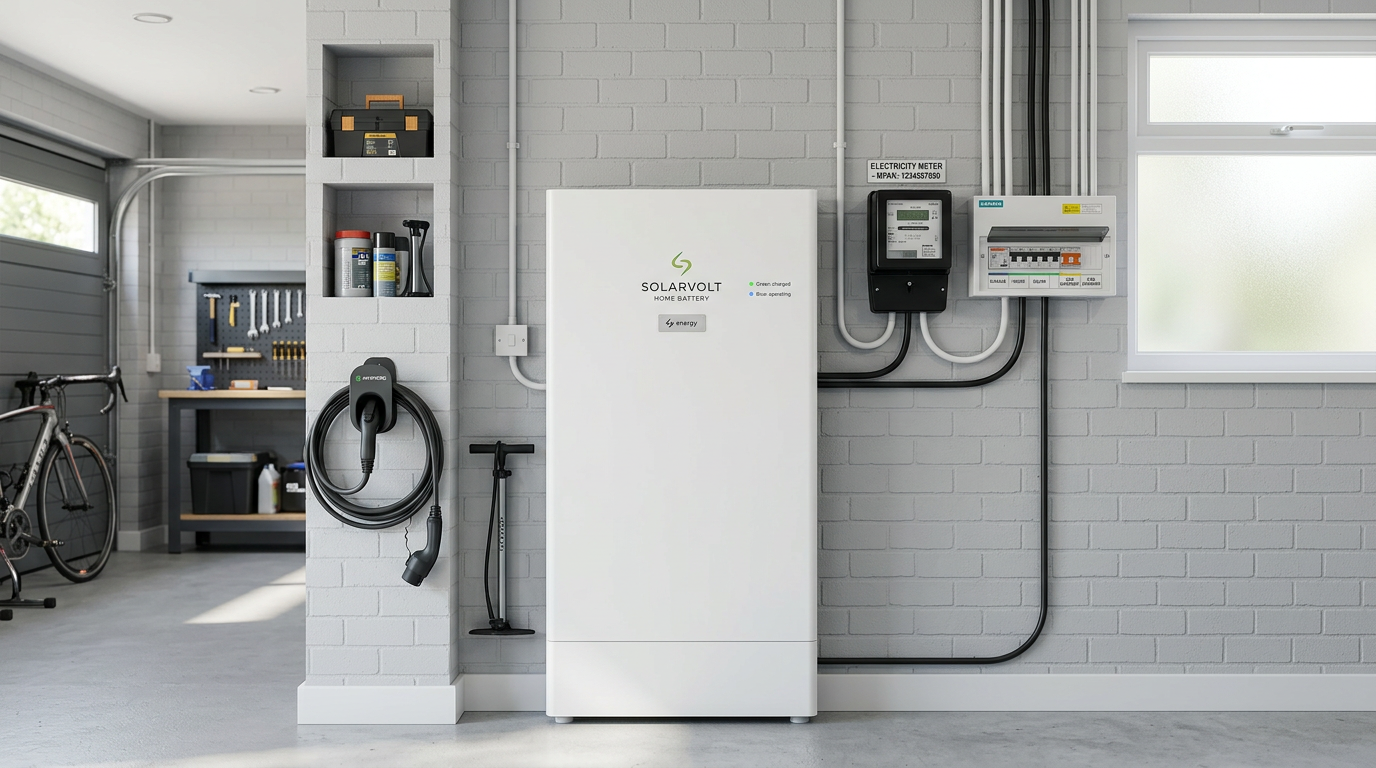
One of the most common misconceptions about home battery storage is that you need solar panels to make it work. You don't. A growing number of UK households are installing batteries purely to take advantage of cheap overnight electricity, and the economics can be surprisingly compelling — if you pick the right tariff and the right sized system.
This guide explains exactly how battery storage works without solar, what the savings look like, and whether it makes financial sense for your home.
How It Works: Tariff Arbitrage
The principle is simple. You sign up for a time-of-use electricity tariff that charges different rates at different times of day. You charge your battery during the cheapest overnight window — typically 5 to 7 hours — and then draw from the battery during the expensive daytime and evening hours instead of buying from the grid.
The difference between the cheap rate and the standard rate is your saving per kilowatt-hour. Multiply that by the usable capacity of your battery, and you have your daily saving.
Which Tariffs Work Best?
Not all time-of-use tariffs are created equal. The wider the gap between off-peak and peak, the more you save. Here's how the main options compare in 2026:
| Tariff | Off-Peak Rate | Peak Rate | Gap | Off-Peak Hours | Best For |
|---|---|---|---|---|---|
| Intelligent Octopus Go | ~7.5p | ~24.5p | ~17p | 23:30–05:30 + smart slots | EV owners (required) |
| Octopus Go | ~7.5p | ~24.5p | ~17p | 00:30–05:30 | Battery-only setups |
| Agile Octopus | Variable | Variable | Variable | Dynamic 30-min slots | Tech-savvy users |
| Economy 7 | 12–18p | 28–34p | ~12–16p | 7 hours overnight | Storage heater homes |
| Cosy Octopus | Variable | ~24.5p | Variable | 3 windows daily | Heat pump homes |
Octopus Go and Intelligent Octopus Go offer the widest gap at roughly 17p per kWh. That's the number that drives your savings calculation. Economy 7 works too, but the narrower gap and higher off-peak rate means slower payback.
Agile Octopus is the wildcard — prices change every 30 minutes and occasionally drop to zero or go negative, meaning you'd be paid to charge your battery. The savings can be excellent, but you need a battery system with smart scheduling or an automation setup to capture those windows reliably.
Realistic Savings Without Solar
Let's run the numbers on a concrete example. Assume a 5 kWh battery on Octopus Go:
| Item | Value |
|---|---|
| Usable battery capacity | 5 kWh |
| Off-peak rate | 7.5p/kWh |
| Peak rate avoided | 24.5p/kWh |
| Net saving per kWh (after ~10% round-trip loss) | ~15p |
| Daily saving (5 kWh × 15p) | ~75p |
| Annual saving | ~£274 |
Scale that up to a 10 kWh battery and you're looking at roughly £548 a year — but only if your household actually uses 10 kWh during peak hours daily. Most UK homes use 8–10 kWh total per day, so a 10 kWh battery without solar would often have leftover charge that goes unused. A 5 kWh system is the more realistic sweet spot for arbitrage-only setups.
The important caveat: these savings assume 100% round-trip efficiency and perfect daily cycling. In reality, batteries lose around 10% in the charge–discharge cycle, and there will be days when you don't fully cycle the battery. A more conservative annual saving estimate for a 5 kWh system is £250–£300.
Payback: The Honest Numbers
Here's where it gets sobering. A professionally installed 5 kWh battery system costs roughly £2,500–£5,500 in 2026 (with 0% VAT, which runs until March 2027). Taking a midpoint of £3,500:
| Scenario | Annual Saving | Payback on £3,500 System |
|---|---|---|
| Octopus Go (17p gap) | ~£274 | ~12.8 years |
| Economy 7 (14p gap) | ~£220 | ~15.9 years |
| Agile (optimistic ~20p avg gap) | ~£340 | ~10.3 years |
Most battery warranties cover 10–12 years. On Economy 7 the payback exceeds the warranty, which is a red flag. On Octopus Go you're looking at breaking even just as the warranty expires. Agile offers the fastest payback but requires the most active management.
If rising electricity prices widen the peak–off-peak gap further, payback shortens. But betting your investment thesis on future price movements is speculation, not planning.
When It Makes Sense Anyway
The pure financial case for batteries without solar is marginal. But there are scenarios where the non-financial benefits tip the balance:
You already need backup power. If you live in an area prone to power cuts and want Emergency Power Supply (EPS) for your fridge, lights and broadband, a battery delivers that alongside the tariff savings. The arbitrage offsets the cost of what is essentially a very large UPS.
You plan to add solar later. Installing a battery-ready inverter now means you can add panels in future without repeating the installation work. Your battery earns its keep on tariff arbitrage in the meantime, and the economics improve dramatically once solar is added.
You're on Agile and willing to automate. Households with home automation setups (Home Assistant, GivEnergy's own scheduling, or similar) can capture the deepest Agile troughs automatically. Some users report saving £400+ annually on a 5 kWh system by charging during plunge pricing and even discharging back to the grid during spikes.
What You Need
To run a battery on tariff arbitrage you need three things:
A smart meter. Time-of-use tariffs require a SMETS2 smart meter. If you're still on a traditional meter, your supplier will install one for free — just ask. This is a prerequisite for Octopus Go, Agile, and most other time-of-use tariffs.
A compatible battery system. The battery needs smart scheduling capability so it charges and discharges at the right times automatically. Most modern systems — GivEnergy, Tesla Powerwall 3, Fox ESS, Alpha ESS — support this natively or through third-party integrations.
A time-of-use tariff. You'll need to switch to a tariff with a meaningful off-peak window. Ofgem's price cap sets the standard variable rate at roughly 24.5p, so any off-peak rate significantly below that creates the arbitrage opportunity.
Frequently Asked Questions
Is a home battery worth it without solar panels?
It depends on your tariff. On Octopus Go or Agile, a 5 kWh battery can save £250–£340 per year through tariff arbitrage alone. Payback is typically 10–16 years, which is marginal but can be justified if you also value backup power or plan to add solar later. For a fuller comparison of all scenarios, see our guide on whether home battery storage is worth it.
Do I need an electrician to install a home battery?
Yes. All currently available UK home battery systems require professional installation. Plug-and-play batteries that plug into a standard socket are not yet approved for UK sale — our plug-in solar guide explains the current regulatory position.
Can I sell stored electricity back to the grid?
In theory, some tariffs (like Agile export or Flux) allow grid export from batteries. In practice, the rates are low and the revenue modest. The main value of a no-solar battery is avoiding expensive peak-rate purchases, not exporting.
What happens during a power cut?
Most modern battery systems offer Emergency Power Supply (EPS) that keeps essential circuits running. The duration depends on your battery capacity and what you're powering — a 5 kWh battery could run a fridge, lights and broadband for 8–12 hours.
Will plug-in batteries change this?
Potentially. Several manufacturers have plug-and-play batteries in development that would not require professional installation, bringing the upfront cost down significantly. However, these are not yet approved for UK sale (expected 2027), so for now, professional installation is the only legal route.