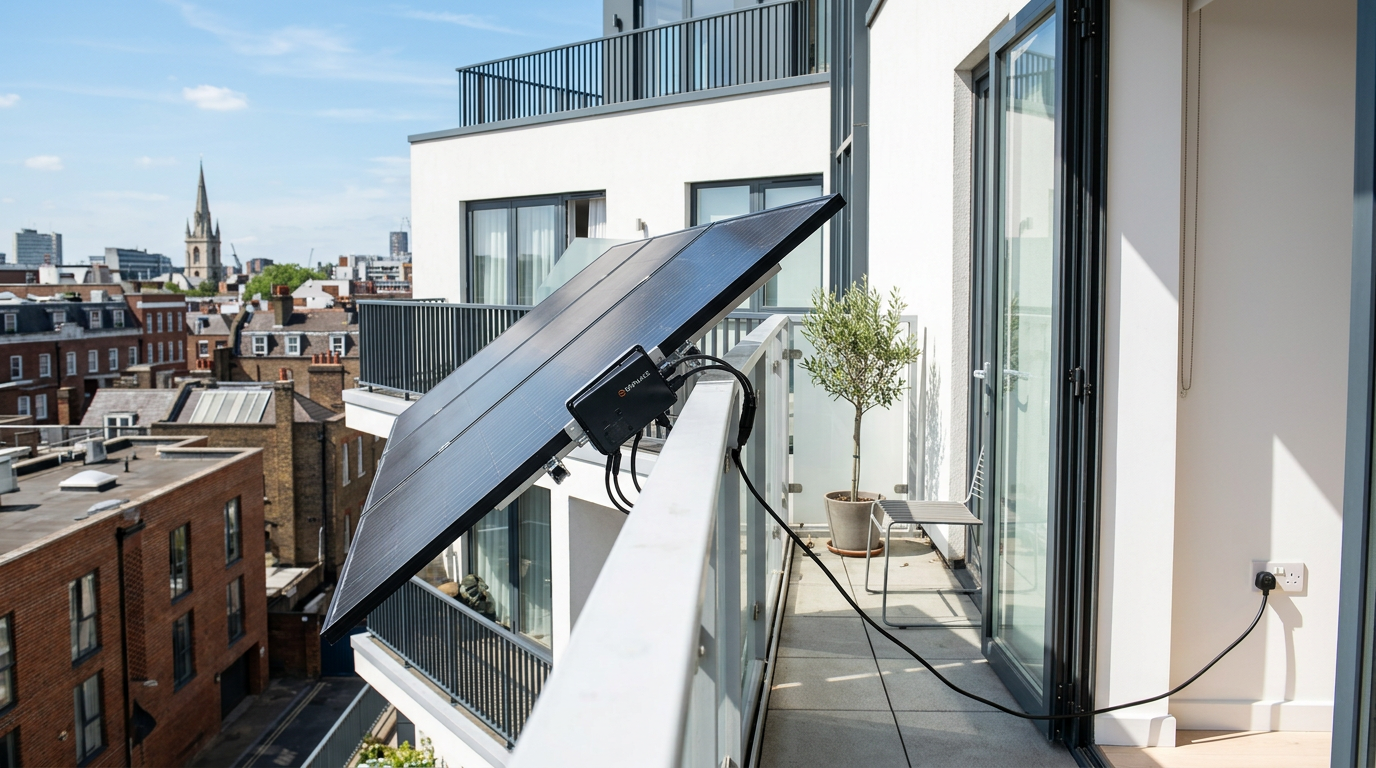
Plug-in solar — the balcony-mounted kits you connect to an ordinary wall socket — has been one of the most talked-about home energy ideas of 2026. For years it sat in an awkward legal grey area in the UK, widely sold online but not clearly permitted to plug into a standard socket. That changed on 27 August 2026. So the short answer is: yes, plug-in solar is now legal in Great Britain — but only if your kit and installation follow a specific set of rules.
This guide explains exactly what the law now allows, the technical limits your kit must meet, the compliance register you should check before buying, and the steps every owner has to take. It is written for UK homeowners, renters and flat-dwellers who want to cut their electricity bills without breaking the rules or the wiring.
Is plug-in solar legal in the UK?
Yes. Since 27 August 2026, plug-in solar is legal to buy and self-install in England, Scotland and Wales under SI 2026/848, which amends the Plugs and Sockets (Safety) Regulations 1994 and the Electricity Safety, Quality and Continuity Regulations 2002. In plain terms, the law now permits a compliant solar kit to be connected to a standard 13A plug and socket, rather than requiring an electrician to hard-wire it into your consumer unit.
Two important caveats before you get excited. First, Northern Ireland is not covered by these regulations — the plug-in socket route does not currently apply there. Second, "legal" does not mean "anything goes": the kit must meet strict technical limits and be on an official compliance register, and you must notify your grid operator after installing. Miss those and you are back outside the law.
What counts as "plug-in solar"?
Plug-in solar (often called balcony solar) is a small system built around a micro-inverter. One or two panels feed a micro-inverter, which converts the power to mains AC and sends it into your home's ring circuit through a normal socket. When your appliances draw power, they use the free solar electricity first before pulling from the grid. It is designed to be tenant-friendly and removable — no roof, no scaffolding, and in most cases no electrician.
That convenience is exactly why the rules are tight: you are feeding electricity into your home wiring through a plug, so the kit has to be provably safe and the grid operator has to know it exists.
The rules at a glance
| Rule | What the law requires |
|---|---|
| Maximum output | 800W AC at the micro-inverter (panels can be higher wattage, but the inverter must clip output to 800W) |
| Devices per home | One plug-in device per household |
| Batteries | Not allowed on the plug-in route — kits designed to import and store grid electricity are excluded |
| Connection | Directly into a standard 13A socket — no extension leads, multi-way adaptors or travel adaptors |
| Safety certification | Must meet the Plug-in Solar Device Interim Product Specification (v2), including anti-islanding and weatherproofing |
| Grid notification | Notify your DNO within 28 days via a G98 form |
| Circuit protection | The socket circuit should be protected by a 30mA RCD (Type A, F or B rather than Type AC) |
The 800W limit — and why it matters
The headline figure is the 800W cap on AC output at the micro-inverter. You can fit panels rated higher than that on the DC side (up to around 2,000W of panel capacity), because panels rarely hit their peak rating in real UK conditions, but the inverter itself must never push more than 800W into your socket. This limit is what keeps a plug-in system safely within the current-carrying capacity of a normal ring circuit. Any kit advertised as feeding more than 800W through a plug is not compliant for the socket route.
Only buy kits on the compliance register
This is the single most important buying rule, and the one most likely to catch people out. To be legal for socket connection, the micro-inverter must be listed as "Compliant" on the ENA G98 Type Test Register and the kit must meet the Interim Product Specification v2. Plenty of kits sold on general marketplaces look identical to compliant ones but are unlisted or marked non-compliant — which means they have no legal route to a plug. Major UK retailers including Argos, B&Q, Currys, Screwfix, Wickes and Lidl have engaged with the government on stocking compliant kits, but you should still verify the exact model number against the register before you pay.
For an independent view on panel quality and performance more broadly, Which? tests and rates solar equipment and is a useful second opinion.
You must notify your DNO within 28 days
Even though no electrician is needed, you are still connecting generation to the grid, so your local Distribution Network Operator (DNO) has to be told. This is a "connect and notify" process under ENA Engineering Recommendation G98: you do not need prior permission, but you must submit a G98 notification form within 28 days of switching the system on. It is free, it is straightforward, and skipping it puts you outside the rules.
Where you cannot install plug-in solar
The regulations ban installation in several higher-risk situations, mostly around fire safety:
- Timber balconies — combustible balcony structures are excluded.
- Buildings with combustible cladding such as ACM/MCM or HPL.
- Buildings undergoing external wall fire-safety remediation.
If any of these apply to your home, the plug-in route is not available to you regardless of how compliant the kit is.
Renters and leaseholders: get consent first
One of the biggest attractions of plug-in solar is that it finally opens home solar to renters and flat-owners. The Renters' Rights Act 2025 is broadly supportive of tenant energy improvements, but that does not remove the need for permission. If your installation involves fixing brackets to an external wall, a balcony or any part of the building fabric, you need written consent from your landlord or freeholder first. Even for a freestanding, non-fixed setup, it is sensible to give your landlord written notice.
So is it worth it?
A typical compliant 800W kit sells for roughly £300 to £1,000, with realistic annual savings of around £100 to £250 depending on how much daytime electricity you use at home. That points to a payback period of about four to six years — slower than a full rooftop array on a per-watt basis, but with a far lower upfront cost and, crucially, the ability to take it with you when you move. For renters and flat-dwellers who have never had a solar option at all, that is a genuine shift.
The regulations are new and the compliant-product list is still growing, so the smartest approach right now is patience: buy only a register-verified kit, notify your DNO, and get written permission if you are fixing anything to the building. Do that and you are on the right side of the law from day one. Wondering whether it will actually pay off? See our companion guide on whether plug-in solar is worth it in the UK for the real savings numbers, or browse our other UK home and energy buying guides while the plug-in solar market matures.
Frequently Asked Questions
Are plug-in solar panels legal in the UK?
Yes, in England, Scotland and Wales since 27 August 2026 under SI 2026/848, provided the kit is compliant (800W maximum AC output, on the ENA G98 Type Test Register) and you notify your DNO within 28 days. Northern Ireland is not currently covered.
Do I need an electrician to install plug-in solar?
No. The whole point of the plug-in route is that a compliant kit connects to a standard 13A socket without hard-wiring. You must still notify your DNO within 28 days, and you should ensure the socket circuit has 30mA RCD protection.
What is the 800W limit?
The micro-inverter must not send more than 800W of AC power into your socket. Panels can be rated higher on the DC side, but the inverter has to clip the output to 800W to stay within a normal ring circuit's safe capacity.
Do I need to tell my energy network or supplier?
You must notify your local Distribution Network Operator (DNO) within 28 days of switching the system on, using a G98 form. This is a free "connect and notify" step — you do not need prior permission, but it is not optional.
Can renters install plug-in solar?
Yes, which is one of its main advantages. However, if you are fixing brackets to the building, a balcony or an external wall, you need written consent from your landlord or freeholder first, and it is wise to give written notice even for a non-fixed setup.
Can I add a battery to a plug-in solar kit?
Not on the plug-in socket route. Kits designed to import and store grid electricity are excluded from the current plug-in regulations, so a battery-integrated system would need a conventional, professionally installed setup instead. If you're interested in that route, our guide on whether home battery storage is worth it covers the costs, savings and payback for installed systems.