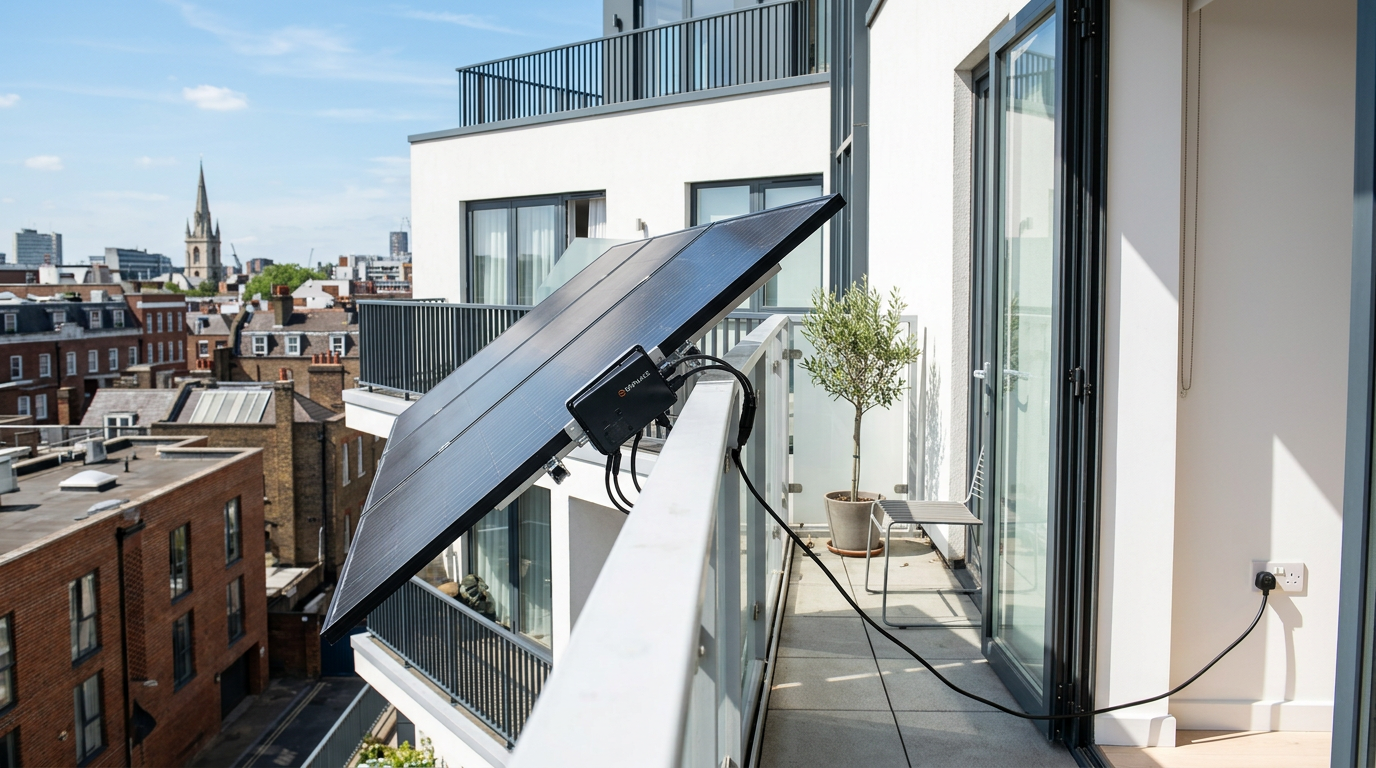
Now that plug-in solar is legal in Great Britain, the obvious next question is whether it is actually worth the money. A compliant 800W kit costs somewhere between £300 and £1,000, and unlike a full rooftop array you can install it yourself and take it with you when you move. But the savings are modest and depend heavily on how you live. This guide gives you the honest numbers so you can decide.
If you are not yet sure whether your home or kit qualifies, read our companion guide on whether plug-in solar is legal in the UK first — it covers the 800W limit, the compliance register and the notification rules. This post assumes you are buying a compliant kit and focuses purely on the economics.
How much can a plug-in solar kit actually save?
Realistic annual savings for an 800W plug-in system are roughly £100 to £250 a year. Where you land in that range depends almost entirely on one thing: how much of the solar electricity you use in your home as it is generated. Plug-in kits have no battery (batteries are not permitted on the plug-in route), so any power you do not use immediately is effectively given to the grid for nothing. The value is in self-consumption, not export.
Here is a simplified illustration of how self-consumption changes the payback maths on a mid-range £600 kit:
| Your daytime usage | Typical annual saving | Rough payback (£600 kit) |
|---|---|---|
| Low (out all day, little used before evening) | ~£100 | 6 years+ |
| Medium (some home working, fridge/freezer, standby loads) | ~£170 | ~4 years |
| High (home most days, daytime appliance use) | ~£250 | ~3 years |
These are illustrative figures based on an 800W kit and typical UK electricity pricing — your own result depends on the current unit rate you pay, your roof or balcony orientation, and shading. You can check where the energy price cap sits to estimate your unit rate, since a higher rate makes every self-consumed unit worth more.
What makes the savings bigger or smaller
- Daytime occupancy. Solar generates while the sun is up. If nobody is home and drawing power during the day, most of it is wasted. Home workers and retirees get the best return.
- Always-on loads. Fridges, freezers, routers, and standby devices quietly soak up solar all day — this baseload is what a plug-in kit covers most reliably.
- Orientation and shading. A south-facing, unshaded balcony or wall produces far more than a north-facing or overshadowed one. Balcony-railing mounting is usually steeper than ideal, which trims output.
- Your unit rate. The more you pay per kWh, the more each self-consumed unit saves you. Rising prices shorten payback; falling prices lengthen it.
- Kit price. A £300 kit at the same savings pays back in half the time of a £900 one, so avoid over-buying capacity you cannot self-consume.
Can you get paid for what you export?
In theory, exported electricity can earn money through the Smart Export Guarantee, but in practice this rarely stacks up for plug-in solar. Many SEG tariffs require an approved export meter and a professionally certified (MCS) installation, which a self-installed plug-in kit will not have. So the safe assumption is that your savings come from self-consumption only, and any export is a bonus you probably will not be paid for. Plan the numbers on that basis and you will not be disappointed.
Who plug-in solar is genuinely worth it for
Plug-in solar makes the most sense for:
- Renters and flat-dwellers who have never had a solar option — the ability to unplug it and take it to the next home is a real advantage.
- People at home during the day who can time appliance use (washing, dishwasher, batch cooking) to sunny hours.
- Households with high always-on loads and a high electricity unit rate.
- Anyone wanting a low-commitment first step into solar without scaffolding, roof work or a four-figure quote.
It makes less sense if your home is empty all day, your balcony faces north or is heavily shaded, or you were hoping to power most of your home — an 800W cap simply cannot do that.
The honest verdict
For the right household, plug-in solar is worth it — not as a dramatic bill-slasher, but as a low-cost, portable way to shave £100 to £250 a year off your electricity with a three-to-six-year payback and no installer needed. Treat it as a sensible efficiency upgrade rather than an investment, buy a register-compliant kit sized to what you can actually self-consume, and it will quietly pay for itself. For a wider view on solar performance and reliability, Which? is a useful independent reference, and you can find our other UK home and energy buying guides here.
Frequently Asked Questions
How much does plug-in solar save per year in the UK?
Realistically around £100 to £250 a year for an 800W kit, depending mostly on how much of the solar power you use as it is generated. Households at home during the day save the most; homes empty all day save the least.
What is the payback period for a plug-in solar kit?
Typically three to six years. A cheaper kit and high daytime self-consumption shorten it; an expensive kit, low occupancy, or a shaded/north-facing position lengthen it.
Do I need a battery to make plug-in solar worthwhile?
Batteries are not allowed on the plug-in socket route, so the savings come from using power as it is generated. That is why daytime usage matters so much — anything you do not use immediately is exported, usually with no payment. If you want to store energy for later, you would need a professionally installed home battery — see our guide on whether home battery storage is worth it for the full breakdown.
Can I get paid for exporting plug-in solar electricity?
Rarely in practice. The Smart Export Guarantee usually requires an approved export meter and a certified MCS installation, which self-installed plug-in kits do not have. Plan your savings on self-consumption only.
Is plug-in solar worth it for renters?
It is one of the best options for renters, because it needs no roof work and can be unplugged and taken to your next home. Just get written landlord consent before fixing anything to the building.