This is one of the most common questions people ask before buying a pergola, and the good news is that the answer is usually no. Most freestanding garden pergolas in the UK fall under permitted development rights, which means you can build them without applying for planning permission. But there are specific rules, and getting them wrong can mean an enforcement notice and an expensive mistake. This guide covers exactly what you can and cannot do.
The short answer
In England and Wales, a pergola is classified as an "outbuilding" or "incidental building" under Schedule 2, Part 1 of the Town and Country Planning (General Permitted Development) Order 2015. You do not need planning permission provided the pergola meets all of the following conditions:
- Not in front of the house. The pergola must be to the rear or side of the property, not forward of the principal elevation (the front of the house facing the road).
- Maximum height of 2.5 metres if within 2 metres of any boundary (fence, wall or neighbouring property line).
- Maximum height of 4 metres if it has a dual-pitched roof, or 3 metres for any other roof type, when positioned more than 2 metres from a boundary.
- Does not cover more than 50% of the total area of land around the original house (the "curtilage"). Existing sheds, extensions and other outbuildings count towards this 50%.
- Not on designated land without checking specific restrictions (see below).
If your pergola ticks every box above, you can build it without planning permission.
The height rule is the one people get wrong
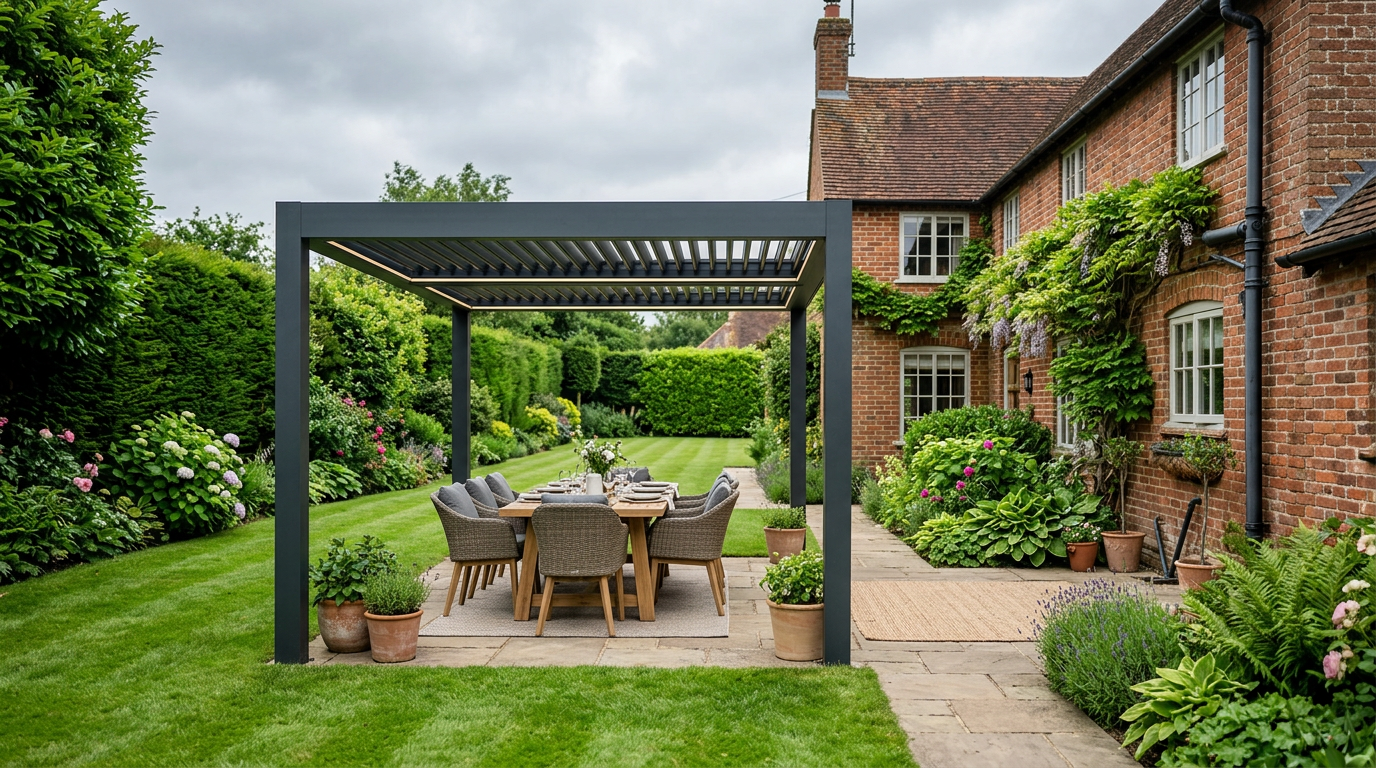
Most garden pergolas are between 2.3 m and 2.7 m to the top of the highest beam. If you position a 2.7 m pergola within 2 metres of your garden boundary, you are technically over the 2.5 m permitted development limit and would need planning permission.
The practical fix is simple: either choose a pergola that sits at or under 2.5 m, or position it more than 2 metres from any boundary. The Outsunny 3×4 m at 2.36 m and the PURPLE LEAF 3×3 m retractable at 2.30 m both come in comfortably under the boundary limit. The taller Palram Canopia Stockholm at 3.05 m needs to be more than 2 metres from any boundary.
When you DO need planning permission
Listed buildings
If your house is listed (Grade I, II* or II), you need listed building consent for any structure in the curtilage, regardless of size. This applies even to a small wooden pergola that would otherwise be permitted development. Contact your local conservation officer before buying anything.
Conservation areas, AONBs and National Parks
On "designated land" — conservation areas, Areas of Outstanding Natural Beauty, National Parks, the Broads and World Heritage Sites — permitted development rights are more restricted. You may still be able to build a pergola, but the rules on positioning and coverage are tighter. Check with your local planning authority before proceeding. The Planning Portal has a useful interactive tool for checking what applies to your property.
Flats and maisonettes
Permitted development rights for outbuildings only apply to houses, not flats or maisonettes. If you share a garden or have a ground-floor flat with a patio, you will likely need permission.
Condition on your planning permission
If your house was built recently or has had a major extension, the original planning permission may include a condition removing permitted development rights. Check your property's planning history on your council's website.
Scotland and Northern Ireland
Scotland has its own permitted development rules under the Town and Country Planning (General Permitted Development) (Scotland) Order 2011. The principles are similar — outbuildings to the rear, height limits near boundaries, coverage limits — but the specific numbers differ. Check with your local authority.
Northern Ireland uses the Planning (General Permitted Development) Order (Northern Ireland) 2015. Again, similar in principle but with different thresholds.
Do wall-mounted pergolas need permission?
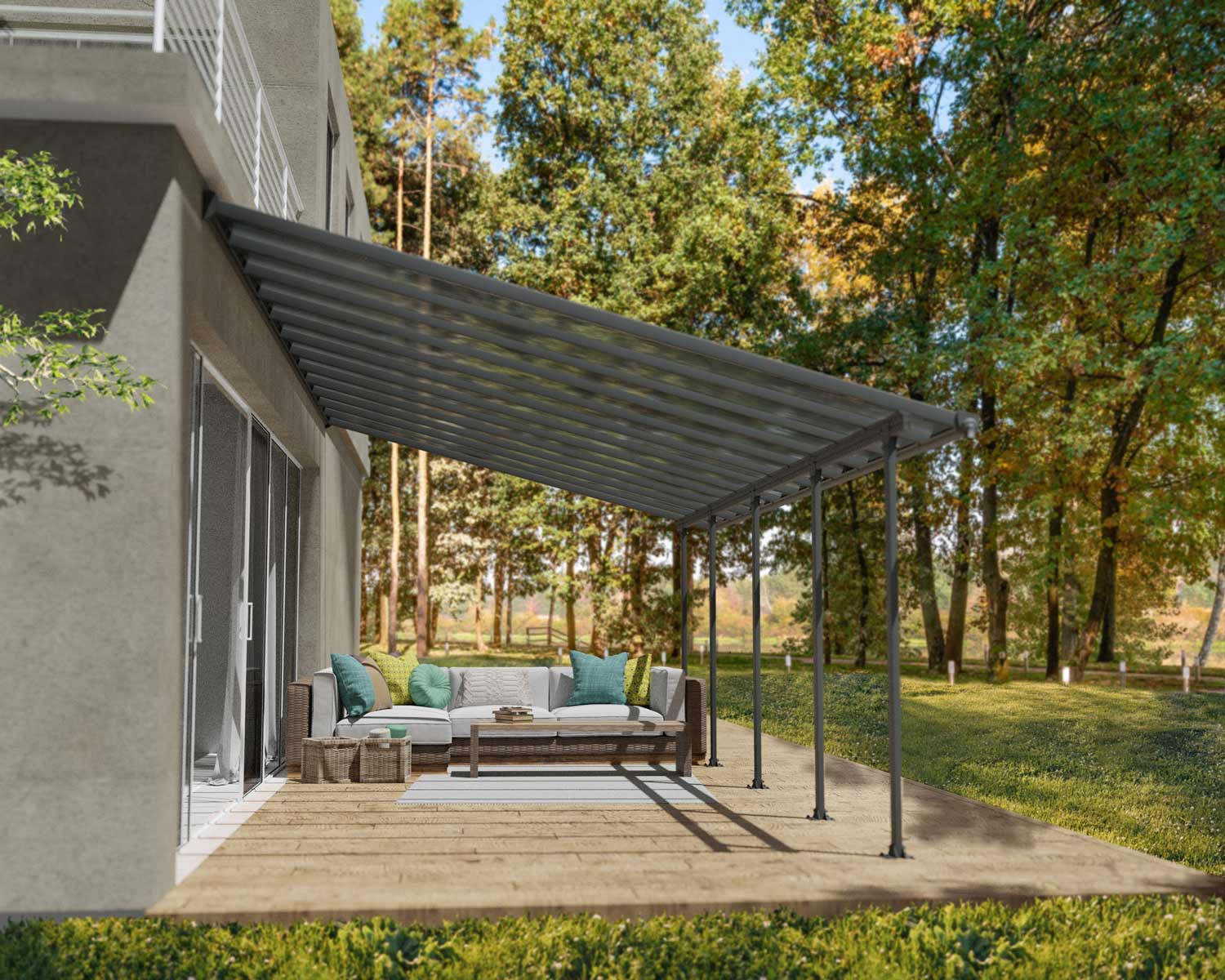
A lean-to pergola that fixes to the house wall — like the Outsunny wall-mounted lean-to — is still classed as an outbuilding under permitted development, provided it meets the same height, boundary and coverage rules. The key point is that it must not project above the eaves of the house. If it does, it could be reclassified as an extension, which has different and stricter rules.
What about building regulations?
Planning permission and building regulations are separate things. A small open-topped pergola does not normally need building regulations approval. However, a larger enclosed structure — particularly one with a solid roof, electrical wiring, glass walls or heating — may fall under building regulations for structural safety, electrical safety (Part P) and drainage.
A premium motorised pergola like the Veraforza Bioclimatic with integrated electrics, LED lighting and optional glass walls is exactly the type of structure where building regulations may apply. The supplier's installation team should handle this, but ask explicitly before signing.
The practical checklist
- Measure the distance from your planned position to the nearest boundary. If under 2 m, the pergola must not exceed 2.5 m in height.
- Check total outbuilding coverage. Add up the footprint of every shed, summerhouse, greenhouse and existing structure in the garden. The total including the pergola must not exceed 50% of the curtilage.
- Check whether your property is listed or in a designated area. Your local council website or the Planning Portal will tell you.
- Check your original planning permission for any conditions removing permitted development rights.
- If in any doubt, apply for a Lawful Development Certificate. This is not planning permission — it is a formal confirmation from the council that your proposed structure is permitted development. It costs around £103 in England and gives you a legally binding answer. Worth it for peace of mind, especially if you are spending £1,000+ on a pergola.
The verdict
For the vast majority of UK homeowners, a garden pergola does not need planning permission. Keep it under 2.5 m if it is near a boundary, do not put it in the front garden, and check for listed building or conservation area restrictions. If you are planning something larger or enclosed, a Lawful Development Certificate is the cheapest insurance you can buy.
Once you have confirmed you are clear to build, our guide to whether pergolas are worth it covers the costs, the types and the models that work best for UK gardens. And if you are torn between a pergola and a simpler gazebo, our pergola vs gazebo comparison lays out the trade-offs.